La Revue Blanche
Original title: La Revue Blanche
kurzbeschreibung
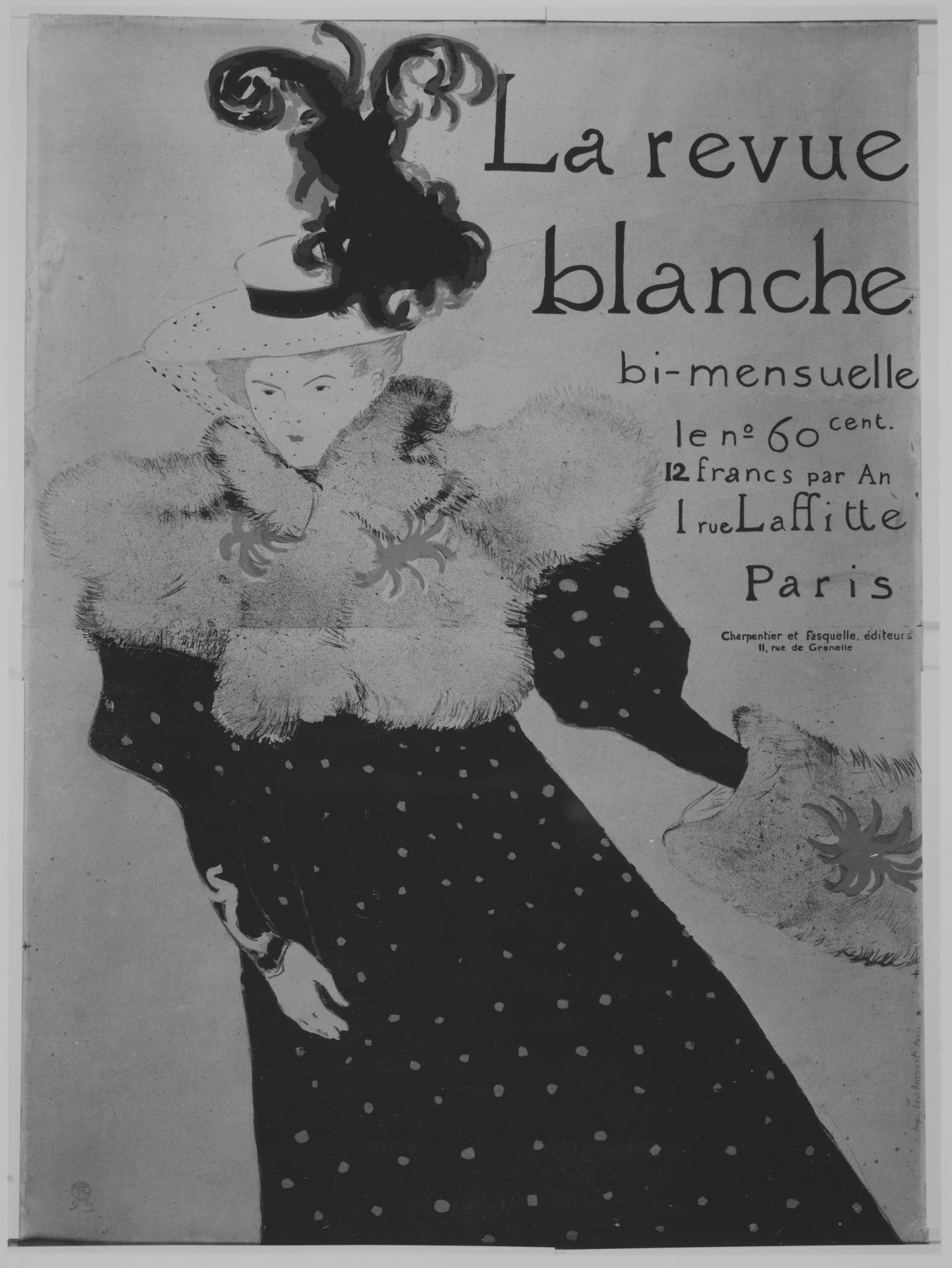
In 1895, Henri de Toulouse-Lautrec designed this four-color lithograph on machine-made wove paper as an advertisement for the journal 'La Revue Blanche'. A fashionably dressed woman looks directly at the viewer, surrounded by text.
Description
A woman in a long, dotted dress, a fur cape, and a hat with lavish feather trim dominates the image. She stands centrally, facing forward; her face is highly simplified and lacks personal features. At the top, large letters proclaim 'La revue blanche', with the price and Paris address below. Black and white define the palette, as was typical for lithographs, and the clear contours point to Art Nouveau.
Context
The poster was commissioned by the magazine 'La Revue Blanche', founded in 1889, which served as a major platform for avant-garde literature and art. Toulouse-Lautrec was known in the 1890s for his poster art, capturing Parisian nightlife and its characters. The woman depicted is often linked to the dancer Misia Natanson, wife of a co-founder, though this is not securely documented. This print belongs to a series of posters promoting the magazine and underscoring its artistic ambitions.
Impact
The frontal orientation and few colors give the poster a forceful presence that immediately engages the viewer. The stylized elegance of the figure and the clear typography feel calm yet memorable, characteristic of poster art around 1900.
Technique
The print was executed as a four-color lithograph on machine-made wove paper, a process Toulouse-Lautrec often chose for posters. Lithography allowed him to produce large editions with fine lines and flat areas of color, though here the restriction to black and white stands out. At approximately 125 × 90 cm, it matches the format of a street poster intended for public display.
AI-generated description text
Source: Metropolitan Museum of Art · Public Domain (CC0 1.0)