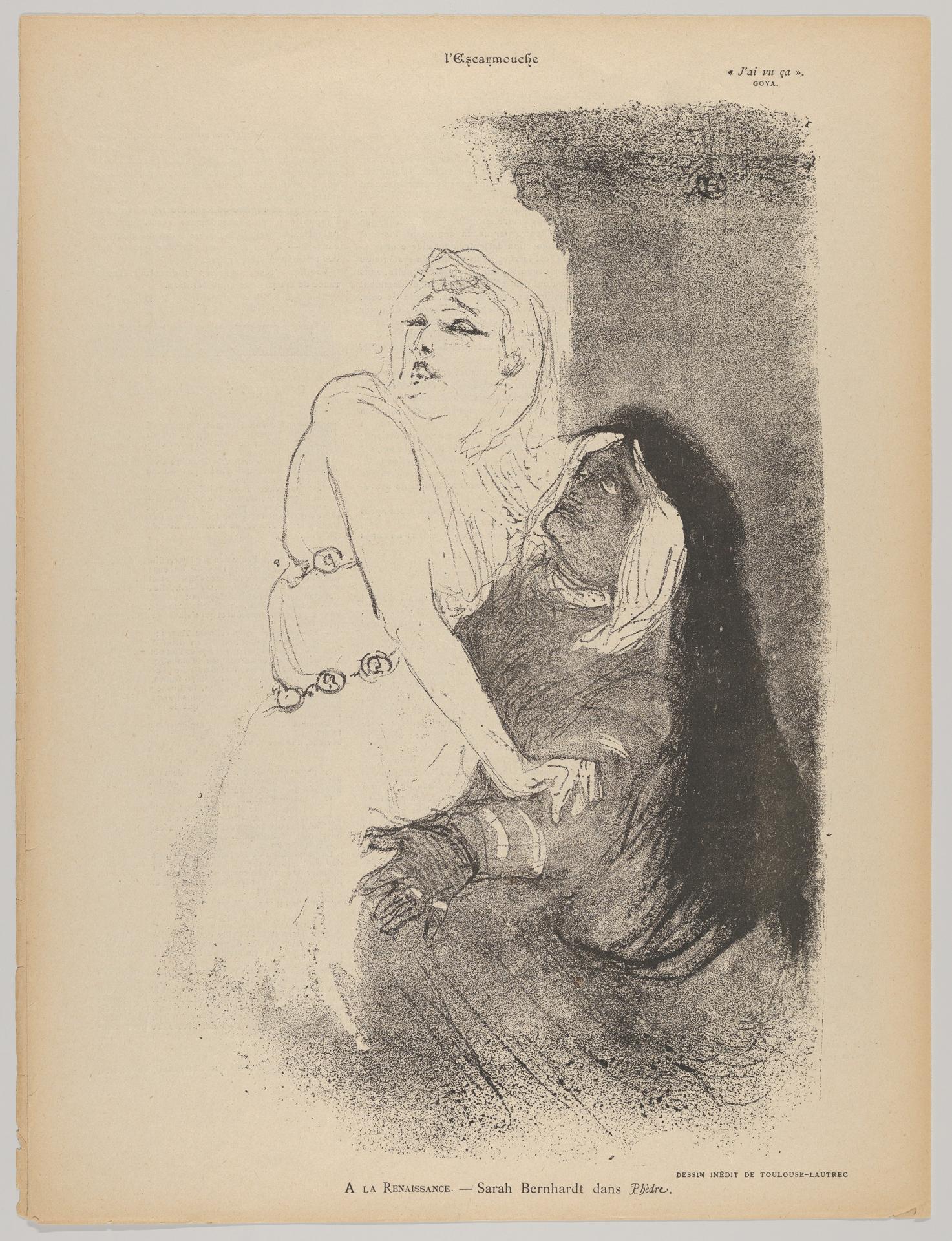
At the Théâtre de la Renaissance: Sarah Bernhardt in Phèdre (1893, Met-Objekt 854)
Original title: At the Théâtre de la Renaissance: Sarah Bernhardt in Phèdre
kurzbeschreibung
Sarah Bernhardt appears as the title character in Racine's tragedy Phèdre. Henri de Toulouse-Lautrec made the original lithograph in 1893; this sheet is a photomechanical reproduction on machine wove paper.
Description
Caught in a dramatic moment, Sarah Bernhardt throws back her head and spreads her arms, her expression tense and charged with emotion. To her right, a second figure kneels, head bowed, arms crossed over the chest. Both wear dark garments; the background stays plain and gloomy. The lithograph is monochrome in shades of gray, with an asymmetrical layout that places Bernhardt at the center. At the top one reads the title 'L'Escarbouche', at the bottom the note 'A la Renaissance - Sarah Bernhardt dans Phèdre'.
Context
In 1893 Toulouse-Lautrec created this sheet as publicity graphics for the Théâtre de la Renaissance in Paris, where Sarah Bernhardt was performing Phèdre. It belongs to a series of lithographs the artist made for her appearances. The photomechanical reproduction circulated as a single-sheet print, likely sold at the theater or included as a program insert.
Impact
The dark, monochrome treatment and Bernhardt's expressive posture evoke a somber, almost ominous mood. The spare arrangement immediately draws the eye to the main figure's dramatic gesture and heightens the emotional force of the moment.
Technique
This sheet is a photomechanical reproduction of a lithograph, printed on machine wove paper. The lithograph was probably drawn with ink on stone and then reproduced photomechanically, which preserved fine gray tones and textures. It is the only state of this reproduction.
AI-generated description text
Source: Metropolitan Museum of Art · Public Domain (CC0 1.0)