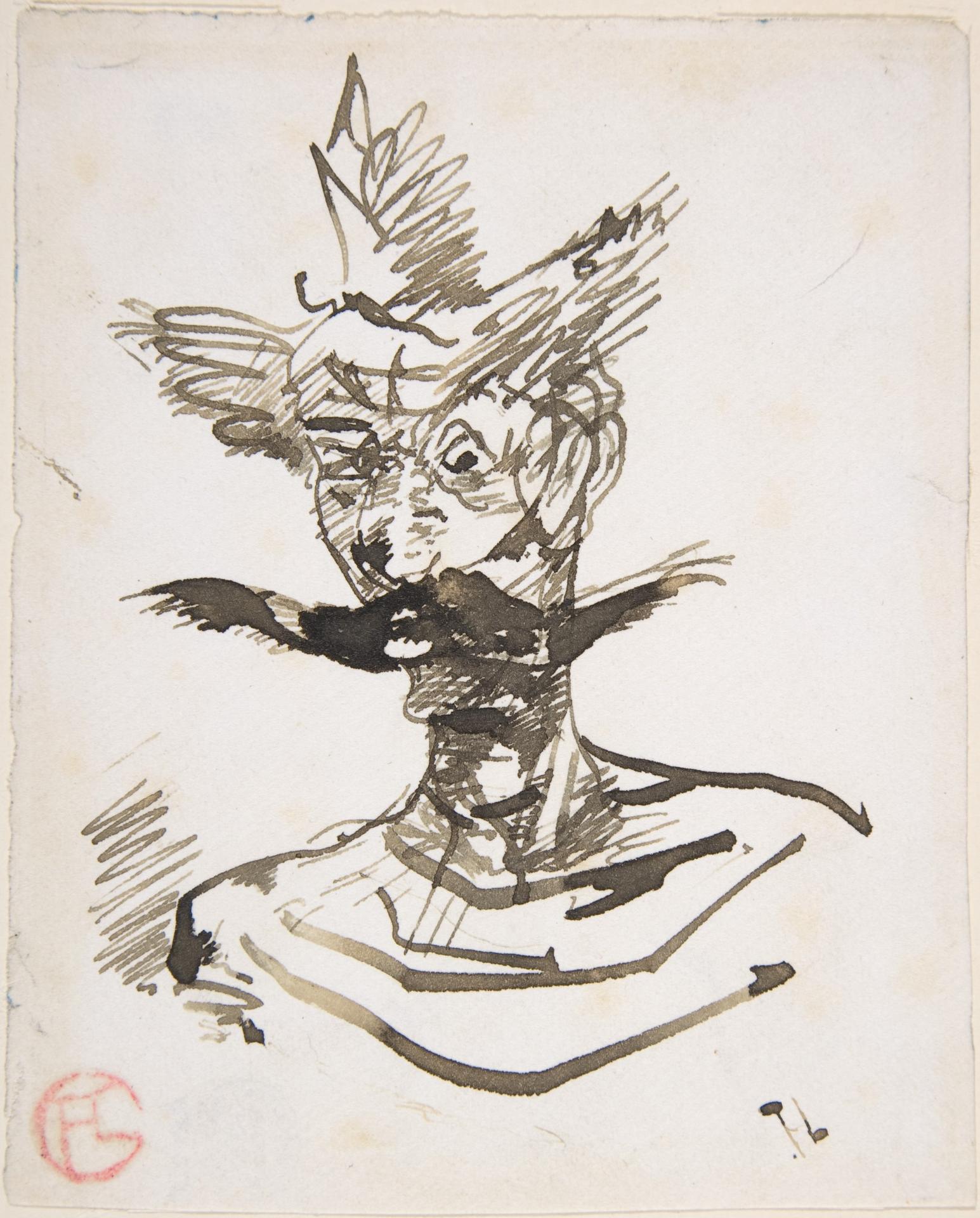
The Clown: M. Joret
Original title: The Clown: M. Joret
kurzbeschreibung
Henri de Toulouse-Lautrec drew 'Der Clown: M. Joret' in 1885 with pen and black ink that has since faded to brown. The image shows the bust of a clown with striking hair and a dark top; the linework is expressive and sets bold contours.
Description
A clown fills the picture surface as the central figure, his head dominating the foreground. Hair sticks out like a feather duster. The facial expression seems sullen or brooding; emphatic lines and hatching bring out the structure of face and clothing. The top appears dark, the background remains empty. Black and brown tones define the impression, with the brownish values resulting from the darkened ink.
Context
Toulouse-Lautrec made this drawing in 1885, when he was deeply engaged with Parisian nightlife and its players—artists and entertainers. The sheet measures only about 12.7 x 10.2 cm and belongs to a group of portrait studies he often executed from memory or after preparatory sketches. Nothing further is known about M. Joret, which fits Lautrec's fondness for anonymous or unknown figures of the entertainment scene.
Impact
Immediate and almost sketch-like, the sheet stands out and directs the gaze at once to the clown's facial expression. The sparing means—line and shading—create an intimate, insistent mood, as if it were a fleeting moment. The brownish tone gives the work an unobtrusive historical note.
Technique
The drawing is executed with pen and black ink that has turned brown over time. The lines are precise and energetic; parallel hatching models volume and shadow. The small format suggests a quick, spontaneous notation, typical of Lautrec's drawn studies.
AI-generated description text
Source: Metropolitan Museum of Art · Public Domain (CC0 1.0)