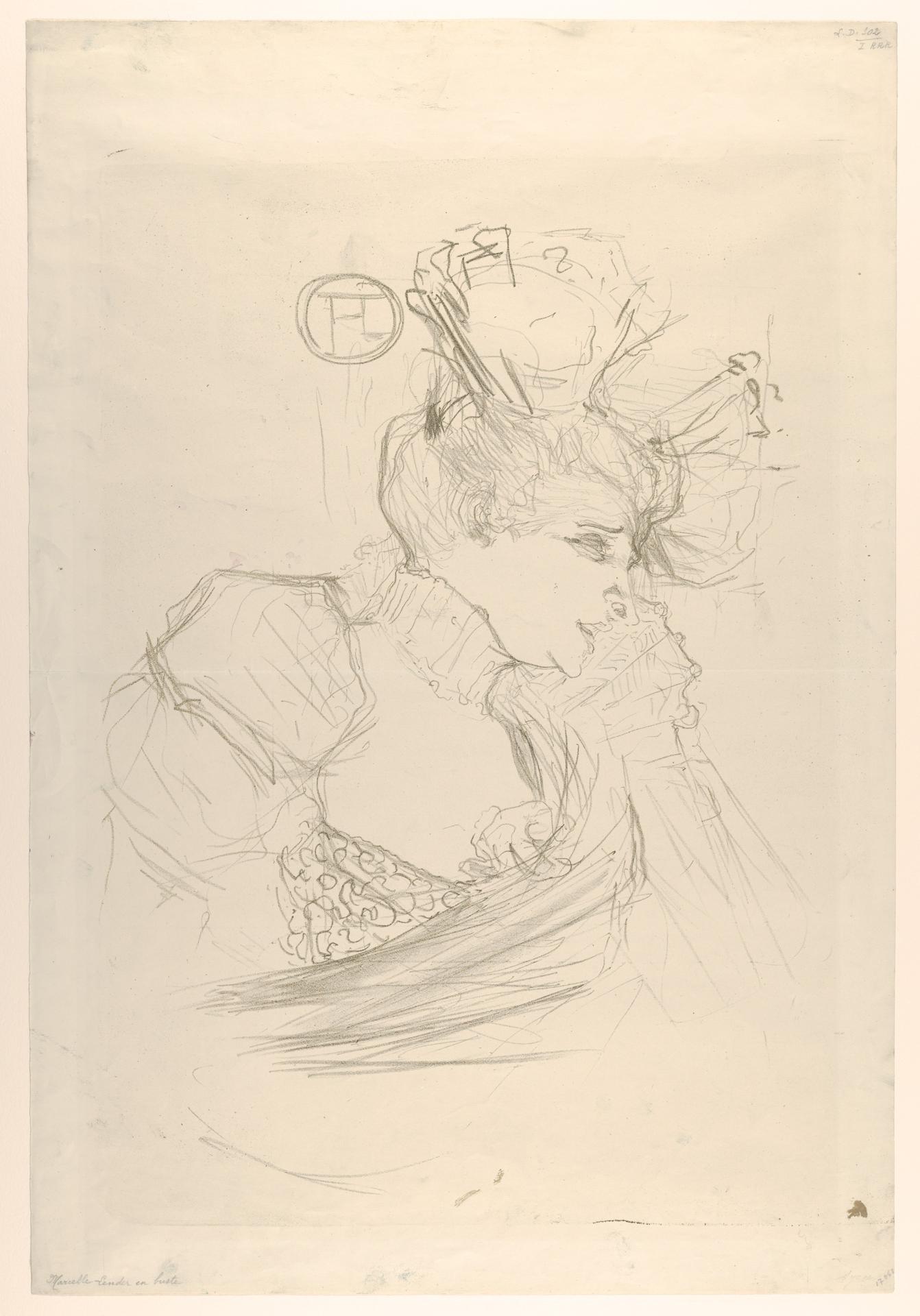
Portrait Bust of Mademoiselle Marcelle Lender (1895, Met-Objekt 849)
Original title: Portrait Bust of Mademoiselle Marcelle Lender
kurzbeschreibung
In 1895, Henri de Toulouse-Lautrec created the "Portrait Bust of Mademoiselle Marcelle Lender," which shows the dancer in a half-reclining pose. The print is an eight-color lithograph using crayon, brush, and spatter techniques; it is the fourth state of four and a rare trial proof for the journal Pan.
Description
A young woman appears with curly, intricately braided hair adorned with flowers. Her dress features a striking floral pattern at the waist. Gazing to the right, her expression seems pensive. The background consists of stylized, abstract geometric shapes and lines, along with a small circular symbol in the upper left. Realistic traits combine with a decorative, flat treatment.
Context
Marcelle Lender was a well-known Belle Époque dancer and singer who often performed in variety theaters. Toulouse-Lautrec portrayed her in 1895, when he was deeply engaged with the world of theater and entertainment. The print was made as a lithograph for the art journal Pan, founded in Berlin in 1895, which promoted avant-garde art. The fourth state is a rare trial proof that was used for the planned Pan edition.
Impact
Realistic representation and abstract background elements enter into a tense, modern relationship. The decorative details and the color-intensive lithograph give the portrait a lively, almost poster-like presence. The sitter's pensive demeanor invites an intimate encounter.
Technique
Lithography was used for this print, printed in eight colors with crayon, brush, and spatter techniques. This combination allows fine lines, soft transitions, and vibrant areas of color. The fourth state of the print is a rare variant intended for the Pan edition.
AI-generated description text
Source: Metropolitan Museum of Art · Public Domain (CC0 1.0)