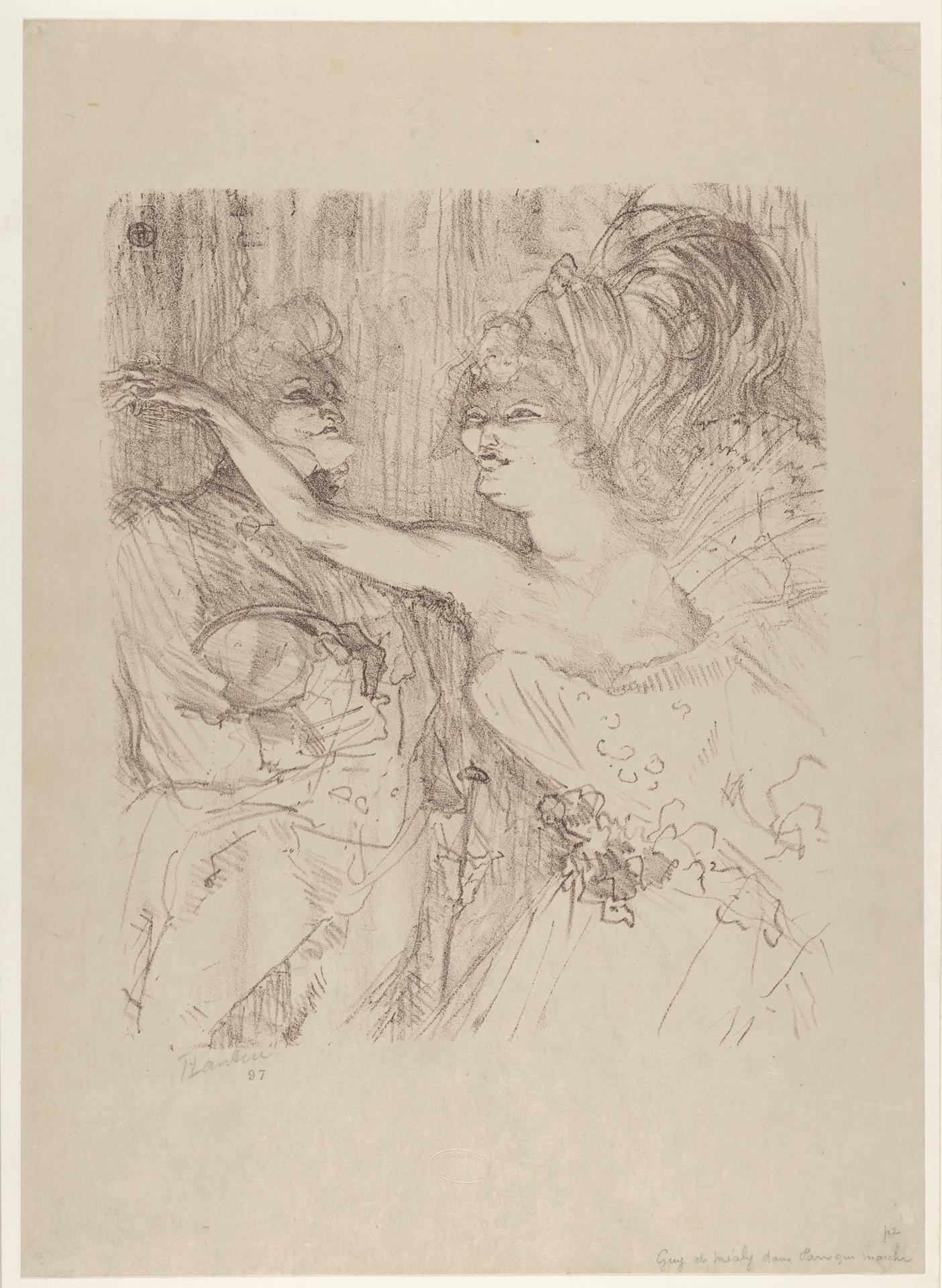
Guy and Mealy, in Paris Qui Marche
Original title: Guy and Mealy, in Paris Qui Marche
kurzbeschreibung
Henri de Toulouse-Lautrec made the lithograph Guy und Mealy, in Paris qui marche in 1898. It presents two figures indoors, most likely in a salon or a dance venue. The print was pulled in dark violet on japan paper. The subject belongs to a series of works capturing Parisian nightlife.
Description
Two figures occupy a room that suggests a salon or dance hall. On the left stands someone in a tight dark dress and a tall, striking hat trimmed with a feather. To the right is a person in a long, elegant gown, head covered by a veil or floral headpiece. The two appear to interact; the figure on the left makes a gestural movement. The setting stays plain, revealing only a hint of curtain or wall decoration.
Context
The lithograph dates from 1898, when Toulouse-Lautrec frequented Parisian entertainment spots such as cabarets and salons, drawing the audiences he found there. Guy and Mealy probably refers to an artist or performer duo active on the Parisian entertainment circuit. The sheet belongs to a group of lithographs that catch the daily life and mood of the Belle Époque.
Impact
Muted grays and the violet give the image a quiet yet dense atmosphere. The slightly grotesque features of the left figure and the pensive bearing of the right create a tension that feels almost symbolist.
Technique
This is a crayon lithograph, pulled in dark violet on japan paper. Delicate lines and shading are characteristic of the process and lend the figures physical presence.
AI-generated description text
Source: Metropolitan Museum of Art · Public Domain (CC0 1.0)