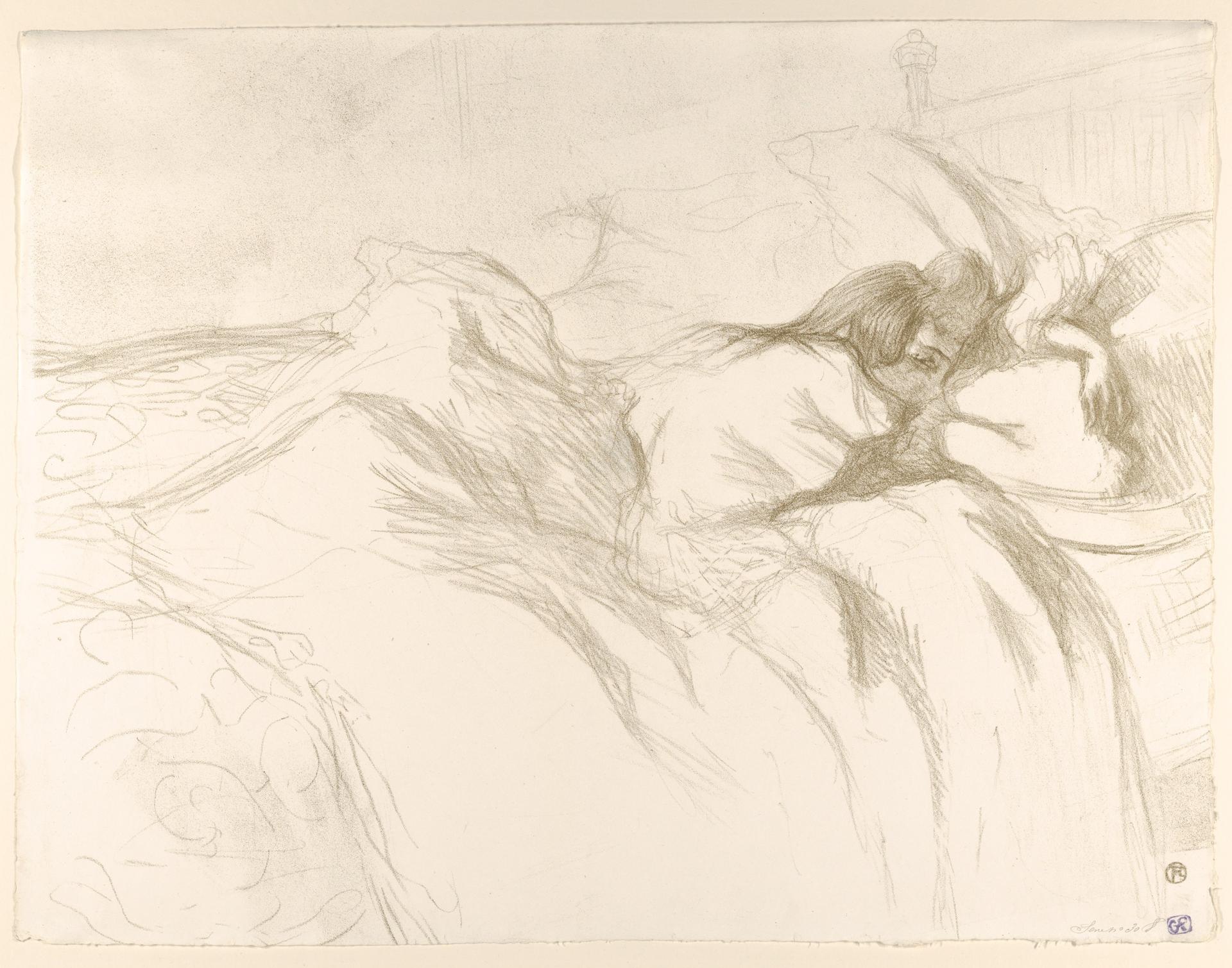
Waking Up, from "Elles" (1896, Met-Objekt 819)
Original title: Waking Up, from "Elles"
kurzbeschreibung
A woman stretches in bed, arms raised above her head — that is the subject of Henri de Toulouse-Lautrec's 'Aufwachen' (Waking Up) from 1896. Executed as a crayon lithograph with scraper technique, printed in olive-gray on wove paper, the sheet belongs to the series 'Elles', which captures scenes from the daily lives of women in brothels.
Description
With arms lifted, the woman lies on the bed and stretches as she wakes from sleep. Her hair falls loosely around her face. Behind her, only vague hints of a window or room partitions can be made out. Gray tones dominate the image; hatching and lines shape body and materiality. The quiet gray tonality gives the view a calm, peaceful mood.
Context
In 1896, the series 'Elles' was created, offering insights into the lives of prostitutes in Parisian brothels — a milieu Toulouse-Lautrec knew firsthand. The lithographs were published in an edition of 100 and aimed at a bourgeois audience with an interest in the 'demi-monde'. The perspective is unusually empathetic: the women appear in intimate, everyday moments, without a voyeuristic note.
Impact
The calm arrangement and soft gray tones create a mood that feels at once close and distant. Nothing in this scene seems staged — the viewer gains an immediate glimpse into a private moment. The fine hatching lends the sheet a sketch-like elegance characteristic of Toulouse-Lautrec's late printmaking.
Technique
For this crayon lithograph, the artist drew directly on the stone with greasy crayon. He then removed color in places with a scraper to bring out highlights and thin lines. Printing was done in olive-gray on wove paper, giving the sheet a matte, tonal effect.
AI-generated description text
Source: Metropolitan Museum of Art · Public Domain (CC0 1.0)