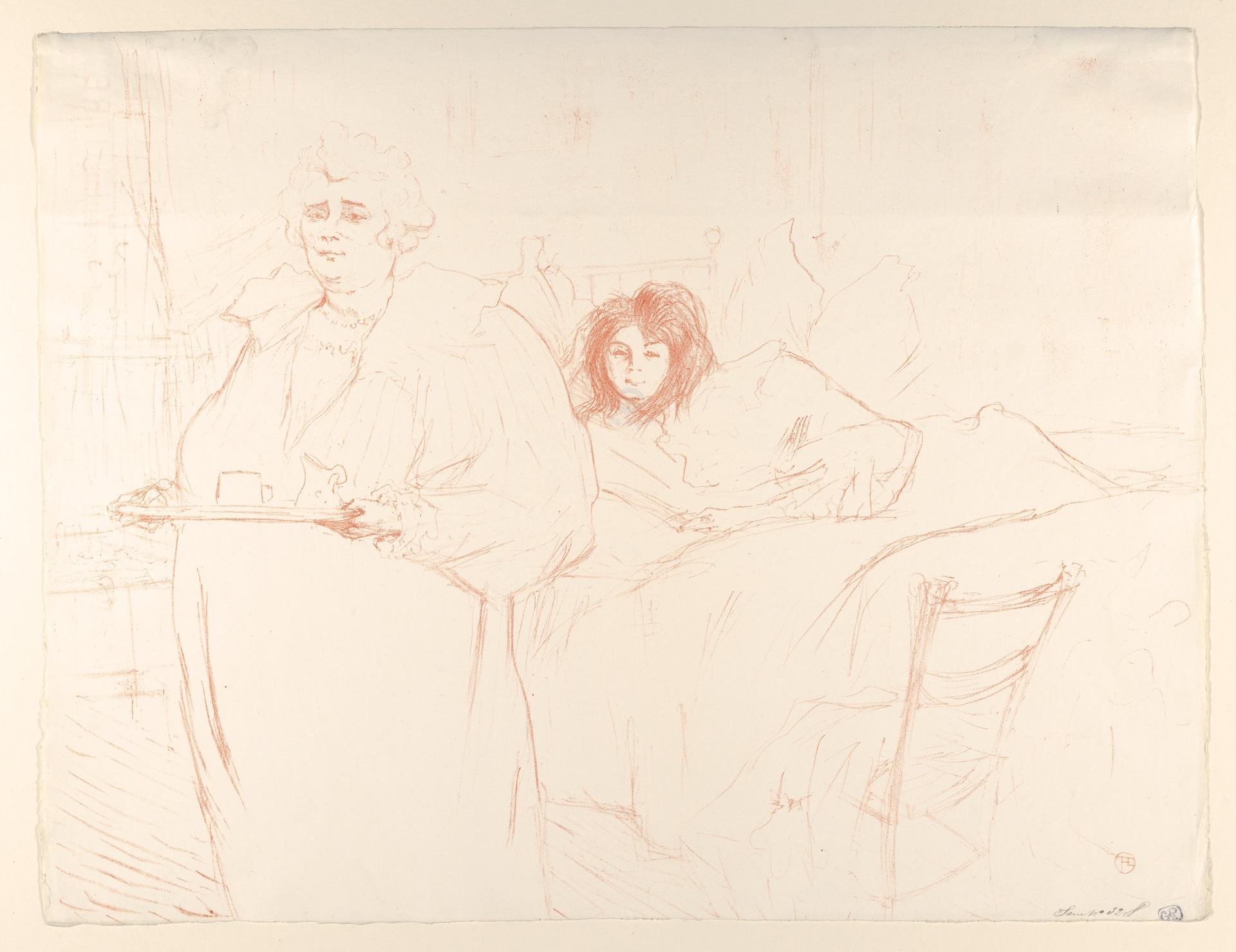
Serving Breakfast (Madame Baron and Mademoiselle Popo), from "Elles" (1896, Met-Objekt 818)
Original title: Serving Breakfast (Madame Baron and Mademoiselle Popo), from "Elles"
kurzbeschreibung
Henri de Toulouse-Lautrec made this crayon lithograph in 1896, titled Serving Breakfast (Madame Baron and Mademoiselle Popo). Two women share a quiet domestic moment: one reclines while the other brings her a tray of breakfast. The print was drawn with crayon, worked over with a scraper, and pulled in sanguine ink on wove paper.
Description
Warm red covers everything, so the eye settles at once into an even, glowing tonality. Two clothed figures face each other in an interior: a dark-haired woman in a dress rests on a bed, while a second woman, cropped and curly-haired, carries in a breakfast tray. Light spreads without hard shadows or sharp contrasts. Soft contours and loosely handled bodies give the image a realist grounding with impressionist ease.
Context
This 1896 lithograph belongs to the series Elles, in which Toulouse-Lautrec portrayed the lives of prostitutes in Parisian brothels. Everyday scenes dominate, shaped by intimacy and routine. The two women shown, Madame Baron and Mademoiselle Popo, are known as real figures from that milieu. The series was issued in an edition of 100 and stands among the high points of late nineteenth-century lithography.
Impact
The plain, unhurried action gives off a familiar, unagitated mood. Warm red deepens the intimacy without dissolving the viewer's distance. A pared-down arrangement draws attention to how the two women relate, lending the sheet a quiet, almost documentary note.
Technique
The artist used crayon lithography with scraper work: a scraper was applied to the stone to set bright accents. Printing in sanguine, a red ink, on wove paper allowed fine tonal gradations and a soft, painterly effect.
AI-generated description text
Source: Metropolitan Museum of Art · Public Domain (CC0 1.0)