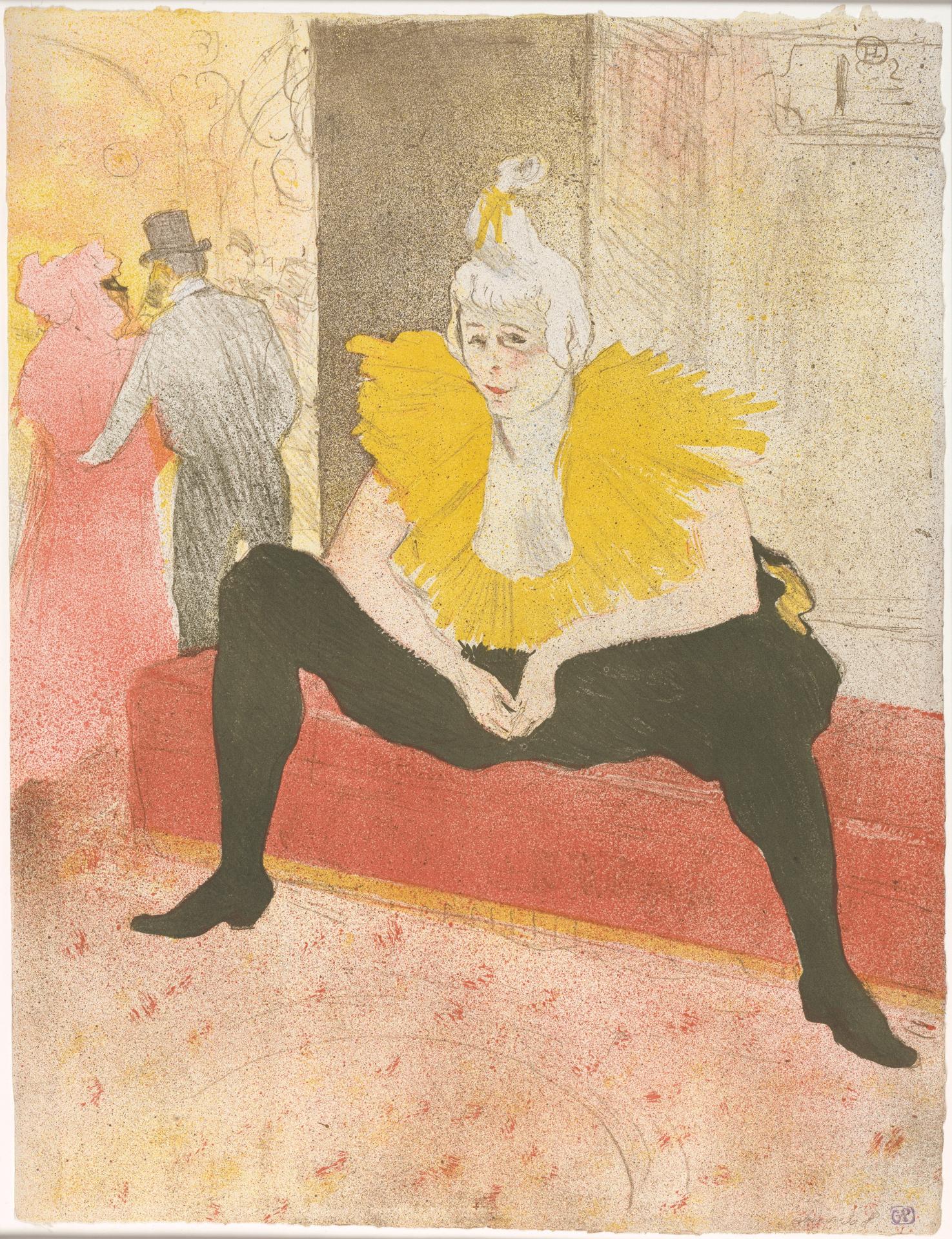
The Seated Clowness (Mademoiselle Cha-u-ka-o), from "Elles" (1896, Met-Objekt 817)
Original title: The Seated Clowness (Mademoiselle Cha-u-ka-o), from "Elles"
kurzbeschreibung
Henri de Toulouse-Lautrec's color lithograph "The Seated Clowness (Mademoiselle Cha-u-ka-o)" dates from 1896 and belongs to the portfolio "Elles." It captures a clowness in a theater interior, one of several scenes from Parisian nightlife gathered in the series.
Description
The clowness squats wide-legged on a stool. She wears a white wig with a yellow bow, a yellow collar, and black stockings; her gaze meets the viewer head-on. Behind her, two figures converse—one in a red coat and pink hat, the other in a gray suit and top hat. Curtains and stage light indicate the theater setting. Red, yellow, and gray dominate the warm palette, interspersed with bluish shadows.
Context
The 1896 portfolio "Elles" is devoted to the lives of prostitutes and female performers in Parisian brothels and theaters. The sitter is Mademoiselle Cha-u-ka-o, a well-known clown from circus and music hall. In those years, lithography gained importance as an artistic medium, and Toulouse-Lautrec regularly designed posters and prints for Parisian venues.
Impact
The clowness's direct gaze and open posture give the image an immediacy and self-assurance. Warm tones and flowing lines create a lively, almost intimate mood that draws the viewer into the scene.
Technique
The print was executed as a five-color lithograph, using crayon, brush, and spatter techniques along with scraper marks. It was printed on wove paper bearing the watermark "G. Pellet / T. Lautrec." Only one state is recorded (only state).
AI-generated description text
Source: Metropolitan Museum of Art · Public Domain (CC0 1.0)