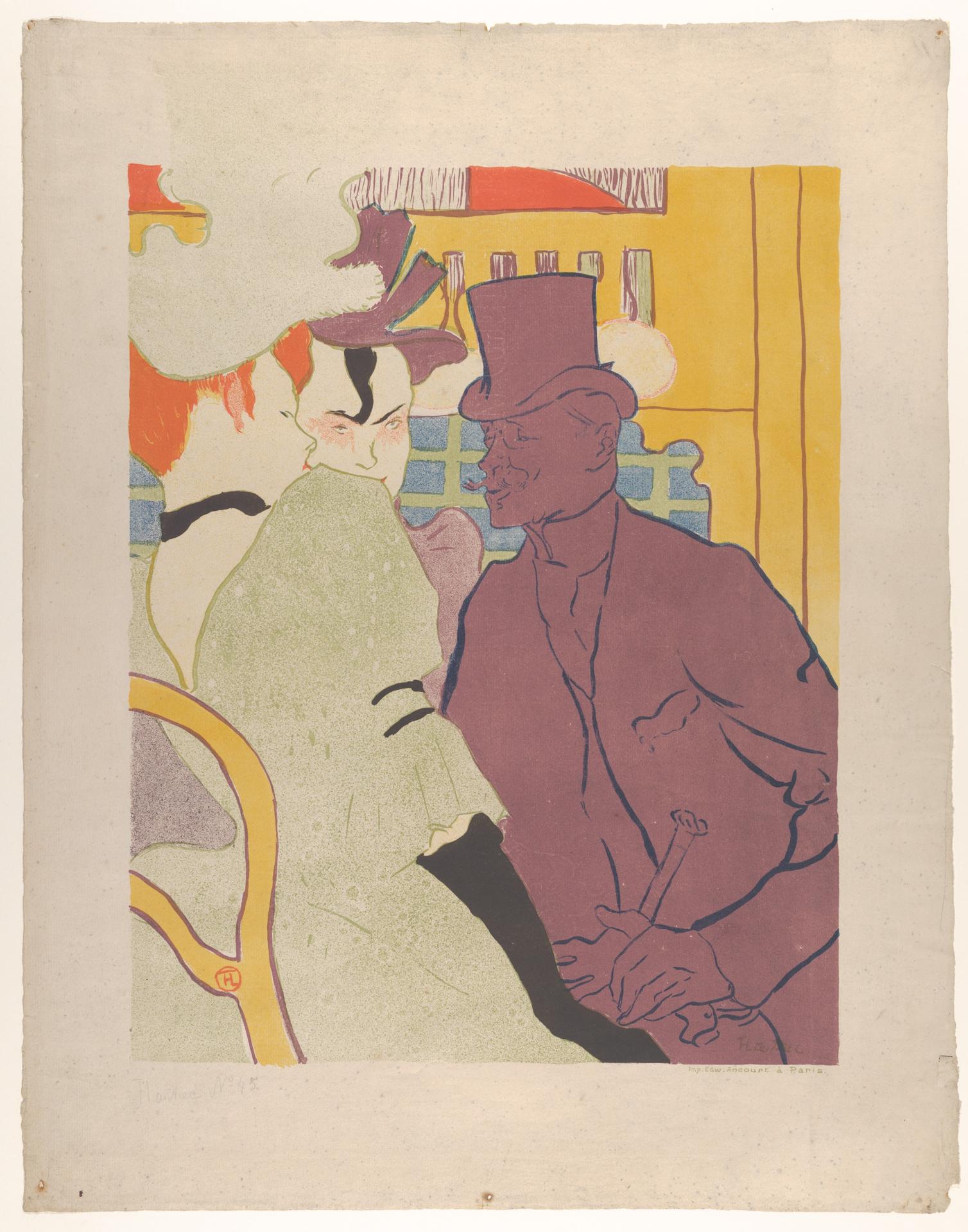
The Englishman at the Moulin Rouge (1892, Met-Objekt 812)
Original title: The Englishman at the Moulin Rouge
kurzbeschreibung
Henri de Toulouse-Lautrec created the lithograph 'Der Engländer im Moulin Rouge' in 1892. It shows a woman in vivid green beside a smoking man in deep red against a stylized backdrop. Printed in six colors on laid paper, the sheet is the second state of two.
Description
On the left, a woman in a light green dress and dark hat leans slightly to one side, her expression pensive or worried. To the right stands a man in a dark red suit with a matching hat, a cigar in his mouth, smiling. Abstract shapes in yellow and red form the background, suggesting a theater or dance bar. Bold, contrasting colors and clear lines stand out. The asymmetrical arrangement pushes the two figures forward, while the background acts as a frame.
Context
In 1892, Toulouse-Lautrec was a regular in Parisian nightlife at the Moulin Rouge, where he sketched numerous scenes. The 'Englishman' was likely a well-known patron of the establishment, though his identity remains unclear. This lithograph belonged to a series of posters and prints promoting the Moulin Rouge. Toulouse-Lautrec used the new color printing technique to capture the venue's atmosphere.
Impact
The strong colors and reduced yet precise linework create an immediate, poster-like impact that draws the viewer into the scene. The slight tilt of the figures and their differing expressions generate a subtle tension, capturing the fleeting, observant moment of nightlife.
Technique
This is a lithograph printed in six colors on laid paper. Stone printing allowed Toulouse-Lautrec to combine bold, opaque layers of color while retaining fine lines. The second edition differs slightly from the first, typical of printing techniques of the time.
AI-generated description text
Source: Metropolitan Museum of Art · Public Domain (CC0 1.0)