Ambassadeurs: Aristide Bruant
Original title: Ambassadeurs: Aristide Bruant
kurzbeschreibung
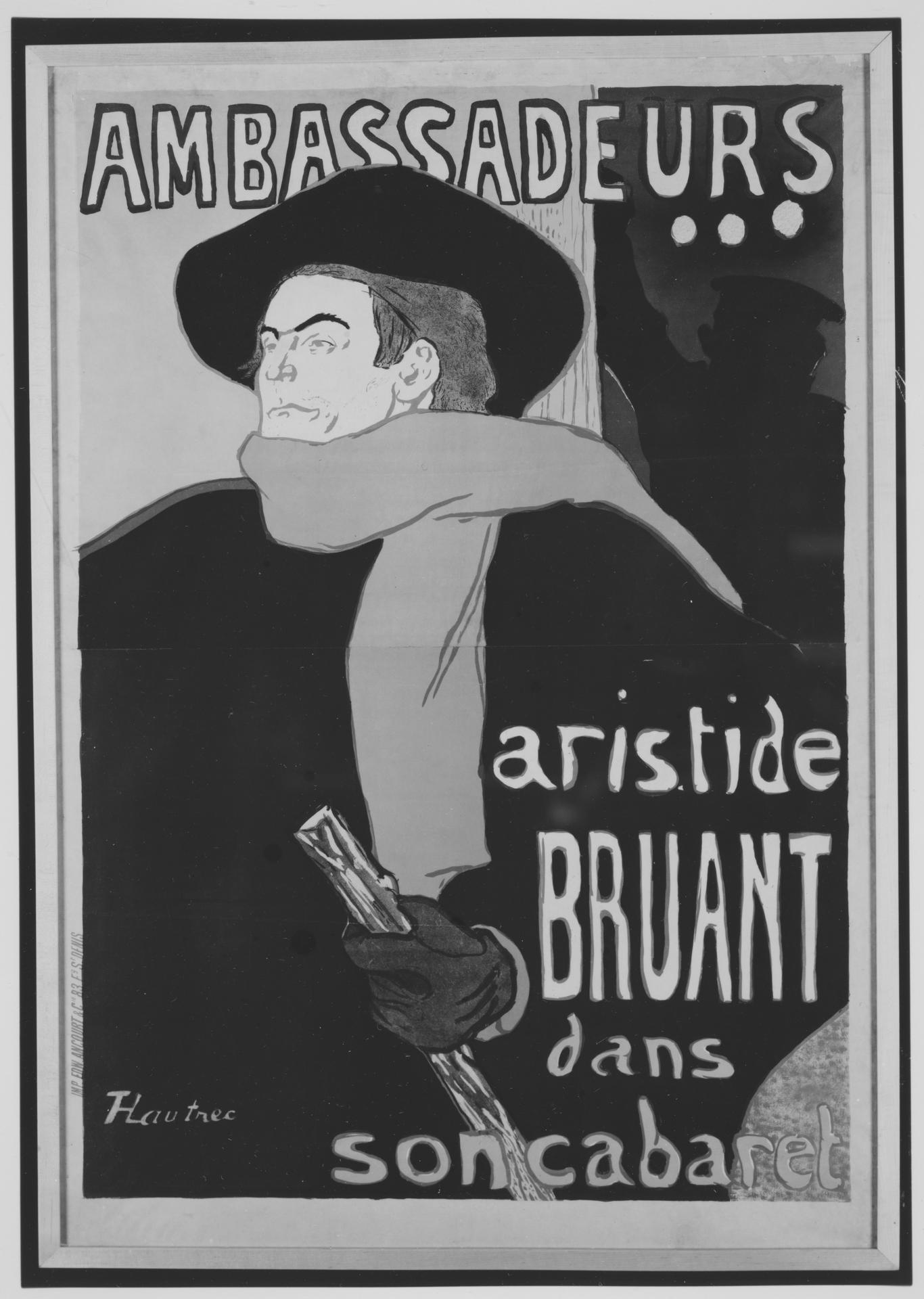
Henri de Toulouse-Lautrec made this five-color lithograph, Ambassadeurs: Aristide Bruant, in 1892 on wove paper. It captures the chansonnier Aristide Bruant during a performance in his cabaret and serves as an advertisement for a show at the Paris venue Les Ambassadeurs.
Description
A man in a black hat and scarf holds a sheet of paper; his expression is serious and pensive. This central figure, Aristide Bruant, dominates the sheet. Across the top, large white letters form the title. Behind the figure, a dim room opens up with a door and a faintly lit window. In the lower right, the name 'Flaunec' appears in small type, while at the bottom the words 'Aristide Bruant dans son cabaret' stand in large white letters. The layout focuses entirely on the person, leaving the background sparse.
Context
Aristide Bruant was one of the well-known chansonniers and cabaret owners in 1890s Paris; he performed at the Mirliton and the Ambassadeurs. Toulouse-Lautrec, a regular at Parisian entertainment spots, designed the poster for a guest appearance by Bruant at the Ambassadeurs on the Boulevard des Capucines. At the time, color lithography was gaining importance as an advertising medium, and artists like Lautrec elevated the poster into an independent art form.
Impact
The limited palette and Bruant's forceful presence give the sheet a direct, almost iconic impact. His serious gaze and the dark surroundings create an intimate, slightly wistful mood that emphasizes Bruant's stage persona.
Technique
The lithograph was printed in five colors on wove paper, as can be seen in the various shades in the figure and lettering. Color lithography allowed Lautrec to use flat areas of color and bold contours without relying on fine gradations.
AI-generated description text
Source: Metropolitan Museum of Art · Public Domain (CC0 1.0)