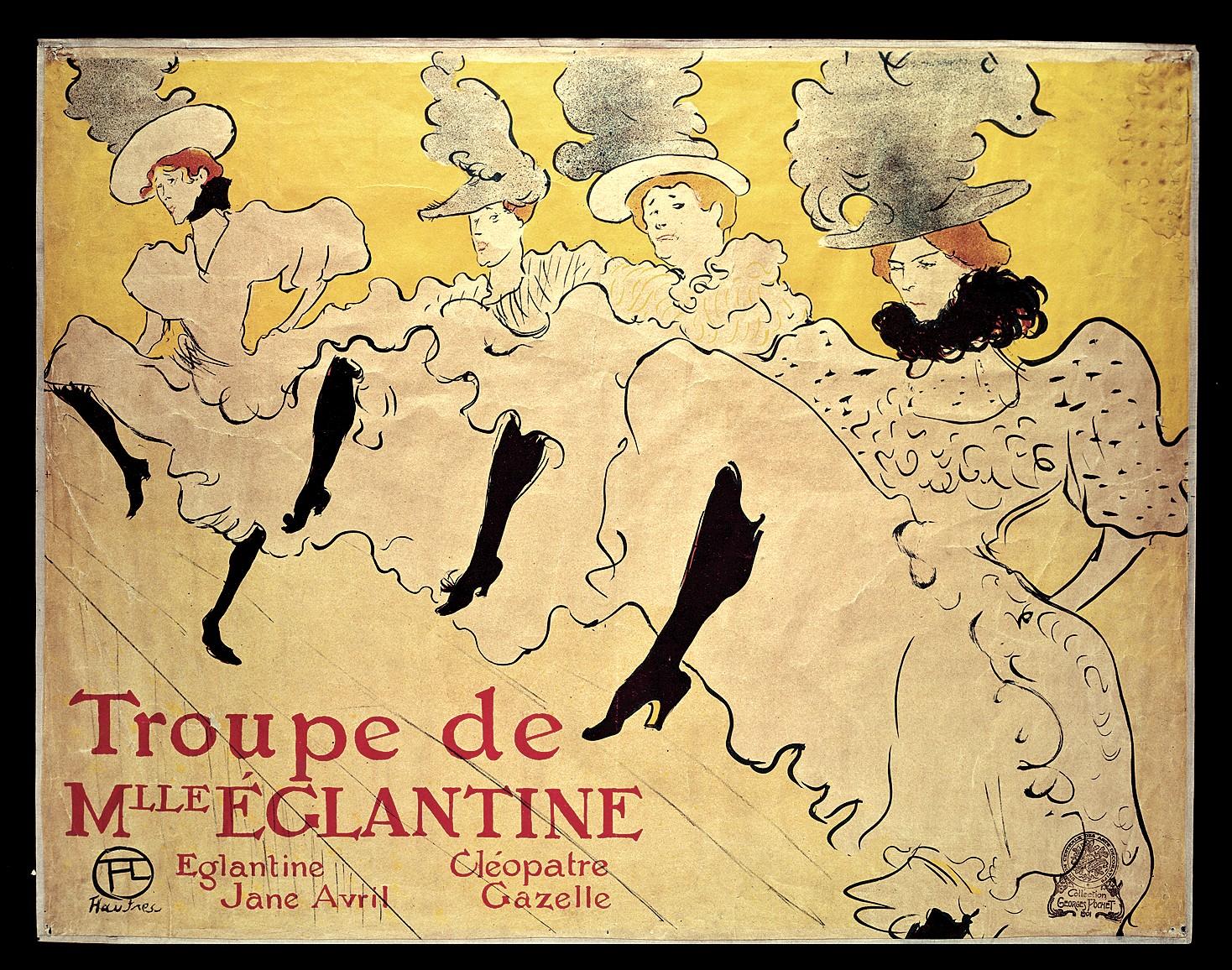
La Troupe de Mademoiselle Eglantine
Original title: La Troupe de Mademoiselle Eglantine
kurzbeschreibung
Henri de Toulouse-Lautrec created the lithograph "The Troupe of Mademoiselle Églantine" in 1895. It shows four dancers in historical costumes. The sheet measures 62.1 x 80 cm and was printed in three colors on machine-made wove paper.
Description
Four female figures line up horizontally, each caught in a lively pose. Large hats and flowing, long-sleeved dresses are drawn with expressive, fluid lines. Warm yellows and beiges dominate the palette, while black contours add sharp accents. Along the bottom edge appear the names Églantine, Jane Avril, Cléopâtre, and Gazelle. The rightmost figure extends furthest to the right, emphasizing the stretched arrangement.
Context
This lithograph emerged in 1895, during a period of intense engagement with Parisian nightlife. It refers to the revue "La Troupe de Mademoiselle Églantine," which played at a Parisian variety theater. The dancers depicted were well-known figures of the Belle Époque and appear in other works by the artist. The piece was printed in an edition and produced for sale to art collectors.
Impact
The viewer's eye is immediately drawn to the movement and lightness of the figures, created by flowing lines and warm colors. The dynamic poses convey the spirit of the Belle Époque. Because only a few colors are used, the print has a graphic clarity, and the silhouettes stand out distinctly.
Technique
The three-color stone print required a separate printing pass for each color. Machine-made wove paper served as the support; its smooth surface allowed fine lines. Black contours shape the figures, while yellow and beige areas form the costumes and backgrounds.
AI-generated description text
Source: Metropolitan Museum of Art · Public Domain (CC0 1.0)