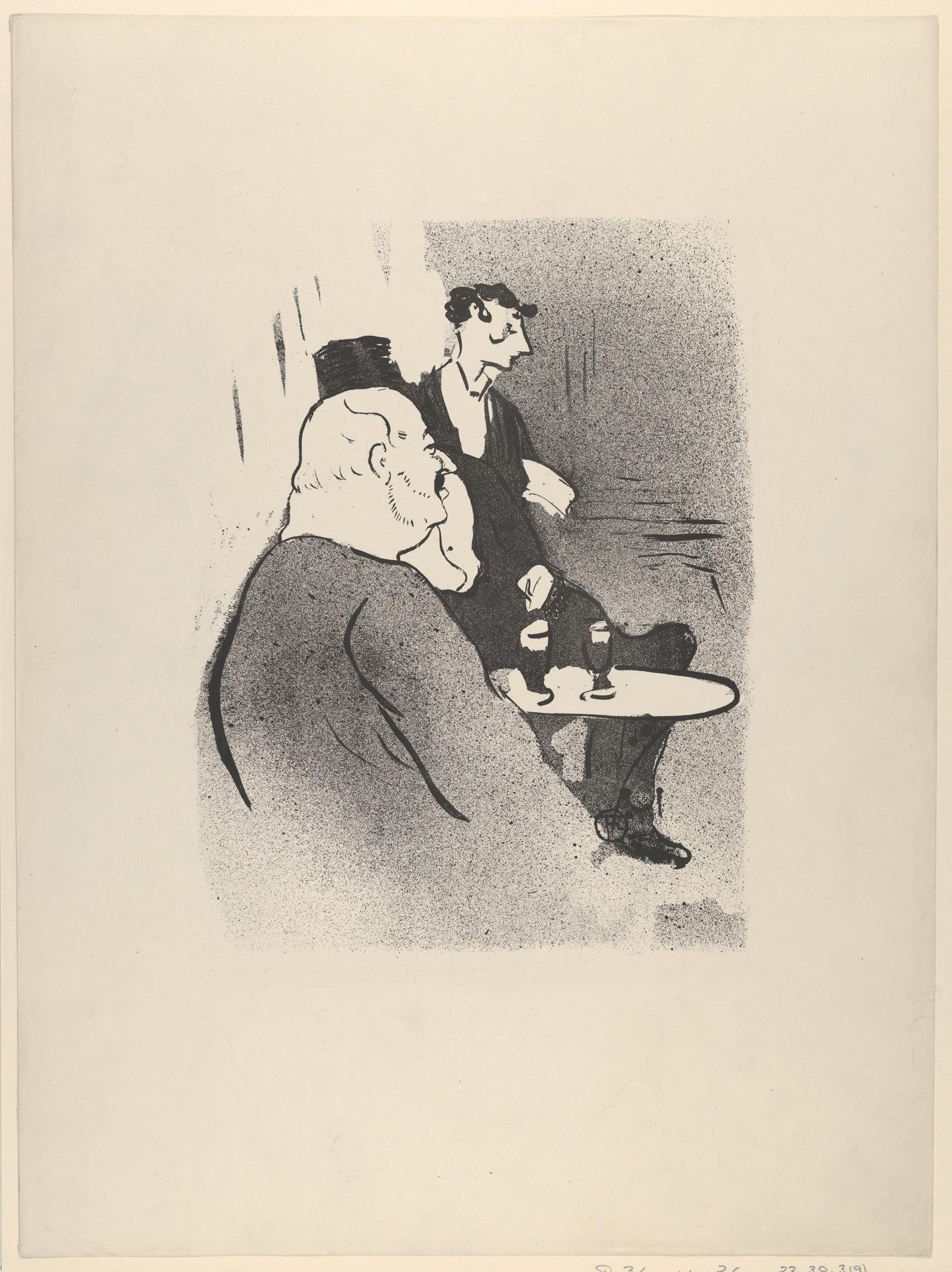
Ducarre at Les Ambassadeurs (from Le Café Concert)
Original title: Ducarre at Les Ambassadeurs (from Le Café Concert)
kurzbeschreibung
Henri de Toulouse-Lautrec portrayed the singer Ducarre in 1893 during a performance at the Parisian café-concert Les Ambassadeurs. This crayon and spatter lithograph, with scraper work, was printed in black on wove paper and belongs to the series 'Le Café Concert'. It is the only state of this print.
Description
In the foreground, a man wearing a flat, round cap turns to the right and looks at a second man in profile. He wears a jacket, trousers, and an apron tied at the waist; in his hands he holds a device or tool. Behind the figures lies a blurred, dark area that can be read as a wall or door. Strong contours and hard contrasts define the drawing, while light is evenly distributed, leaving shadows absent.
Context
In the early 1890s, Toulouse-Lautrec regularly visited Parisian entertainment venues and sketched the artists performing there. Les Ambassadeurs on the Champs-Élysées was among the well-known café-concerts with changing singers and entertainers. In 1893, the year this lithograph was made, the artist devoted himself increasingly to the stage world and nightlife.
Impact
The print strikes the viewer as immediate and lively through its coarse contours and palette restricted to black and white. The work clothes with an apron bring the performance close to everyday life, giving the view a private, almost documentary note. The blurred zone in the background creates spatial depth and draws the eye to the figures.
Technique
For this work, Toulouse-Lautrec used lithography, applying crayon and spatter techniques to the stone and employing a scraper for fine lines and shading. It was printed in black on wove paper; only this one state exists. The interplay of crayon and spatter lithography produced a lively texture and precise contours typical of the artist's prints.
AI-generated description text
Source: Metropolitan Museum of Art · Public Domain (CC0 1.0)