Cover Design for "Les Vieilles Histoires" (1893, Met-Objekt 780)
Original title: Cover Design for "Les Vieilles Histoires"
kurzbeschreibung
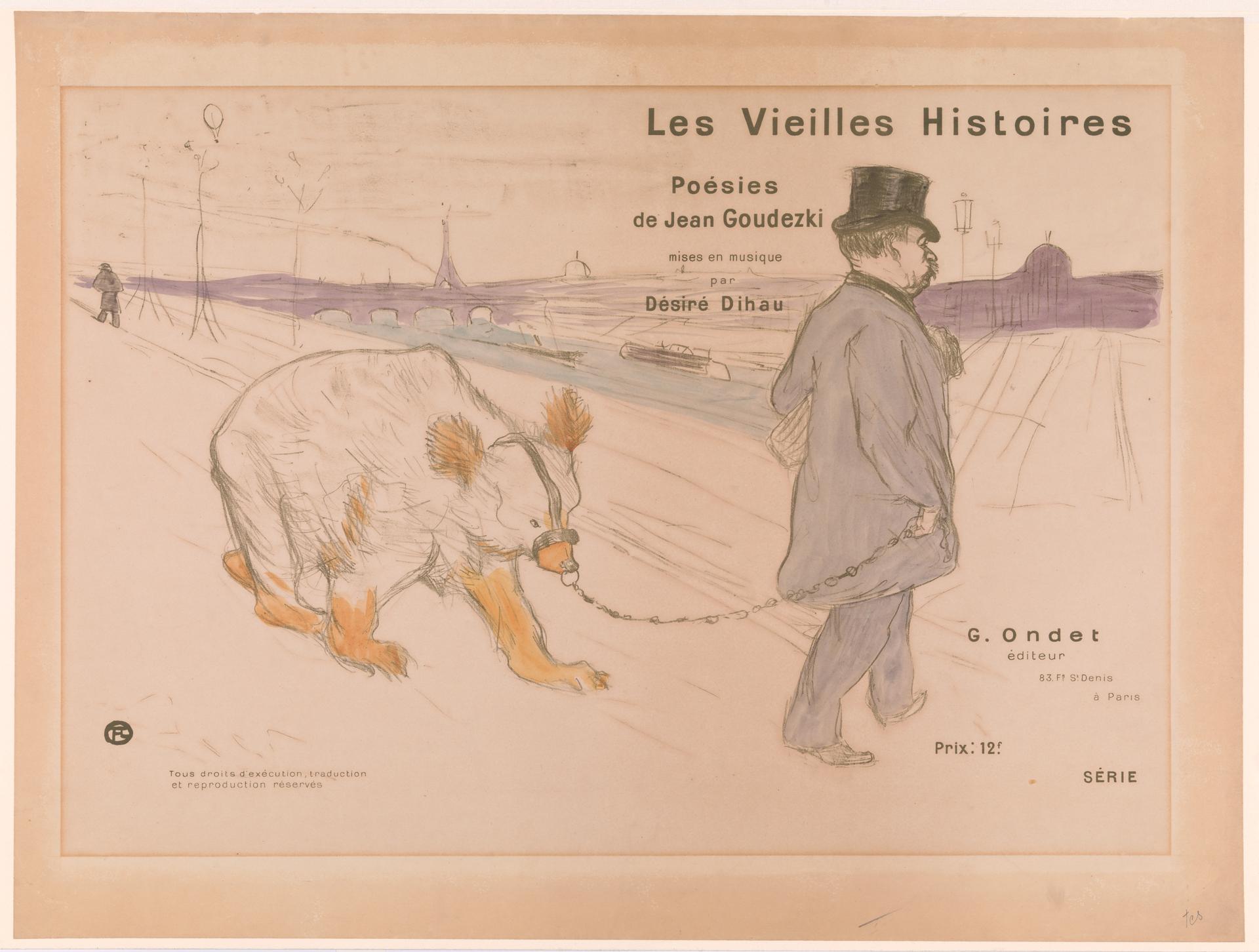
Henri de Toulouse-Lautrec produced this cover design in 1893 as a hand-colored lithograph. It presents a top-hatted man leading a sturdy brown dog on a chain through a night street; behind them rise a bridge and a tower-like structure. The sheet served as the cover for Jean Goudezki's publication 'Les Vieilles Histoires', whose illustrations were by Désiré Dihau.
Description
A gentleman in a dark suit and black top hat holds the chain attached to a large brown four-legged animal. The dog stands upright, almost defiant. Beyond them a street opens with lamps, trees, and a bridge, above which rises a tower reminiscent of the Eiffel Tower. The palette remains mostly pastel; the somber man stands out sharply against the lighter beast. Soft, diffuse light suggests the scene takes place in late afternoon or early evening.
Context
When Toulouse-Lautrec designed the cover in 1893, he was already famous for his posters and prints. 'Les Vieilles Histoires' was a literary publication by Jean Goudezki, for which Désiré Dihau contributed the pictures. With his cover, the artist linked text and image in the manner of the Belle Époque. The man with the dog may allude to the Parisian street scenes that were frequently taken up in art at the time.
Impact
The dog's unusual posture and the man's serious gaze create a mysterious, slightly ironic mood. Pastel tones and the soft light give the image something melancholic, almost dreamlike. The contrast between the two figures brings their relationship to the fore.
Technique
After the lithographic print, the sheet was colored by hand. The process allowed fine lines and flat areas of color, which here are supplemented by manual coloring. Pastel tones and soft transitions are typical of Toulouse-Lautrec's technique in this creative phase.
AI-generated description text
Source: Metropolitan Museum of Art · Public Domain (CC0 1.0)