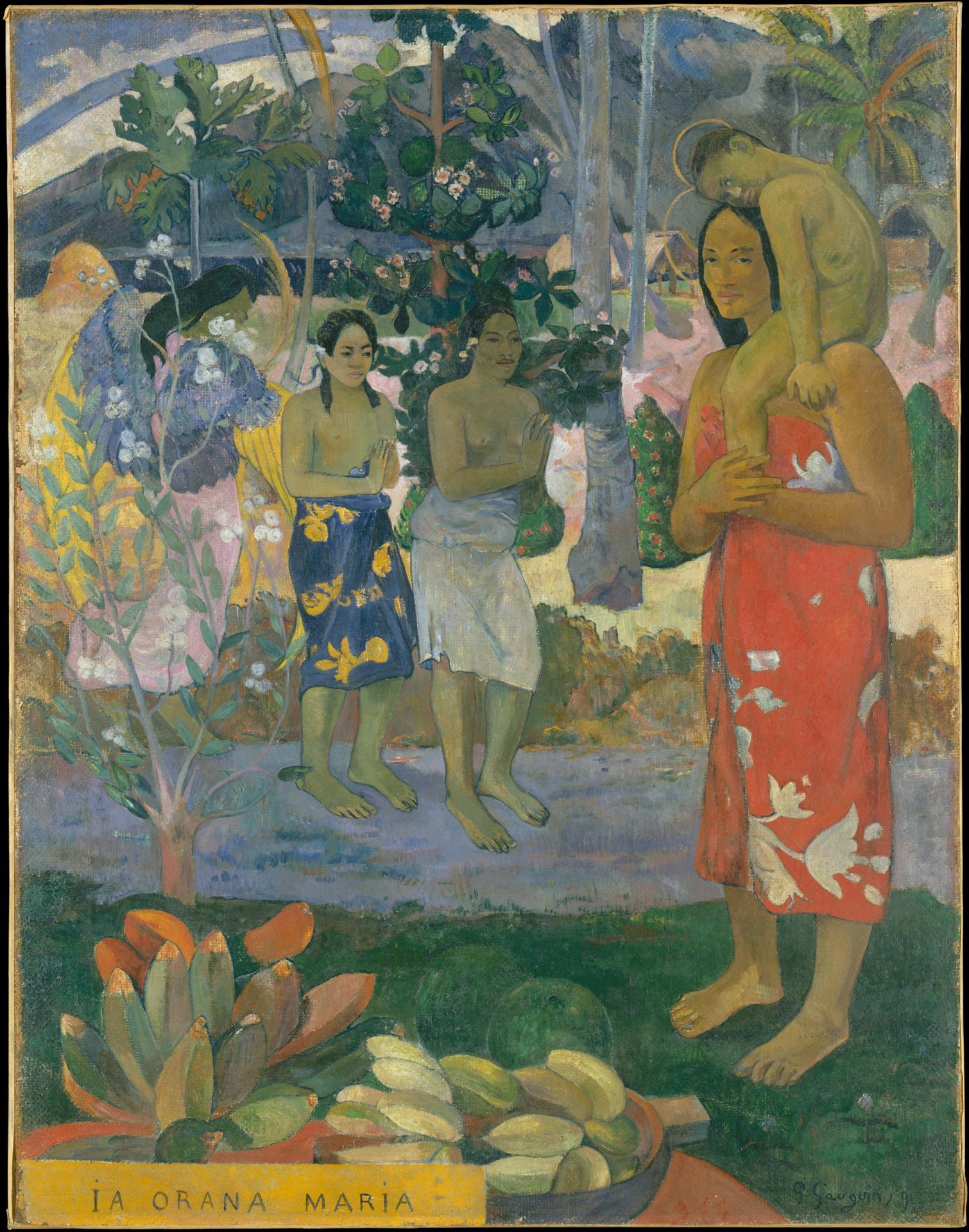
Ia Orana Maria (Hail Mary)
Original title: Ia Orana Maria (Hail Mary)
kurzbeschreibung
Paul Gauguin painted "Ia Orana Maria" in 1891, using oil on canvas. The work presents a group of Tahitian women in a dense garden; one carries a child on her shoulder. It intertwines a Christian motif with a South Seas view that reflects Gauguin's idea of exoticism.
Description
In the foreground, fruits and leaves make the garden tangible. A woman has lifted a child onto her shoulders, while other women stand around her in dresses with floral patterns. All are barefoot, and their garments remain plain. Behind the figures, trees rise; beyond them lies a landscape under a blue sky. The light feels warm, and the tones are strong.
Context
The painting was made in 1891, during his first stay in Tahiti. Gauguin was then searching for a culture he considered primitive and unspoiled. Christian motifs and Tahitian elements merge in this picture, reflecting his engagement with the local surroundings.
Impact
Warm light and a coordinated palette give the image a calm, almost absorbed mood. Because the Christian motif is placed in a foreign setting, it feels both familiar and distant to the viewer, creating a lasting aesthetic appeal.
Technique
Oil on canvas; Gauguin used bold areas of color and visible brushstrokes. In some places, the texture of the fabric remains visible and contributes to the structure of the painting. The tones are intense and often unnatural, which is characteristic of Gauguin's method.
AI-generated description text
Source: Metropolitan Museum of Art · Public Domain (CC0 1.0)