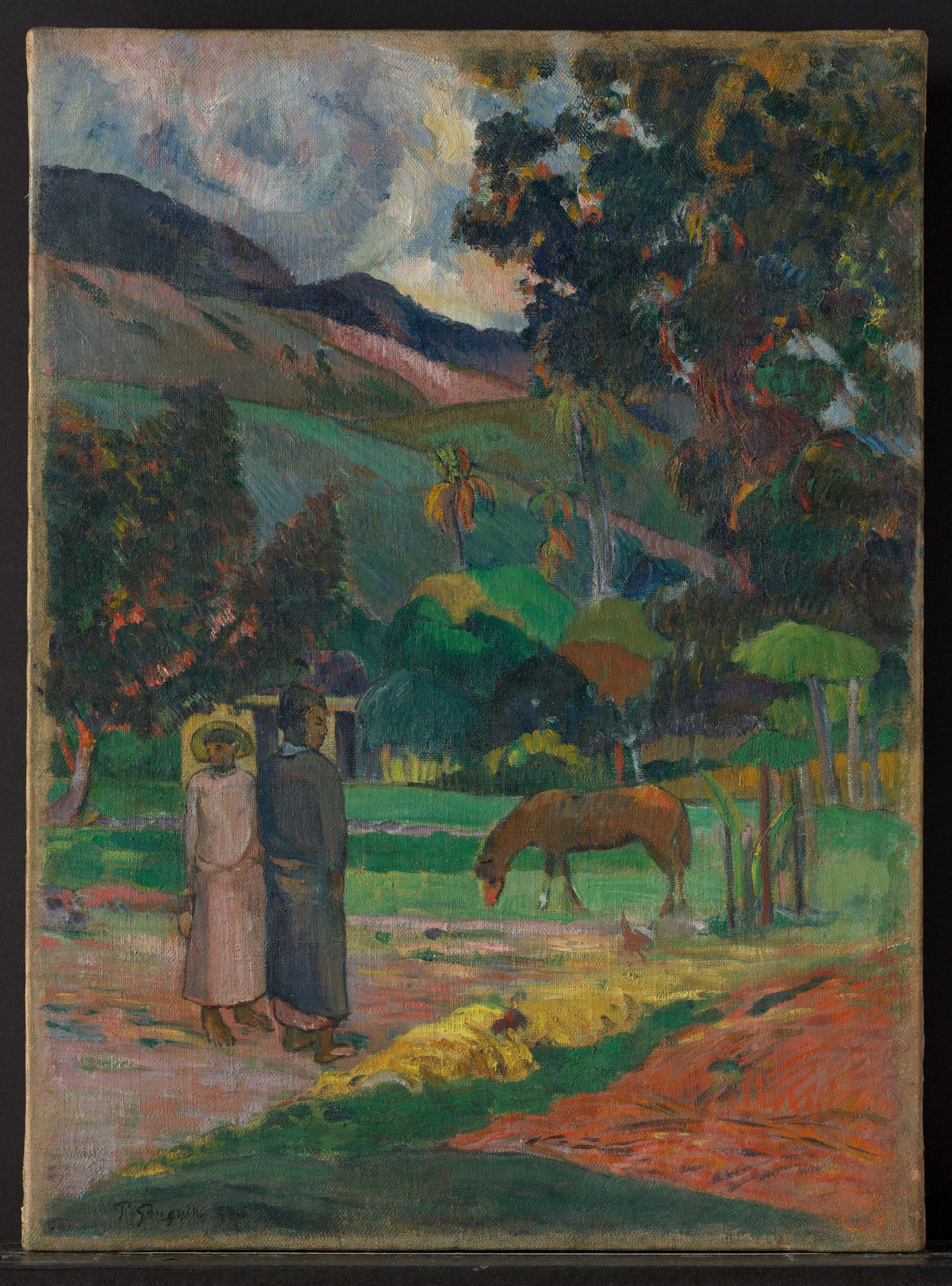
Tahitian Landscape
Original title: Tahitian Landscape
kurzbeschreibung
Paul Gauguin painted Tahitianische Landschaft in 1892, a rural view of Tahiti featuring two figures, a horse, and dense tropical vegetation. The oil on canvas measures 64.5 x 47.3 cm.
Description
Two figures stand in the foreground: one wears light clothing and a hat, the other is dressed in dark garments. They are in a field bordered by a wall; a horse appears to graze there. Trees, including palms, and mountains rise in the background. The colors are strong, the application expressive with visible brushstrokes. Diffuse light creates a warm atmosphere.
Context
Gauguin first set off for Tahiti in 1891, driven by a desire to escape European civilization and discover an untouched, primal culture. This painting was made during his first stay on the island, inspired by the landscape and daily life. In his Tahitian works, he combined impressions of local culture with his own ideas of exoticism and simplicity.
Impact
The vivid colors and expressive brushwork produce an immediate, sensual effect. The warm, diffuse atmosphere invites immersion in the peaceful tropical scene. The calm and naturalness of the subject stand in tension with the modern painterly execution.
Technique
Oil on canvas – a technique characteristic of Gauguin. Visible brushstrokes and expressive application of paint give the picture a dynamic surface. Gauguin used strong, often unmixed colors to capture the tropical landscape with intensity and liveliness.
AI-generated description text
Source: Metropolitan Museum of Art · Public Domain (CC0 1.0)