The Siesta
Original title: The Siesta
kurzbeschreibung
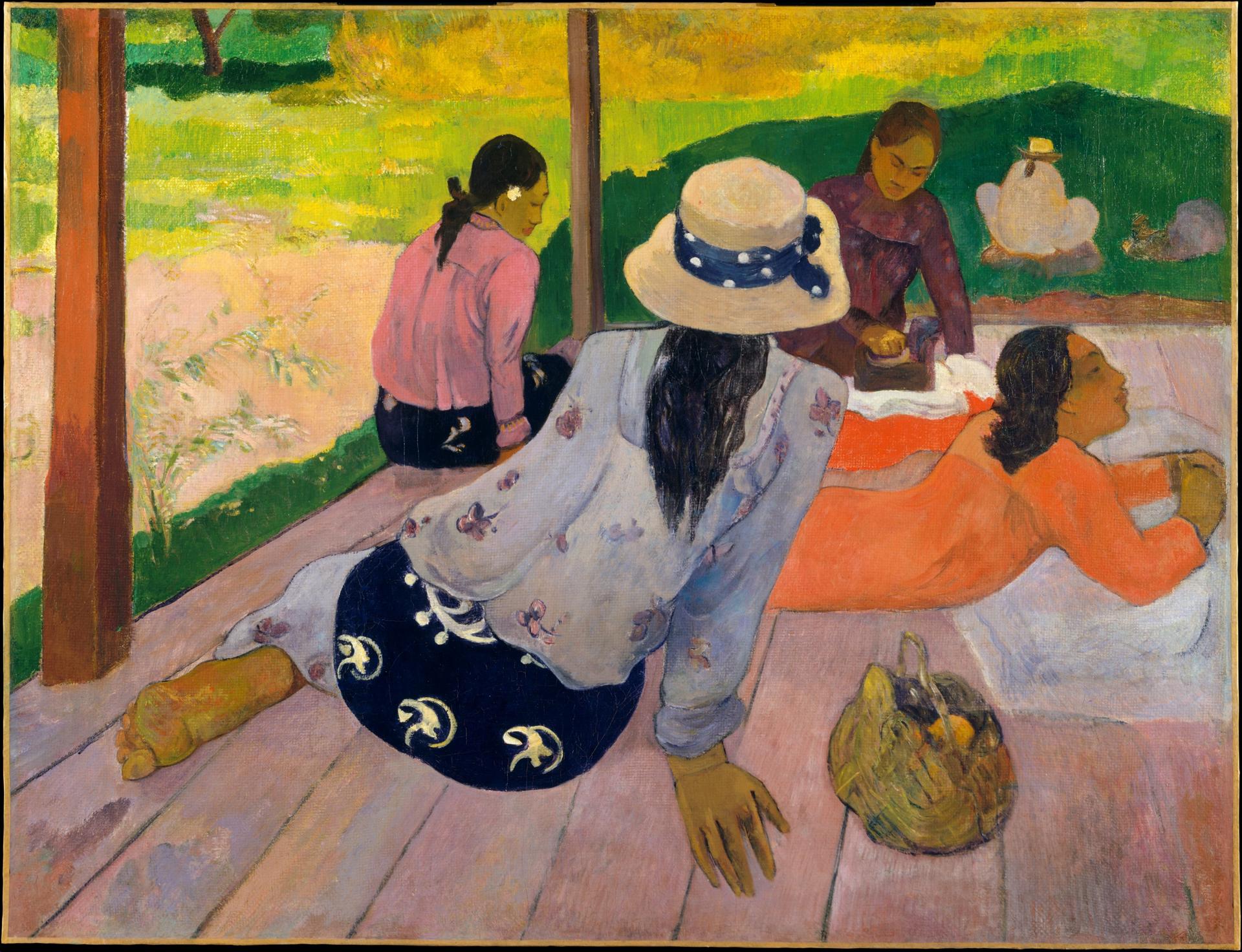
Two women sit on a bench while a third reclines in the foreground and a fourth crouches behind them. Paul Gauguin's 'Die Siesta' (ca. 1892–94) gathers Tahitian women in an open-air setting. The oil on canvas captures a quiet moment of everyday life.
Description
In front, a woman rests on a couch, wearing an orange top and white trousers. On the bench beside her, two women have made themselves comfortable: one wears a broad-brimmed hat, the other a pink top. A fourth figure, perhaps a child, sits somewhat further back on the same bench. Trees frame the open space, above which stands a clear sky; the strong colors and bright light suggest an hour between morning and afternoon.
Context
In the early 1890s, Gauguin lived in Tahiti and recorded the lives of the locals in his paintings. 'Die Siesta' was made during his first stay (1891–1893) and may have been completed only after his return to France. The subject reflects his longing for a culture that, from Europe, he idealized as unspoiled and primal.
Impact
The relaxed postures of the figures and the warm colors give off a calm, almost meditative mood. The clear structure and simplified forms lend the scene a timeless, quiet quality—the viewer is drawn into the tropical air.
Technique
Gauguin worked with oil on canvas, using bold, flat areas of color while simplifying the details of the figures. Characteristic of his post-impressionist phase are the expressive color contrasts and the flattened perspective.
AI-generated description text
Source: Metropolitan Museum of Art · Public Domain (CC0 1.0)