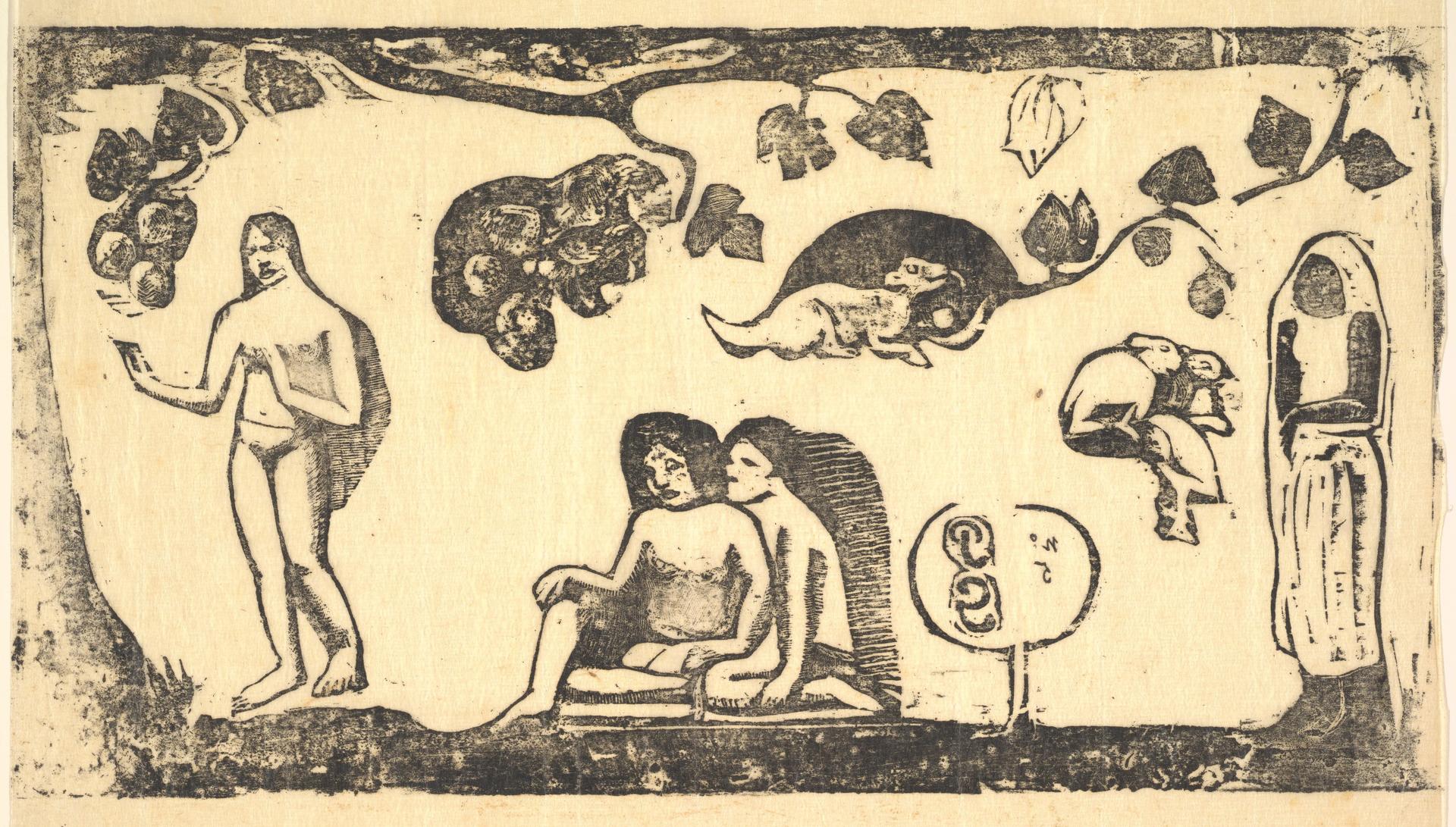
Women, Animals, and Foliage
Original title: Women, Animals, and Foliage
kurzbeschreibung
This broad, horizontally oriented woodcut by Paul Gauguin, made in 1898, gathers several figures, animals, and plant motifs in a dense sequence. Printed in black ink, the impression combines representational elements with an overall flat, decorative design.
Description
Two figures sit facing each other at the center, while another stands to the left with a book. Foliage and branches stretch across the group, enclosing the image above and below. In the upper right, a small dog-like quadruped appears; below it, two people embrace. At the right edge, an abstracted figure in a garment is visible. Black on white dominates the entire view, with no intermediate tones or hatching.
Context
Gauguin made this print in 1898 during his first stay in Tahiti, a time when he was deeply engaged with graphic processes. He sought an expression he considered primal, which the woodcut seemed to offer. The motifs stem from impressions and observations in the South Seas, recorded in his 1897 manuscript Noa Noa. The impression was produced in small numbers and later served as a starting point for further print variations.
Impact
The rough cut and flat black-and-white placement give the scene an archaic, immediate quality. The crowded succession of figures, animals, and foliage feels ornamental and pins the gaze to the surface. Black contours and white intervals emphasize the expressive linework and the decorative structure of the sheet.
Technique
For this woodcut, Gauguin transferred his drawing to a block of wood, cut out the forms, and printed the result with black ink on paper. The process allows no fine tonal gradations, so the image consists of hard contrasts between printing ink and the white of the paper. Traces of the cutting remain visible, giving the forms a raw, handcrafted quality.
AI-generated description text
Source: Metropolitan Museum of Art · Public Domain (CC0 1.0)