Le Sourire
Original title: Le Sourire
kurzbeschreibung
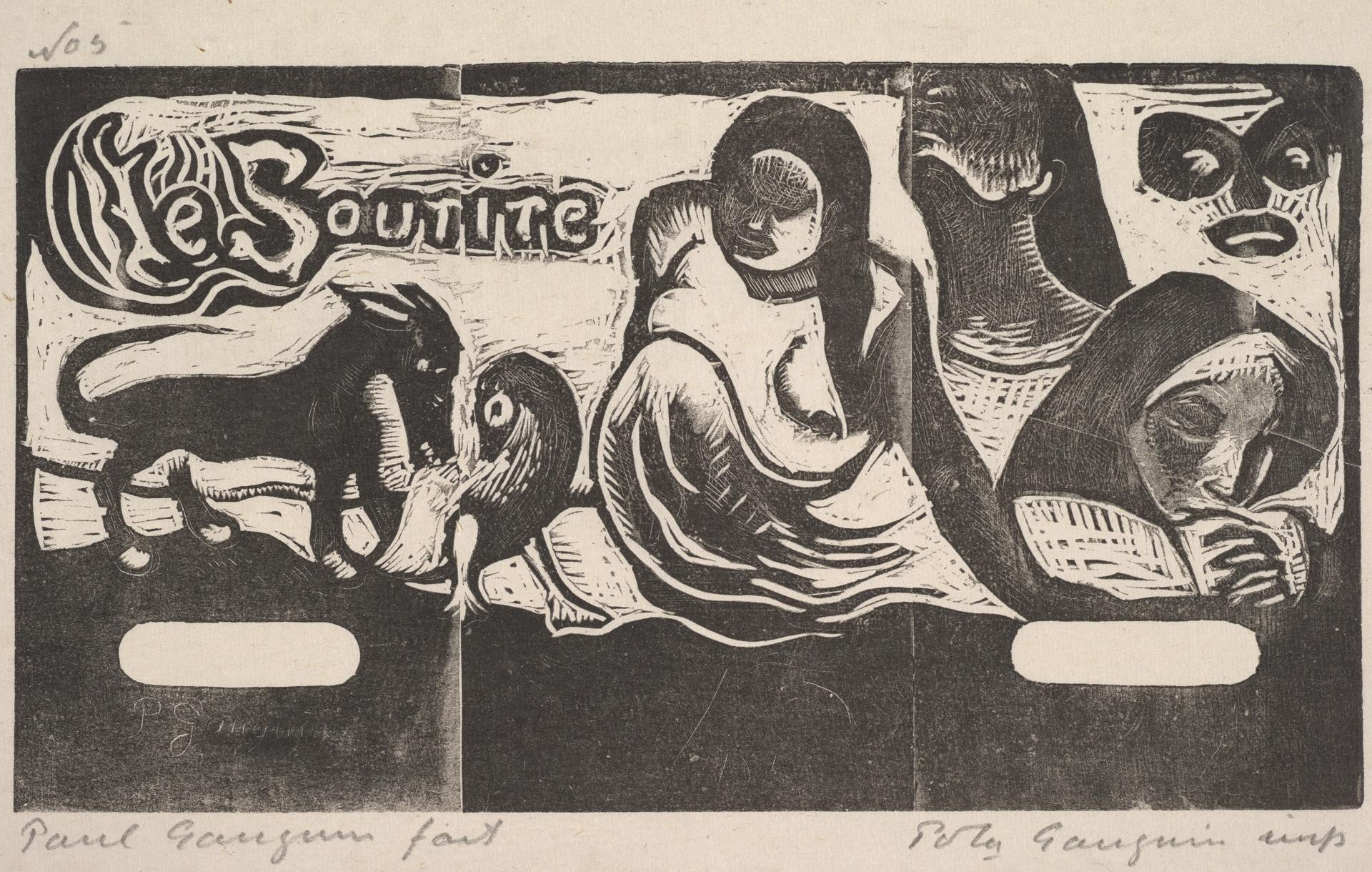
Paul Gauguin's woodcut 'Das Lächeln' (Le Sourire) dates from 1899. It presents four seated figures arranged in a row. The lines are simple and stylised, and the sheet was printed on china paper. It belongs to Gauguin's printmaking works in a primitivist style.
Description
Four figures sit side by side in a horizontal row. The leftmost figure stands out with an oversized, expressive face and a wide-open mouth — a stark contrast to the others, which have simple features and wear traditional garments. The layout feels even and horizontally aligned. Black and white dominate the woodcut; straight lines and flat areas of shading define the image.
Context
Gauguin made this woodcut in 1899 during his stay in Tahiti. He brought out a short-lived satirical journal titled 'Le Sourire', whose cover featured this print. Woodcut was a cheap and direct technique that Gauguin valued for his graphic work. The primitive visual language reflects his interest in non-Western cultures.
Impact
The rough lines and the distorted left figure give the sheet an immediate, almost expressive presence. Monochrome and a simple layout create a calm yet provocative impact. The contrast between the exaggerated facial expression and the static remaining figures unsettles the viewer.
Technique
Woodcut on china paper. The cut, straight lines and flat areas of shading are typical of this technique. Gauguin used the natural grain of the wood to achieve textured surfaces.
AI-generated description text
Source: Metropolitan Museum of Art · Public Domain (CC0 1.0)