Here we make love
Original title: Here we make love
kurzbeschreibung
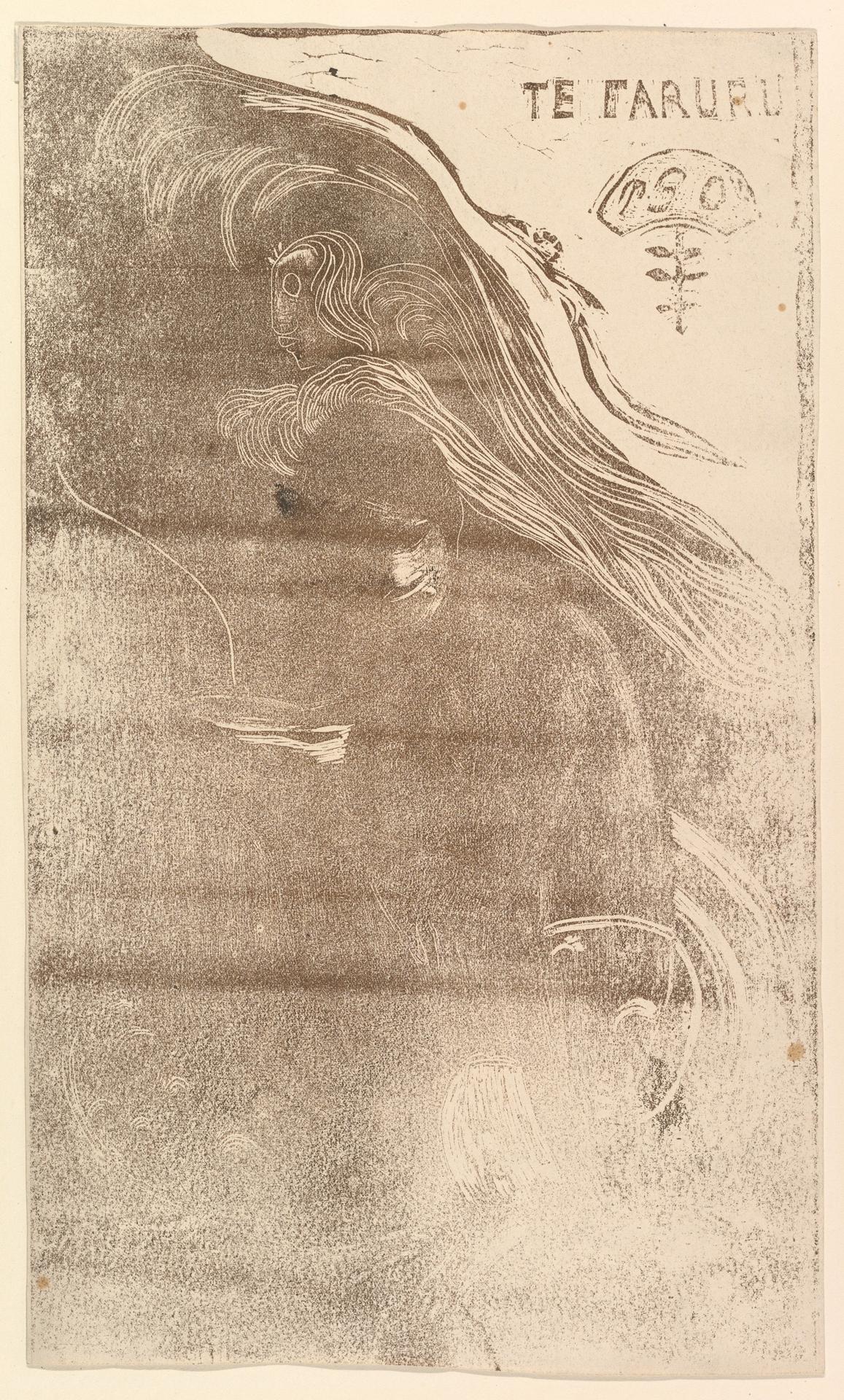
Paul Gauguin made this color woodcut in 1893–94, after his first stay in Tahiti. Two figures locked in a close embrace fill the sheet, set within a clear, symmetrical arrangement. Printed on wove paper, it belongs to the works in which Gauguin carried his South Seas motifs over into printmaking.
Description
A couple dominates the image: the woman, with long loose hair, turns toward the viewer, while the man, also long-haired, is seen from behind. Her face is severely stylized and contained by a narrow contour. Brown tones govern the color, broken by restrained gray and white passages that bring out shadows and surfaces. Across the top runs the inscription “TE FARURU,” beside it a small mark. The layout is asymmetrical, focused entirely on the two figures, who occupy most of the area.
Context
This woodcut came about during Gauguin’s first stay in Tahiti (1891–1893), when he was searching for simple, original ways of life. The Tahitian title “Te Faruru” means “Here we make love” and points to local culture. The sheet belongs to a series of woodcuts from those years that often take up motifs from Gauguin’s South Seas novel “Noa Noa.” Printmaking allowed him to make his ideas of exoticism and primitiveness accessible to a wider audience.
Impact
The muted browns and soft contours give the sheet a calm, intimate mood. Because the palette is reduced and the rendering stylized, the image gains an archaic, almost ceremonial presence. Irregular lines and the visible wood grain create a tactile quality that draws the viewer into the scene.
Technique
For this sheet, Gauguin cut the motif into a woodblock, inked it, and then transferred the result to paper. The visible lines and wood texture are characteristic of the process and give the print an organic, handcrafted feel. That several tones were used, especially brown and gray, shows Gauguin experimenting with different inking and printing states.
AI-generated description text
Source: Metropolitan Museum of Art · Public Domain (CC0 1.0)