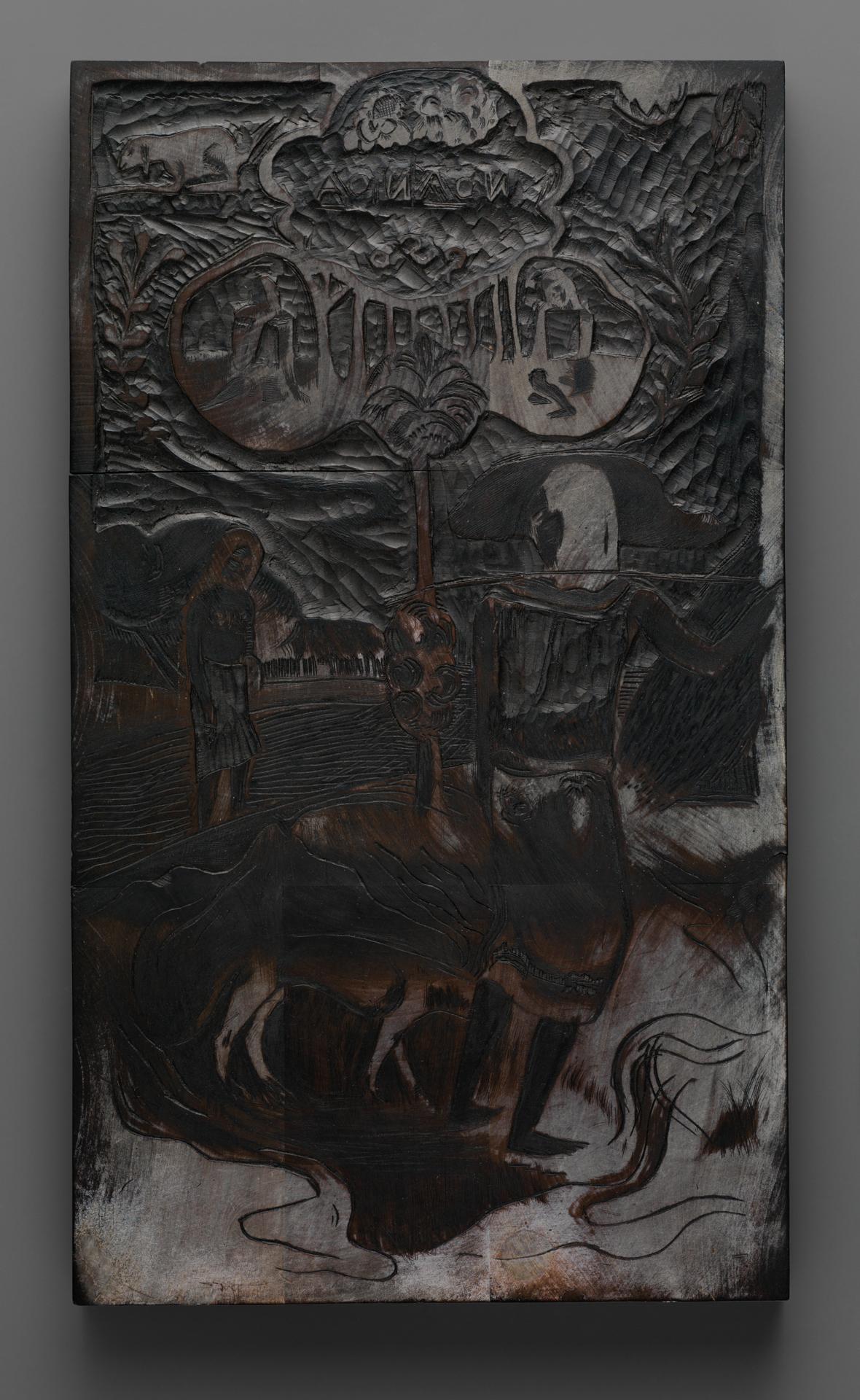
Fragrance (Noa Noa), from Fragrance (Noa Noa)
Original title: Fragrance (Noa Noa), from Fragrance (Noa Noa), title block
kurzbeschreibung
Two dark figures, seemingly absorbed in a ritual act, stand beneath a large stylized leaf inscribed with 'Noa Noa'. Paul Gauguin made this woodcut in 1893–94. The motif is cut into fruit wood and bears traces of zinc white and ink.
Description
A large, stylized leaf dominates the center, its surface carrying the words 'Noa Noa'. Around it, other leaves and branches curl in sinuous, restless lines. Below, two figures in traditional dress appear deep in a ritual or spiritual act. Dark in tone, they stand out against the lighter ground of the leaf. At the bottom edge, stylized forms suggest water and perhaps plants. The palette is mostly dark, with grays and browns, shaped by the woodcut technique and the traces of zinc white and ink.
Context
During his stay in Tahiti, Gauguin engaged with local culture and mythology; this print emerged from that period. In Tahitian, 'Noa Noa' means 'fragrant', pointing to the sensory experience of the South Seas. The woodcut belongs to a series in which Gauguin recorded his impressions of Tahiti. Rituals and traditional motifs reflect his interest in a way of life he perceived as primal.
Impact
The expressive lines and strong light-dark contrast give the print a mystical, almost meditative presence. The centrally placed leaf and the calm figures produce a symmetrical, balanced layout, enlivened by the moving plant motifs. The dark palette heightens the mysterious atmosphere and invites close looking.
Technique
Gauguin cut the motif into fruit wood, which allows fine and precise incision. Traces of zinc white and ink suggest later working or coloring that intensifies the contrasts. The process renders lines and areas clearly, as is characteristic of his expressive style.
AI-generated description text
Source: Metropolitan Museum of Art · Public Domain (CC0 1.0)