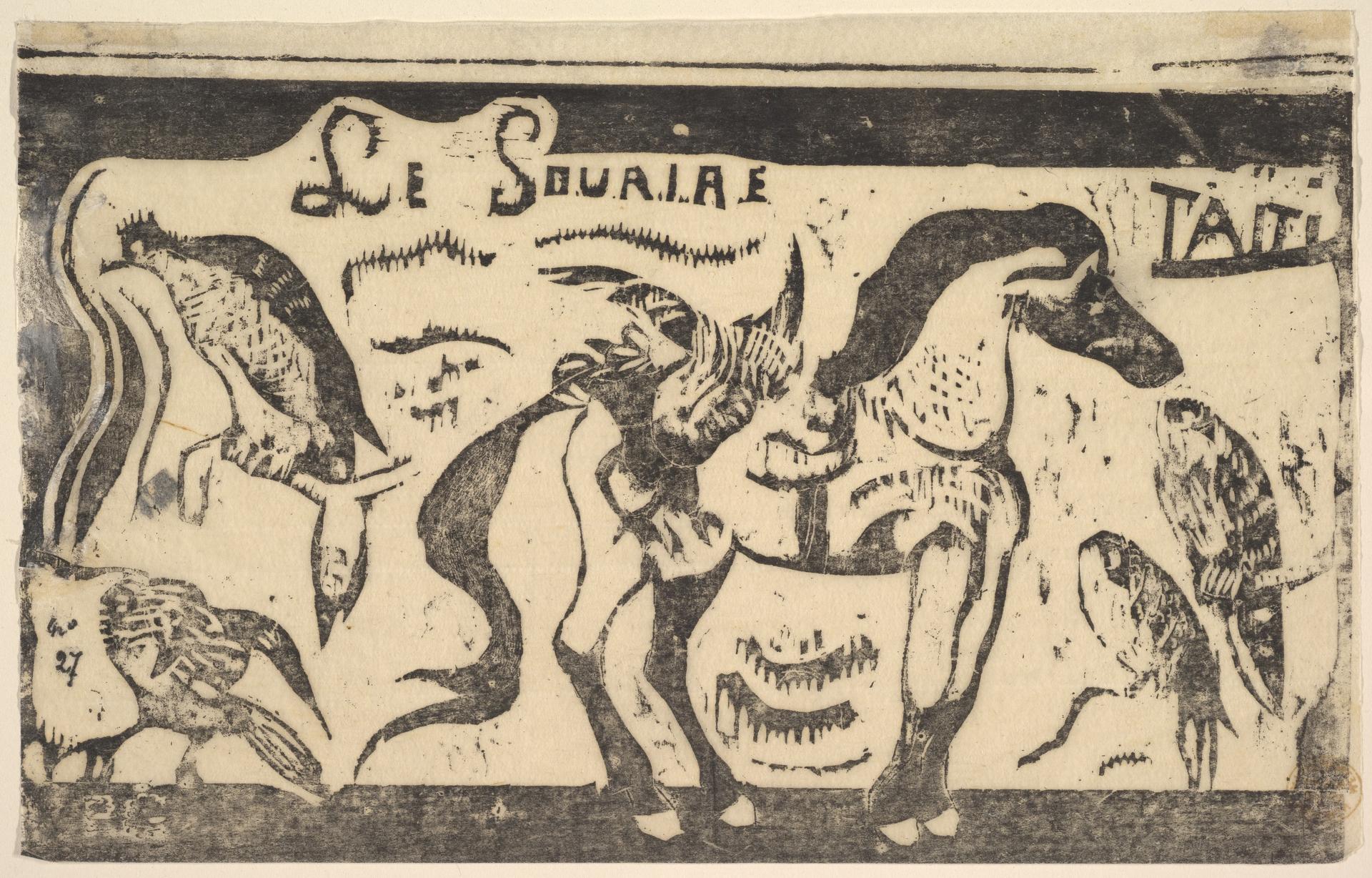
Le Sourire; Taiti (Smile; Tahiti)
Original title: Le Sourire;Taiti (Smile; Tahiti)
kurzbeschreibung
Unlike many animal studies of his time, Paul Gauguin's "Le Sourire; Taiti" from December 1899 relies on a flat, ornamental arrangement of animals and birds. The woodcut, executed in black and white on thin, transparent Japanese paper, measures 13.7 × 21.8 centimeters.
Description
Two horses meet in the foreground and touch; their heads are carefully worked out with striking manes and horns. Around them appear several birds in various poses, some with wings spread wide. Another animal, perhaps a horse or donkey, can be made out at the back. Above the design stand the words "Le Sourire," and at the upper right "Taiti." The horizontally oriented, monochrome arrangement feels calm thanks to its clear lines and even light.
Context
The woodcut was made during Gauguin's second stay in Tahiti (1895–1901) for his short-lived satirical newspaper "Le Sourire," which he launched in Papeete in 1899. For this sheet he printed the impressions himself, often in small editions on fine paper. The title links the newspaper's name with the place of origin, Tahiti. Gauguin also used such prints to bring his work closer to a European audience.
Impact
The black-and-white graphic conveys a quiet, almost meditative mood, supported by the symmetrical placement of the animals. The rough, expressive linework of the woodcut gives the sheet a primal, handmade quality characteristic of Gauguin's printmaking.
Technique
The woodcut was printed on transparent, thin Japanese paper. In working the block, strong, sometimes coarse cuts were used, resulting in clear, high-contrast lines. The sheet is trimmed to the image format, so the print appears without a margin.
AI-generated description text
Source: Metropolitan Museum of Art · Public Domain (CC0 1.0)