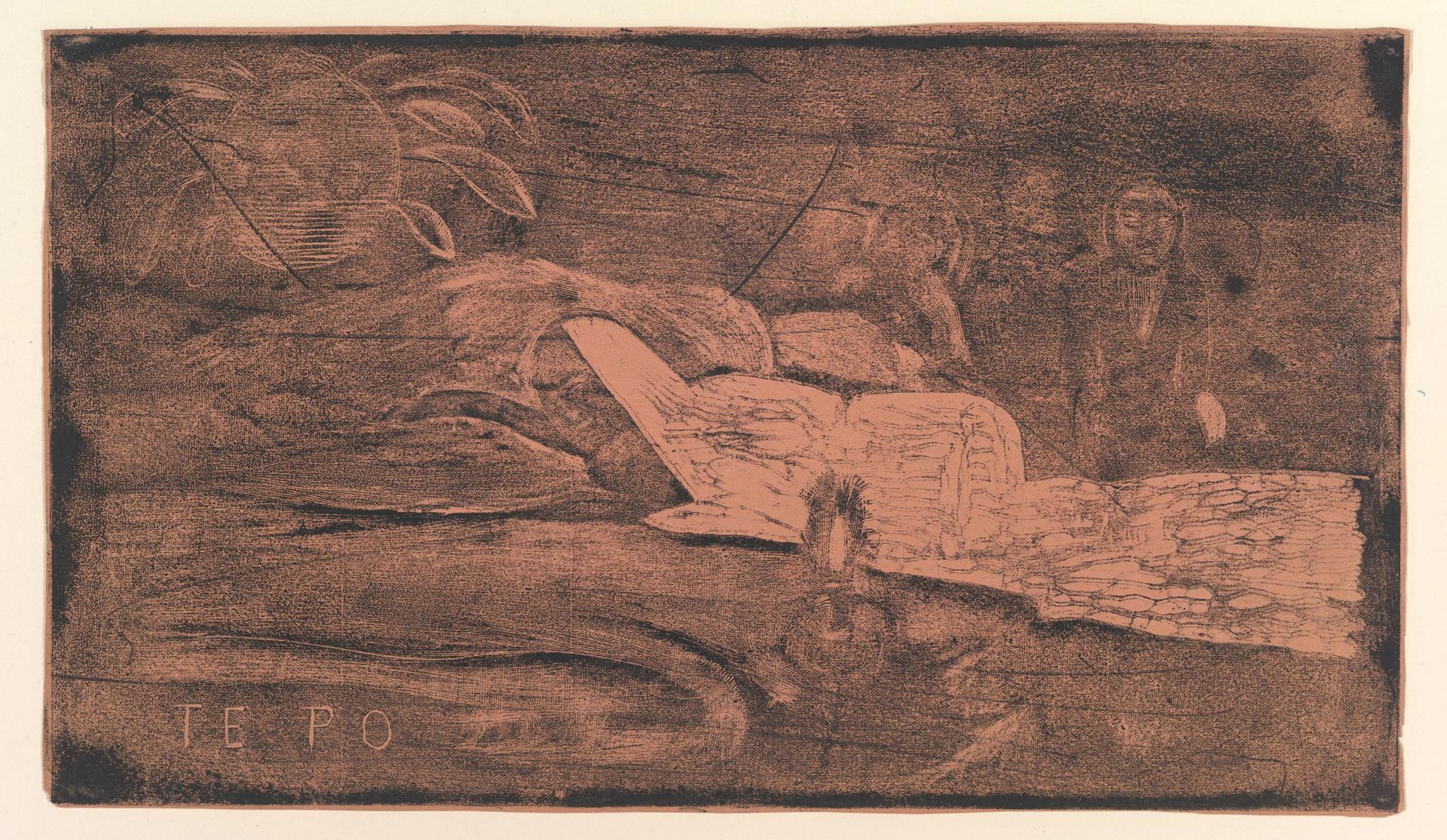
Te Po (1893–94, Met-Objekt 757)
Original title: Te Po
kurzbeschreibung
Paul Gauguin made Te Po (The Night) in 1893–94 as a color woodcut. It presents a seated figure holding a book in the foreground, with other figures and landscape elements around. The print was pulled on wove paper that was later lined with silk.
Description
In front, a figure in traditional dress sits on a rock and reads. Behind, other people, trees, and rocks are suggested. Browns dominate, and the light feels subdued. The arrangement is broad, the contours are sharp, and the surface shows the textures typical of woodcut.
Context
Gauguin worked on this sheet during his first stay in Tahiti (1891–1893) and finished it after returning to France. It belongs to a series of woodcuts that take up everyday life and myths of Polynesia. Te Po means The Night in the Tahitian language and names the nocturnal mood of the motif.
Impact
The muted browns and the calm posture of the reading figure create a quiet, almost meditative atmosphere. Sharp contours and the rough texture of the woodcut give the sheet something primal, handmade.
Technique
For this color woodcut, several printing blocks were used, one for each color. It was printed on wove paper, which was then lined with silk to stabilize the surface. The process yields strong lines and areas with characteristic irregularities.
AI-generated description text
Source: Metropolitan Museum of Art · Public Domain (CC0 1.0)