Te Po (1893–94, Met-Objekt 756)
Original title: Te Po
kurzbeschreibung
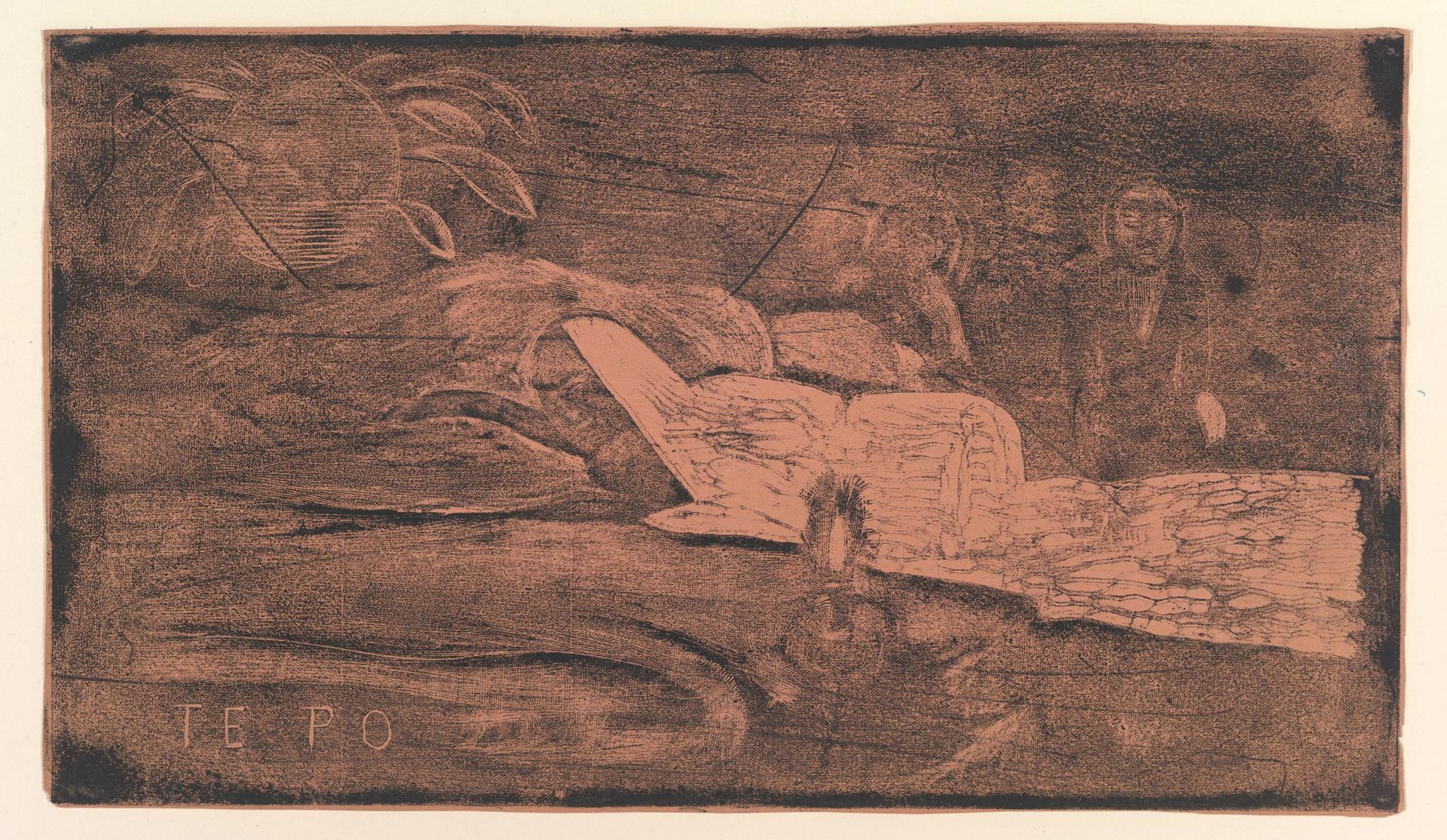
Paul Gauguin made the woodcut Te Po (The Night) in 1893–94, part of his graphic output from the Tahiti years. A person in traditional dress reads, surrounded by other figures in a landscape. The print is a woodcut on wove paper.
Description
In the foreground, a figure sits on a rock, absorbed in a book. Traditional clothing points to a historical or cultural setting. Behind, more people in similar garments appear, drawn more sparsely as secondary elements. Trees and rocks frame the image, which is dominated by brown tones. The subdued light creates a calm mood.
Context
Gauguin made this woodcut during his time in Tahiti, where he engaged with local culture and mythology. Te Po means 'The Night' in Tahitian and alludes to the region's creation myths. In this period, he devoted himself intensively to printmaking and tested the woodcut as an independent medium.
Impact
The restrained browns and the calm layout produce a meditative atmosphere. The reading figure in the foreground draws the eye and invites lingering, while the people behind place the scene in a broader cultural context.
Technique
Gauguin used woodcut on wove paper. Typical of this printing method are delicate lines and the texture of the wood surface. The paper was trimmed almost to the image edge, giving the arrangement a compact feel.
AI-generated description text
Source: Metropolitan Museum of Art · Public Domain (CC0 1.0)