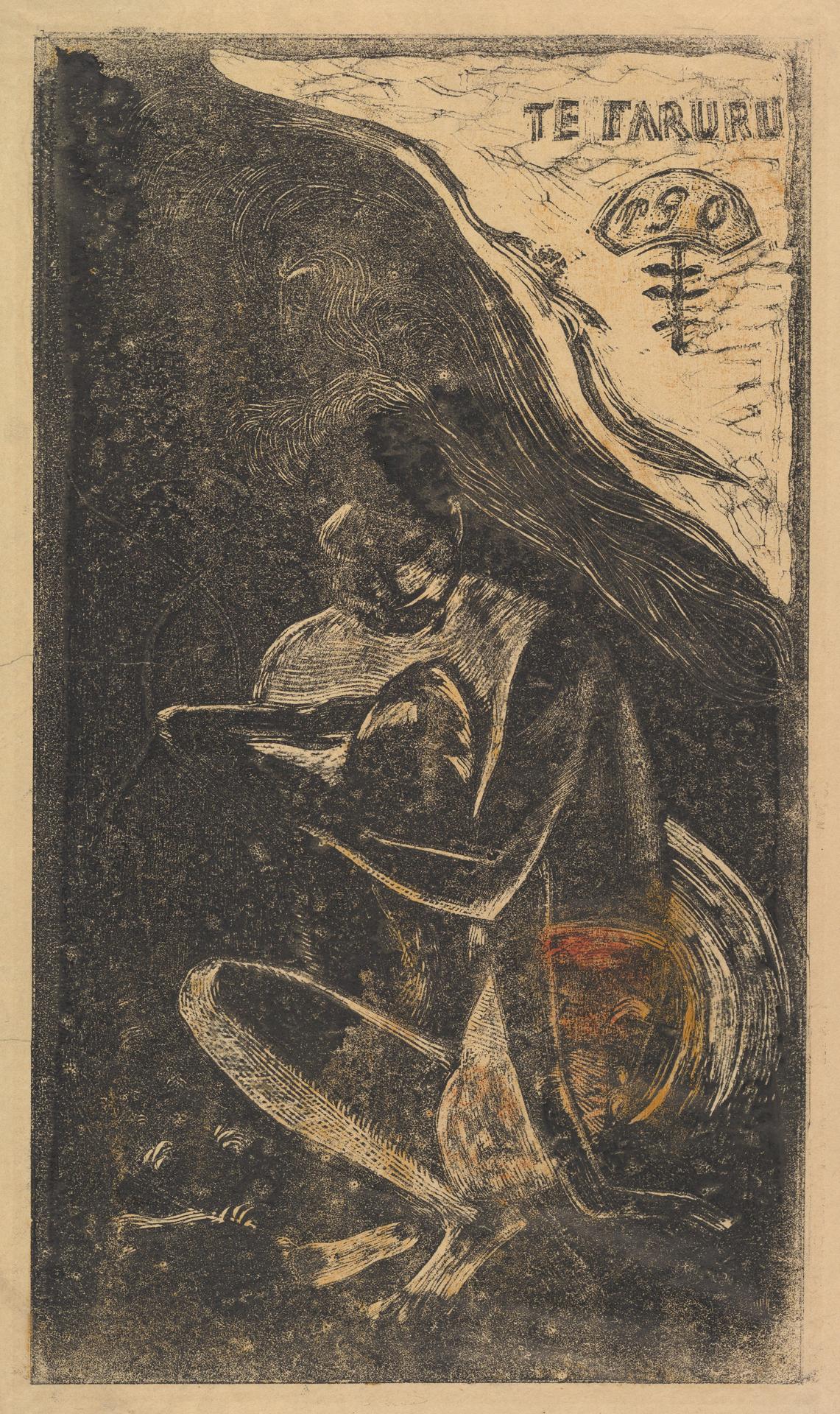
Here We Make Love (Te Faruru), from Fragrance (Noa Noa)
Original title: Here We Make Love (Te Faruru), from Fragrance (Noa Noa)
kurzbeschreibung
Two figures lie entwined in an intimate pose. Paul Gauguin captured this motif in a color woodcut around 1893–94. The sheet belongs to the 'Noa Noa' series, in which the artist processed his stay in Tahiti. It was printed on Japan paper; the block surface measures 35.4 x 20.3 cm.
Description
One dark body sits with its back to the viewer, while another lies on its side next to it, the two pressed close together. Above them, curving, stylized lines suggest clouds or pure forms. In the upper right appear the words 'TE FARURU' and a stamp with the number '30'. The colors remain mostly dark, with bright highlights only on the skin. The strong linear quality contributes much to the mood.
Context
During his first stay in Tahiti (1891–1893), Gauguin made this woodcut, which he later included in the 'Noa Noa' portfolio. That collection draws on his experiences and the island's culture. After returning to France, he continued to work through his memories in art. 'Te Faruru' refers to a poem from 'Noa Noa' that addresses free love in Polynesian society. Only about 30 impressions of the print are known.
Impact
The dark, familiar closeness of the two figures creates a sensual yet enigmatic atmosphere. Because the forms are simplified and the lines expressive, the sheet feels modern, almost abstract. The viewer is drawn into the private event without it becoming intrusive.
Technique
For the color woodcut, Gauguin used several woodblocks, one for each color. Printing was done on Japan paper, which takes up the colors softly. The cuts are coarse and sometimes irregular—a hallmark of Gauguin's experimental approach that emphasizes the handcrafted aspect.
AI-generated description text
Source: Metropolitan Museum of Art · Public Domain (CC0 1.0)