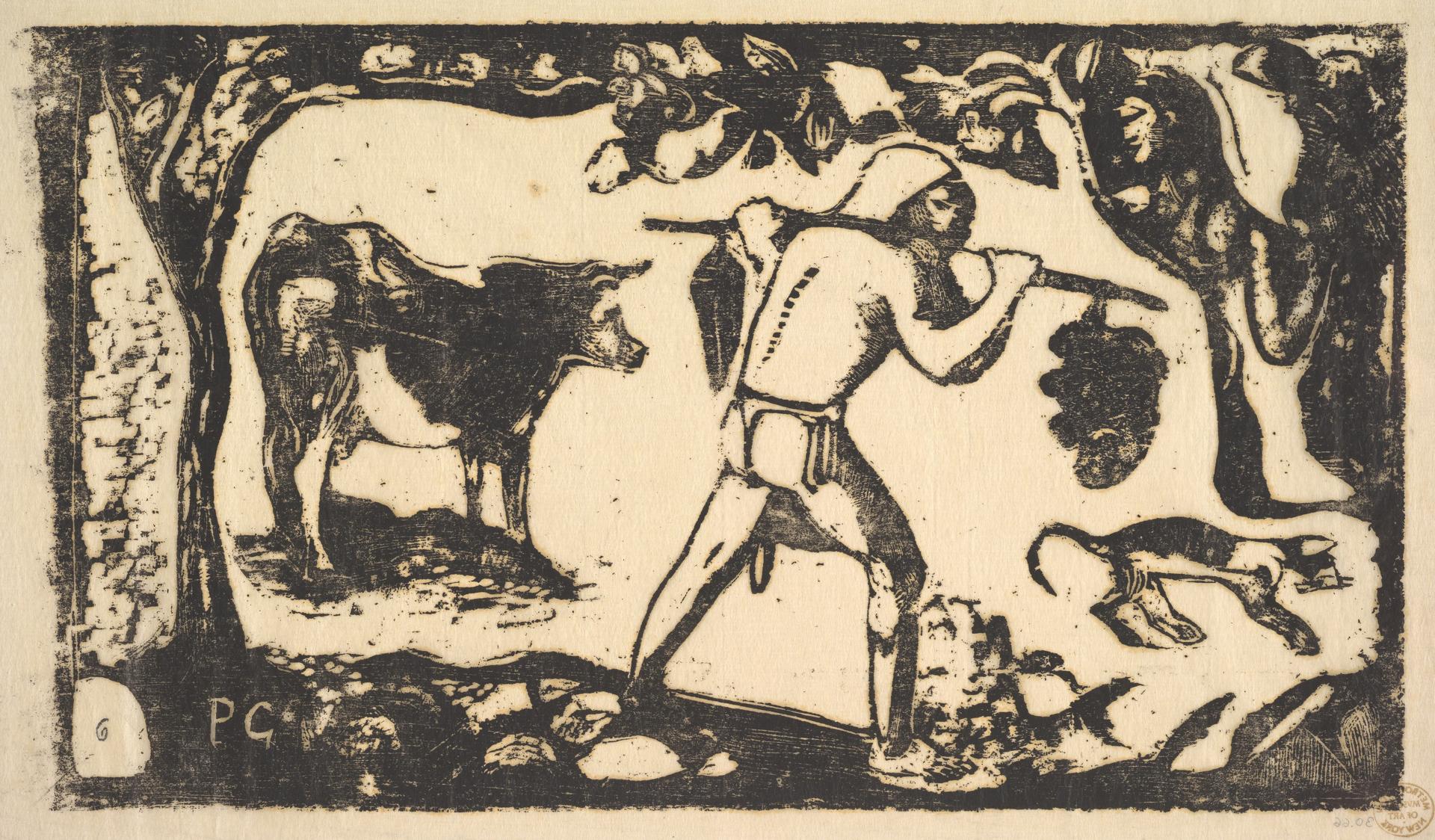
Tahitian Carrying Bananas
Original title: Tahitian Carrying Bananas
kurzbeschreibung
Paul Gauguin's woodcut 'Tahitian with Carrying Bananas' dates from 1898–99 and captures a rural moment: a working man, two cows, other figures in the background, and a dog. The print was pulled on transparent wove tissue paper, measuring 16.2 x 28.7 cm.
Description
In the foreground, a plainly dressed man handles a stick or tool with a collected posture. Two cows stand quietly beside him, while a group of people wearing hats gathers behind. From the right, an animal—likely a dog—approaches the assembled figures. Trees, stones, and earth form the rural setting; the layout runs horizontally, with figures arranged in groups.
Context
This print belongs to Gauguin's second Tahitian period (1895–1901), when he turned away from European civilization and sought the simple life of the South Seas. It is part of a series of prints from these years that often record everyday scenes of the island. The interplay of humans and animals reflects his idealized vision of Polynesian culture.
Impact
The black-and-white woodcut gives the scene a raw, expressive force, heightened by clear contours and strong shadows. The calm grouping of figures and animals creates a quiet, almost meditative mood that draws the viewer into the rural world of Tahiti.
Technique
For this image, Gauguin used the woodcut: the picture was cut into a wooden block and then printed onto transparent wove paper. The black-and-white impression produces strong contrasts and a grainy texture characteristic of his experimental prints. The translucent paper allows light to pass through the sheet with particular effect.
AI-generated description text
Source: Metropolitan Museum of Art · Public Domain (CC0 1.0)