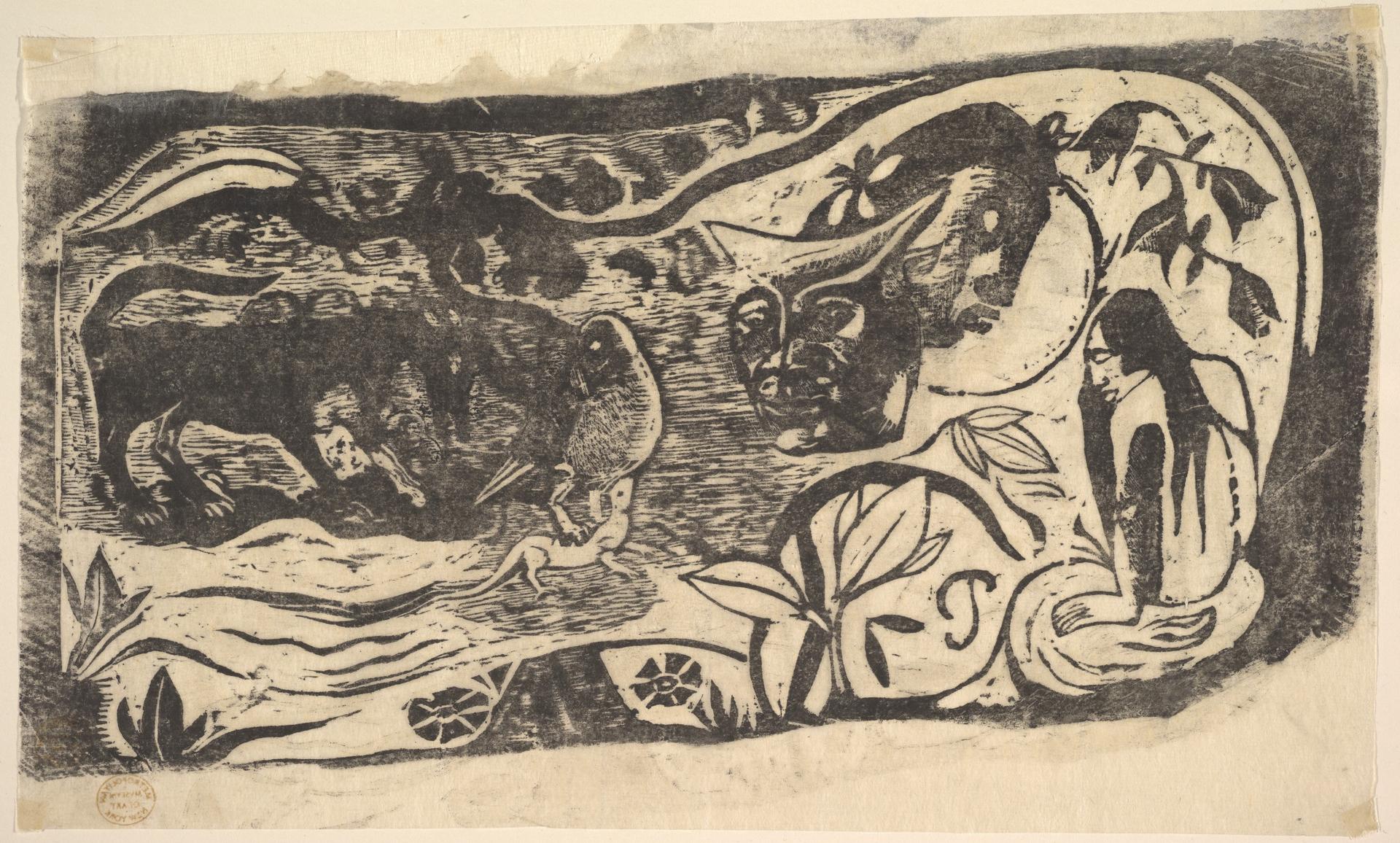
Woodcut with a Horned Head
Original title: Woodcut with a Horned Head
kurzbeschreibung
A horned head is the central subject of this woodcut by Paul Gauguin, made in 1898–99. The sheet was printed on thin, transparent Japan paper. Abstract wavy lines surround the head, while figures appear on the left and a seated figure on the right among foliage.
Description
A horned head dominates the middle, set off by bold contours. Wavy, abstract lines behind it suggest landscape or movement. On the left, several figures that recall animals or humans seem caught in action or confrontation. On the right, a figure squats on the ground, surrounded by leaves and plants. Black and white define the color scheme; the light is even, with no shadows.
Context
Gauguin made this woodcut in Tahiti. At the time, he was experimenting eagerly with the medium of woodcut. The sheet belongs to a series of prints made in the late 1890s. Polynesian culture and mythology provide the motifs worked into the graphic art.
Impact
The expressive, abstract style brings the striking shapes and contours to the fore. Because only black and white are used, the sheet feels graphic and almost archaic. The restless arrangement of the pictorial elements creates tension between the figures and the horned head.
Technique
This is a woodcut printed on thin, transparent Japan paper. Gauguin cut the block with coarse, expressive tools, producing powerful lines and contours. Black was the only printing ink; he avoided additional tones or shading.
AI-generated description text
Source: Metropolitan Museum of Art · Public Domain (CC0 1.0)