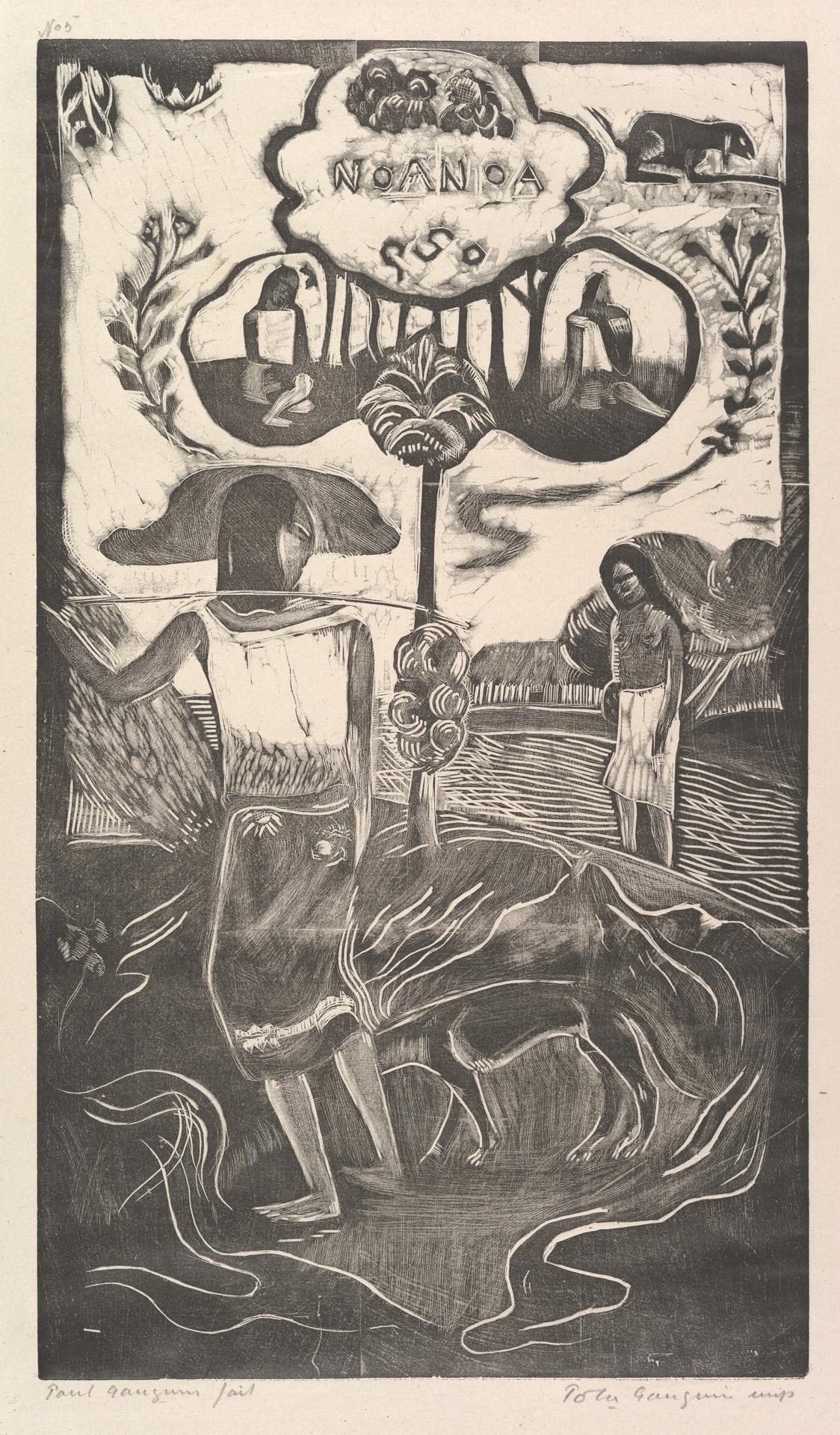
Noa Noa
Original title: Noa Noa
kurzbeschreibung
Unlike many of Gauguin's Tahitian images, this woodcut from 1893–94, printed in 1921 on China paper, places a single sheet of writing at its heart. It bears the title 'NOA NOA' and is surrounded by emblematic figures and natural motifs. The print belongs to the works that emerged from Gauguin's stay in Tahiti and his book project of the same name.
Description
A large, stylised leaf dominates the middle, displaying the words 'NOA NOA'. Below it stand two figures in a landscape: one holds a long, curving object, the other stands to the side. Further figures, trees and shrubs are suggested around them. Black and white define the print, with deep shadows and bright areas typical of woodcuts. The forms are simplified and charged with symbolic meaning.
Context
The woodcut was made during Gauguin's first Tahitian journey (1891–93) and the subsequent period in France. 'Noa Noa' – roughly 'fragrant' – was the title of a manuscript in which he recorded his experiences in the South Seas. The print was part of a series of woodcuts intended for the planned book, but these were not published in an edition until after his death in 1921. The motifs refer to his encounters in Polynesia and to local myths.
Impact
The strong contrasts and reduced formal language give the sheet a direct, expressive presence. The arrangement of the inscribed leaf, figures and landscape feels enigmatic and invites lingering. The coarse cutting lends the print something primal and handcrafted.
Technique
For this woodcut, the motif was cut into a block of wood and then pulled on China paper. This produces bold black lines and areas, while the white spaces let the paper colour show through. The rough, expressive cutting is typical of Gauguin's woodcuts from this period.
AI-generated description text
Source: Metropolitan Museum of Art · Public Domain (CC0 1.0)