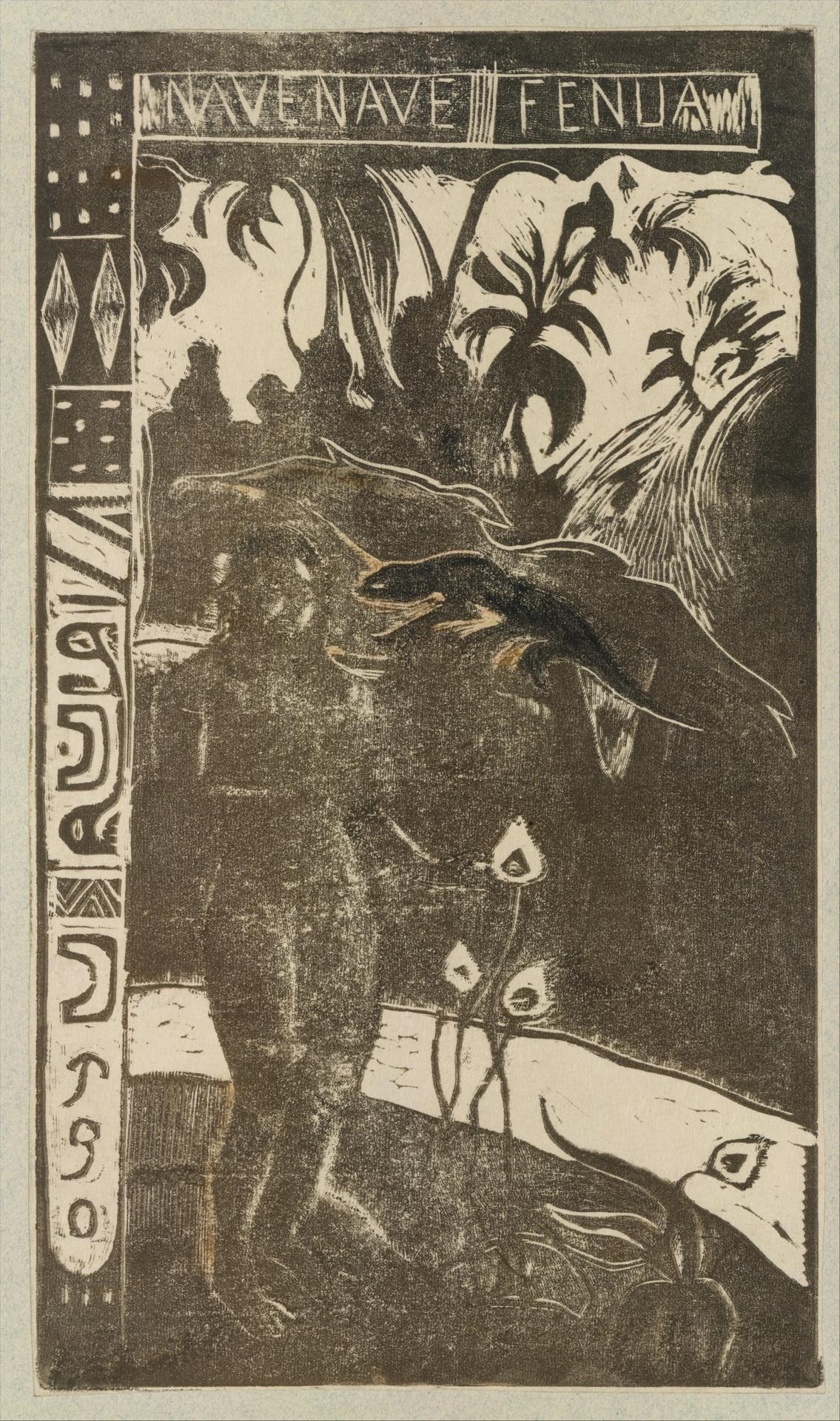
Delightful Land (1893–94, Met-Objekt 749)
Original title: Delightful Land
kurzbeschreibung
Paul Gauguin's woodcut 'Entzückendes Land' (Nave Nave Fenua) dates from 1893–94. It shows a stylised woman in an ornamental, lush setting. The print was pulled on china paper.
Description
A woman leans to the left, holding a feather; her hair flows over her face. Stylised leaves and flowers fill the background, with the inscription 'NAVENAVE FENUA' at the top. Geometric patterns appear on the left, and a small stylised eye sits at the lower right. Monochrome in shades of grey, the print features strong light-dark contrasts and sharp contours.
Context
This woodcut was made during Gauguin's first Tahiti trip (1891–1893) and finished after his return to France. It belongs to a series of woodcuts based on the artist's South Seas experiences. 'Nave Nave Fenua' comes from Tahitian and means 'delightful land'. In it, Gauguin worked through his idea of an exotic, untouched nature.
Impact
The reduced grey tones and clear lines create a calm, almost meditative mood. Ornamental design and symbolic elements give the sheet a mysterious, foreign aura.
Technique
Lines and hatching are cut into the woodblock and printed on china paper. The monochrome effect arises from varying printing pressures and shading, producing a tonal quality. Sharp contours and strong light-dark contrast are characteristic of this printing method.
AI-generated description text
Source: Metropolitan Museum of Art · Public Domain (CC0 1.0)