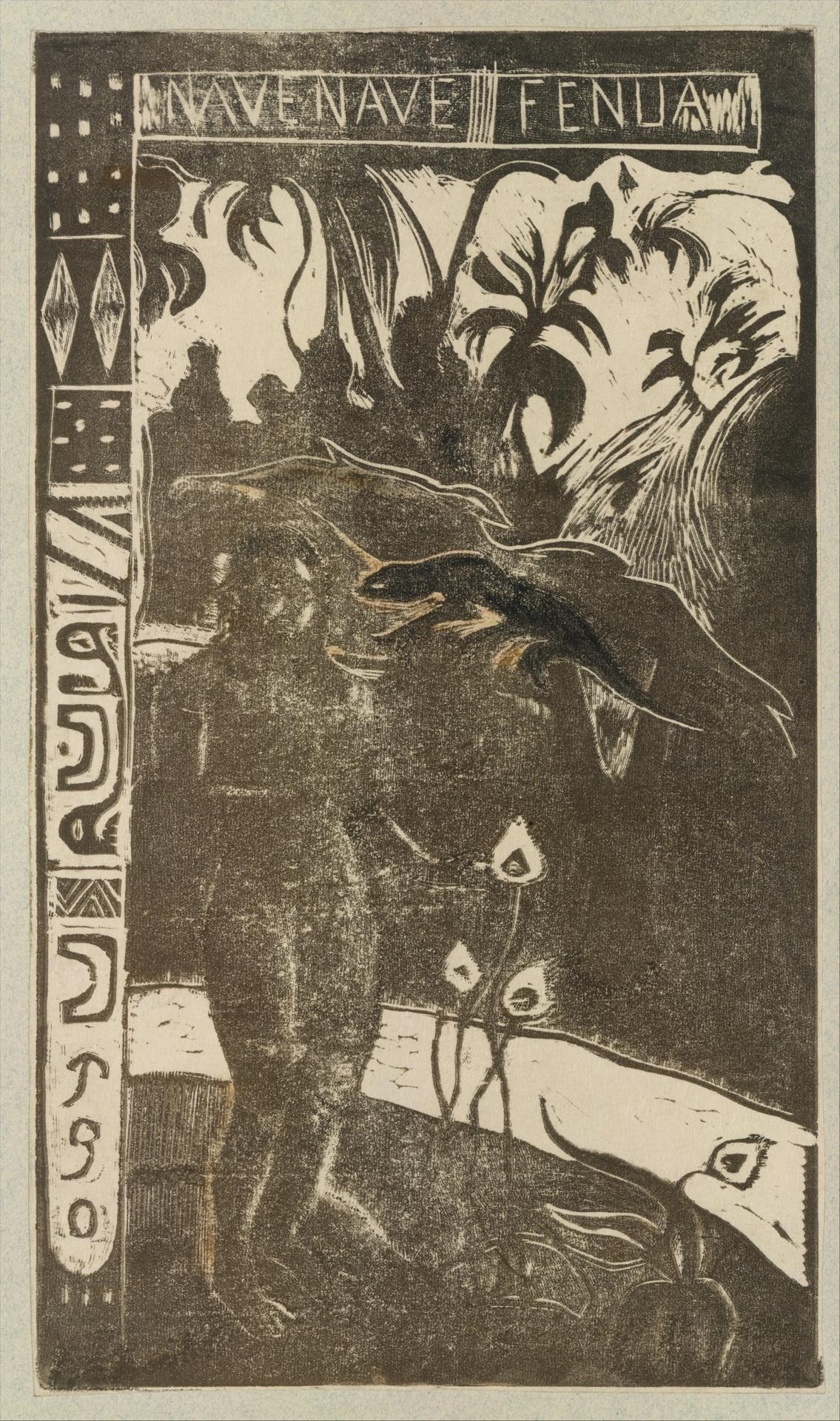
Delightful Land (1893–94, Met-Objekt 748)
Original title: Delightful Land
kurzbeschreibung
Paul Gauguin made "Entzückendes Land" (Nave Nave Fenua) in 1893–94 as a color woodcut. It shows a stylized landscape with plant forms, a figure, and a text band. The print on thin wove paper has a block size of 35.2 × 20.3 cm.
Description
In front stand dark, almost black plant forms and blossoms. Behind them a figure appears, surrounded by voluminous hair or fur. A text band with "NAVENAVE FENUA" runs across the top of the sheet. On the left edge are geometric patterns and numbers. The palette remains mostly somber, while flowers and figure stand out more brightly. Light falling from above sharpens the contours of the pictorial elements.
Context
Gauguin worked on this woodcut during his first stay in Tahiti (1891–1893) and finished it after returning to France. "Nave Nave Fenua" comes from Tahitian and means "delightful land." The sheet belongs to a series of woodcuts intended for the planned publication "Noa Noa." Motifs from his South Seas paintings are taken up and interwoven with symbolist elements.
Impact
The dark, strongly contrasting colors give the sheet something mysterious, almost mystical. Expressive lines and the stylized formal language feel decorative and at the same time enigmatic; the viewer is transported to a distant, exotic world.
Technique
Several colors were printed on thin wove paper for this sheet. Gauguin inked the printing block unevenly, creating varying layers of color and a relief-like surface. This results in the coarse, expressive texture of the print.
AI-generated description text
Source: Metropolitan Museum of Art · Public Domain (CC0 1.0)