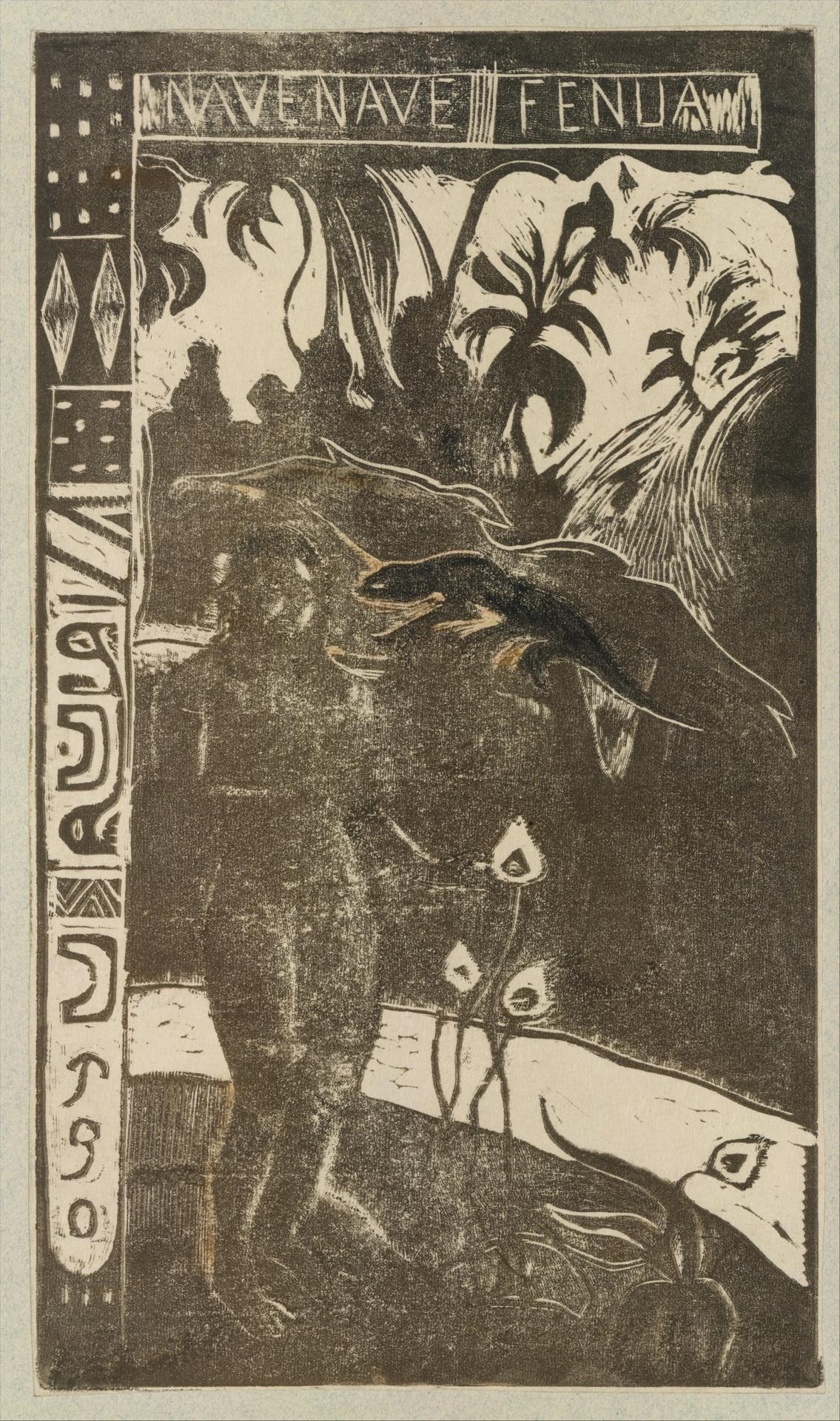
Delightful Land (1893–94, Met-Objekt 746)
Original title: Delightful Land
kurzbeschreibung
Paul Gauguin created "Delightful Land" ("Entzückendes Land") in 1893–94 as a color woodcut on wove paper. It presents a stylized landscape with a large tree, a figure, and an elephant-like animal.
Description
Across the top runs a band of text reading "NAVENAVE FENUA". Below it spreads a mighty tree with richly articulated leaves and branches. In the foreground stands a figure, beside it a large dark animal with long ears and a trunk, reminiscent of an elephant. Flowers and plants in concise, memorable forms fill the space around the figure; on the left appear geometric patterns and signs. Muted colors and a dark ground make contours and motifs stand out.
Context
The woodcut was made during Gauguin's stay in Tahiti, where he lived from 1891 to 1893. "Navenave Fenua" means "Delightful Land" in the Tahitian language and alludes to the South Seas idyll that Gauguin idealized in his works. After returning to France, he produced the print in an edition of about 25 to 30 copies. Gauguin used the woodcut as a medium to disseminate his Polynesian motifs.
Impact
The dark, high-contrast print creates a mysterious, almost dreamlike mood. Few bold forms and the ornamental surface effect give the sheet a decorative and at the same time archaic presence. Exotic animal depiction and plant motifs combine into a surreal, fairy-tale atmosphere.
Technique
For this color woodcut on wove paper, Gauguin used several woodblocks for the different colors. This allowed for bold yet muted color applications and a striking linear quality. The impressions were hand-colored and vary in hue, making each copy unique.
AI-generated description text
Source: Metropolitan Museum of Art · Public Domain (CC0 1.0)