Human Misery
Original title: Human Misery
kurzbeschreibung
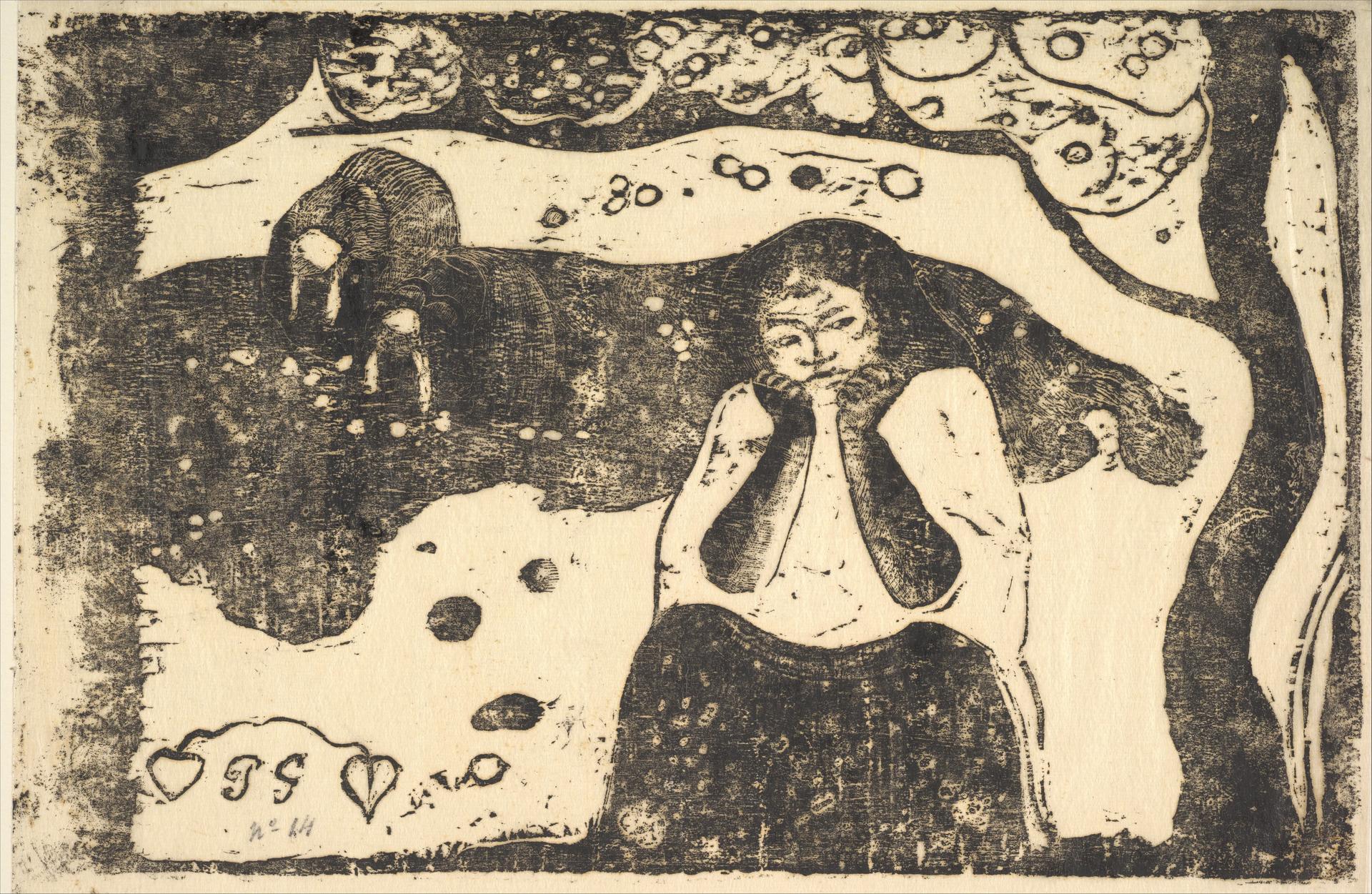
Paul Gauguin's woodcut 'Human Misery' dates from 1898–99. It depicts a seated woman resting her head in both hands. The print was pulled on thin, translucent Japan paper. It belongs to a group of graphic works made during Gauguin's time in Tahiti.
Description
The layout is asymmetrical. A female figure sits on the ground, roughly at the center, holding her head with both hands. Her posture and face convey deep sadness or despair. She wears a dress patterned with flower- or star-like shapes. Behind her, dark, abstract forms stand out against the lighter ground—perhaps clouds or symbolic signs. Grays dominate the palette, with nuances arising from the varying depths of the woodcuts.
Context
This woodcut was made during Gauguin's second stay in Tahiti. He had turned away from European civilization and sought original, spiritual forms of expression. During this period he was in poor health and financial straits, which may have contributed to the print's dark mood. He used the woodcut as an experimental medium, reinterpreting it and often working unconventionally. The prints appeared in small editions; they became known to a wider public only after his death.
Impact
The restrained gray palette and expressive linework give the sheet a melancholy, almost oppressive atmosphere. The central figure appears isolated and withdrawn, intensifying the emotional impact. Coarse contours and abstract background elements create a raw, immediate aesthetic that recalls the primal quality of Tahitian culture.
Technique
For this woodcut, the motif was cut into a wooden block and then printed on thin, transparent Japan paper. Gauguin used a bold, expressive cutting technique that produces sharp contours and fine lines. The various grays result from the differing depths of the cuts, which take up more or less ink during printing.
AI-generated description text
Source: Metropolitan Museum of Art · Public Domain (CC0 1.0)