Maruru
Original title: Maruru
kurzbeschreibung
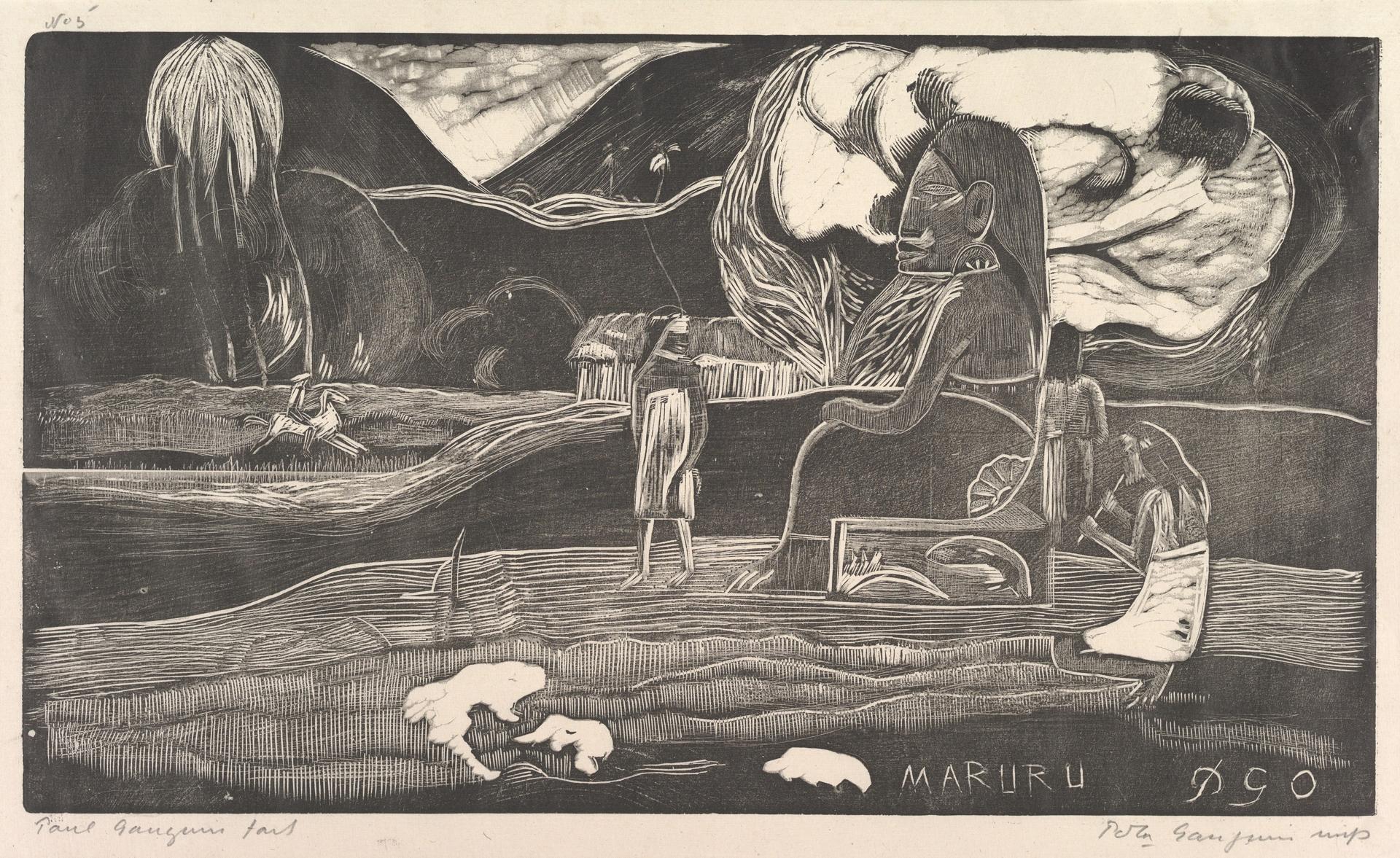
A woodcut by Paul Gauguin, made in 1893–94 and printed on China paper, bears the title "Maruru." It features a large figure with long hair and a hat, surrounded by other figures in traditional dress. Mountains and clouds form the backdrop, while two white dogs appear at the bottom edge.
Description
A towering figure with long hair and a hat dominates the image, standing as if at the heart of a ritual. Around them, several smaller individuals wrapped in traditional garments seem caught up in an action. Mountains rise behind, and clouds drift above, creating a mystical mood. Two white dogs are placed at the lower edge, adding to the foreground activity. The stark black-and-white contrast heightens the dramatic effect.
Context
Gauguin made this woodcut during his stay in Tahiti, which lasted from 1891 to 1893. The print was created after his return to France, when he was processing his South Seas experiences in graphic works. Prints like "Maruru" were part of his experiments with woodcut, which he explored intensively at that time. The rendering of rituals and traditional motifs reveals Gauguin's interest in Tahitian culture.
Impact
The expressive style and hard contrasts of light and dark give the scene a dramatic yet enigmatic aura. The few tonal values direct attention to the forms and the symbolic imagery characteristic of Gauguin's late work. Through the commanding figure and the elements surrounding it, the arrangement feels both monumental and inward-looking.
Technique
For this print, the motif was cut into a wooden block and then pulled onto China paper. The process allows for bold lines and areas that acquire a distinct texture through printing. Gauguin used the contrasts of black-and-white printing to achieve physicality and emotional depth.
AI-generated description text
Source: Metropolitan Museum of Art · Public Domain (CC0 1.0)