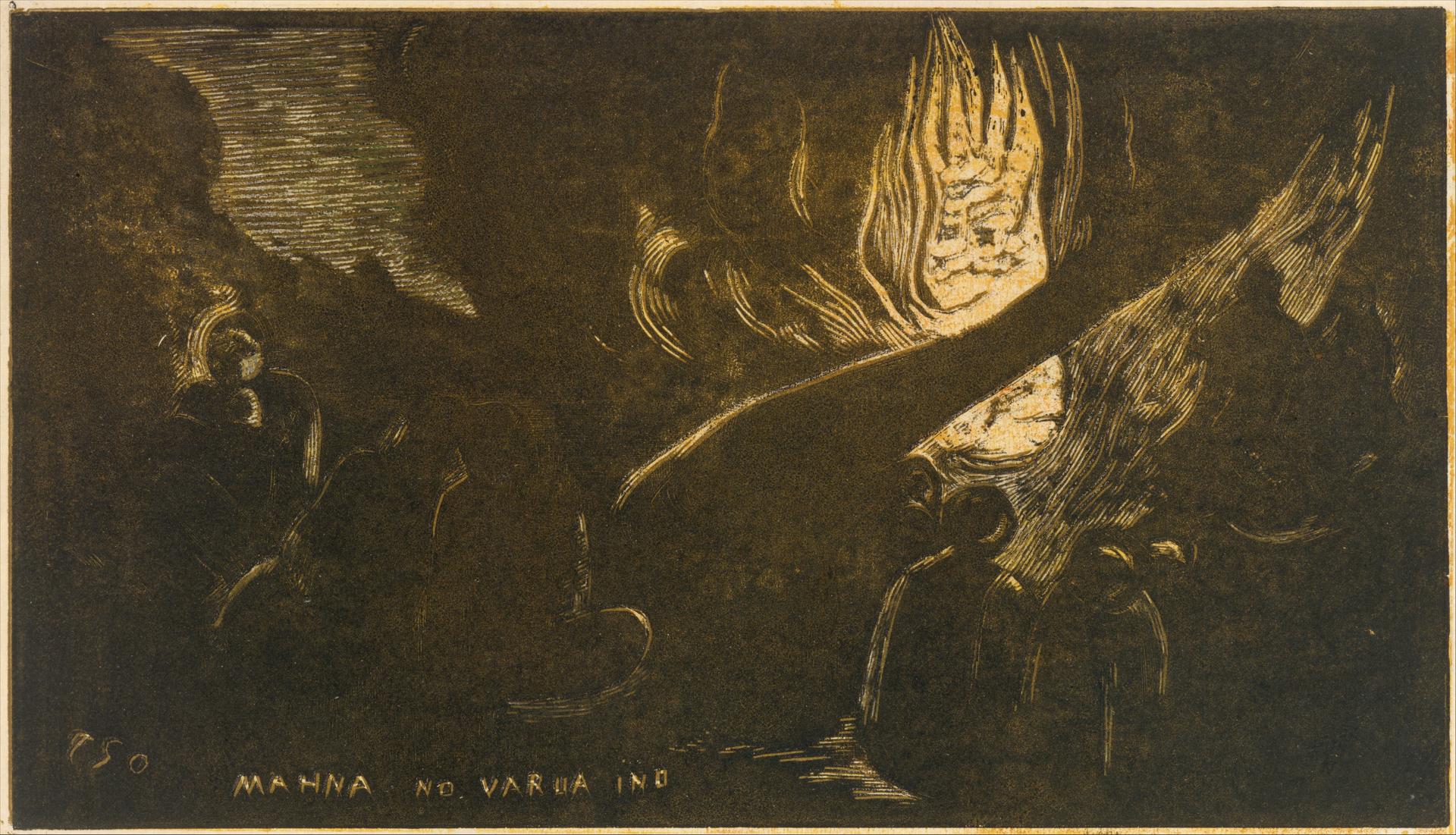
The Devil Speaks (Mahna No Varua Ino), from Fragrance (Noa Noa)
Original title: The Devil Speaks (Mahna No Varua Ino), from Fragrance (Noa Noa)
kurzbeschreibung
Paul Gauguin made this color woodcut in 1893–94, after his first stay in Tahiti. A dark, abstracted figure stands in the foreground, with two large golden winglike forms rising behind it. The print belongs to the 'Noa Noa' series, in which Gauguin explored his South Seas experiences and myths.
Description
An almost black, shadowy figure stands at the front, seemingly frozen in a gloomy setting. Behind it loom two powerful golden shapes with a winged character that could be read as angels or devils. The layout is asymmetrical and draws the eye to the golden areas. Dark tones dominate the color scheme, broken by strong gold accents that create a mystical mood.
Context
Gauguin lived in Tahiti from 1891 to 1893, then returned to France, where he created the woodcuts for the planned publication 'Noa Noa'. 'Mahna No Varua Ino' refers to Tahitian beliefs about evil spirits. The series falls in a phase when Gauguin broke away from European conventions and sought a 'primitive' mode of expression.
Impact
The contrast between the dark figure and the luminous gold surfaces creates an atmosphere that is both threatening and alluring. The rough, reduced linework of the woodcut heightens the impression of primitiveness and mystery.
Technique
The color woodcut used several printing blocks, one for each color. It was printed on Japanese paper, valued for its fine texture and strong absorbency. The coarse cutting and bold contrasts define Gauguin's experimental approach to the medium.
AI-generated description text
Source: Metropolitan Museum of Art · Public Domain (CC0 1.0)