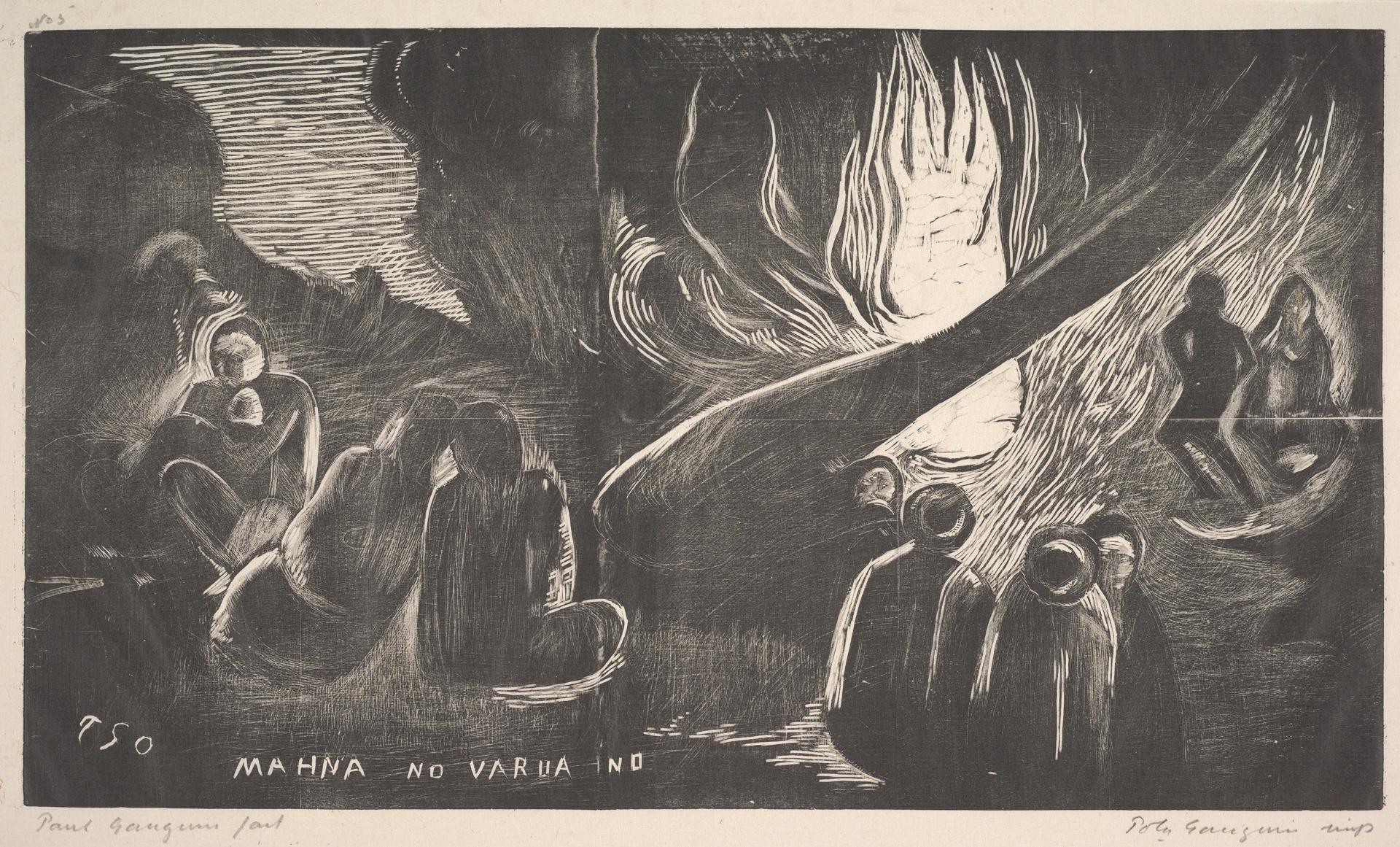
The Devil Speaks
Original title: The Devil Speaks
kurzbeschreibung
Paul Gauguin's woodcut 'Der Teufel spricht' (The Devil Speaks), made in 1893–94, presents a dark scenario: several figures and a blazing apparition in the background. The print is in black and white on china paper.
Description
A large, flaming being dominates the layout; a halo surrounds it and draws the eye. In front, several figures crouch or lie, their faces showing fear or dismay. The scene is gloomy and enigmatic, almost entirely in black and white, which heightens the eerie mood. The lines are forceful and give the print a dynamic, emotionally charged impact.
Context
Gauguin created this woodcut during his first stay in Tahiti (1891–1893), where he engaged deeply with local culture and mythology. The motif belongs to a series of woodcuts made after his return to France and shaped by his South Seas experiences. The devil figure likely stems from Christian influences that Gauguin combined with Polynesian ideas.
Impact
The dark tonality and the central flaming being evoke a disturbing, mysterious atmosphere that captivates the viewer. Expressive lines and the dynamic arrangement convey an emotional intensity characteristic of Gauguin's late work.
Technique
For this print, Gauguin cut into a woodblock and printed it with black ink on china paper. The rough, expressive cutting leaves the tool marks clearly visible, giving the print a handmade, raw quality. The china paper provides a fine, matte surface that emphasizes the contrasts between black and white.
AI-generated description text
Source: Metropolitan Museum of Art · Public Domain (CC0 1.0)