la Orana Maria
Original title: la Orana Maria
kurzbeschreibung
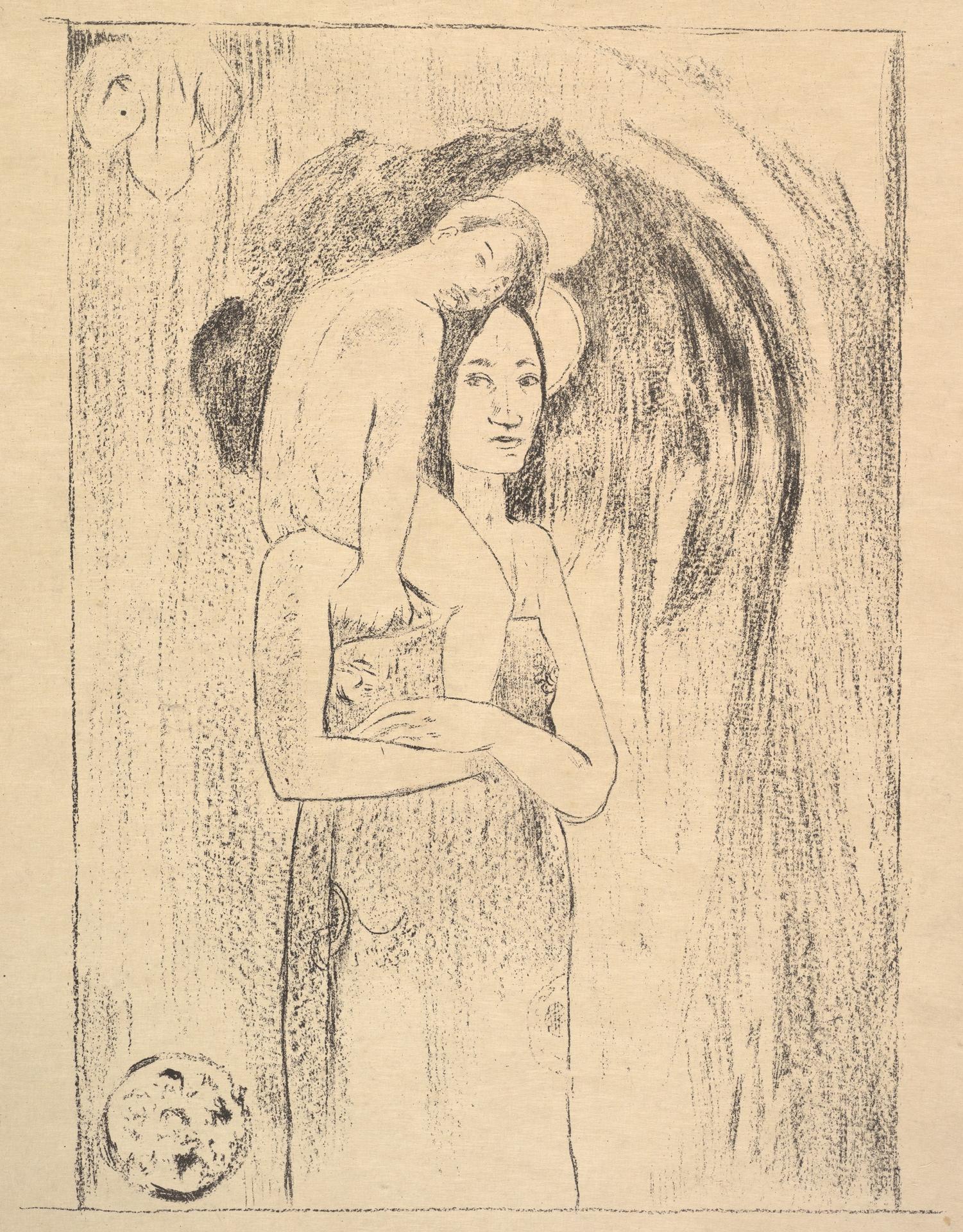
Paul Gauguin made this zincograph, titled Ave Maria (la Orana Maria), in 1894–95. Printed in black on beige-white paper, it shows Mary in monochrome line, an angel placing a halo on her head.
Description
Mary stands facing us, arms folded, in a simple robe. From behind, an angel steps forward with a sweeping motion and holds the halo above her head. His wings are drawn with fluid, energetic strokes. A second stylized figure, possibly Mary again, is suggested in the background. At lower left sits a cross-like sign, hinting at religious meaning. The arrangement is asymmetrical, the main figure clearly emphasized in the foreground, all in black on a light ground.
Context
During his second stay in Tahiti, Gauguin turned intensively to local motifs and Christian themes. This zincograph relates to his 1891 painting la Orana Maria, which shows a Tahitian Mary with child. The printing process allowed him to circulate his images in larger editions and make them available to a European audience. The stylized formal language connects European iconography with influences from Oceanic art.
Impact
From the first glance, a quiet, meditative mood takes hold, arising from the monochrome execution and the lively linework. The reduced forms and asymmetrical layout give the sheet a modern, almost graphic feel that speaks directly to the viewer.
Technique
As a zincograph, a planographic process using a zinc plate as the printing block, the technique allowed Gauguin fine hatching and soft transitions that give the figures depth. It was printed in black on beige-white paper; the linework carries the artist's characteristic hand.
AI-generated description text
Source: Metropolitan Museum of Art · Public Domain (CC0 1.0)