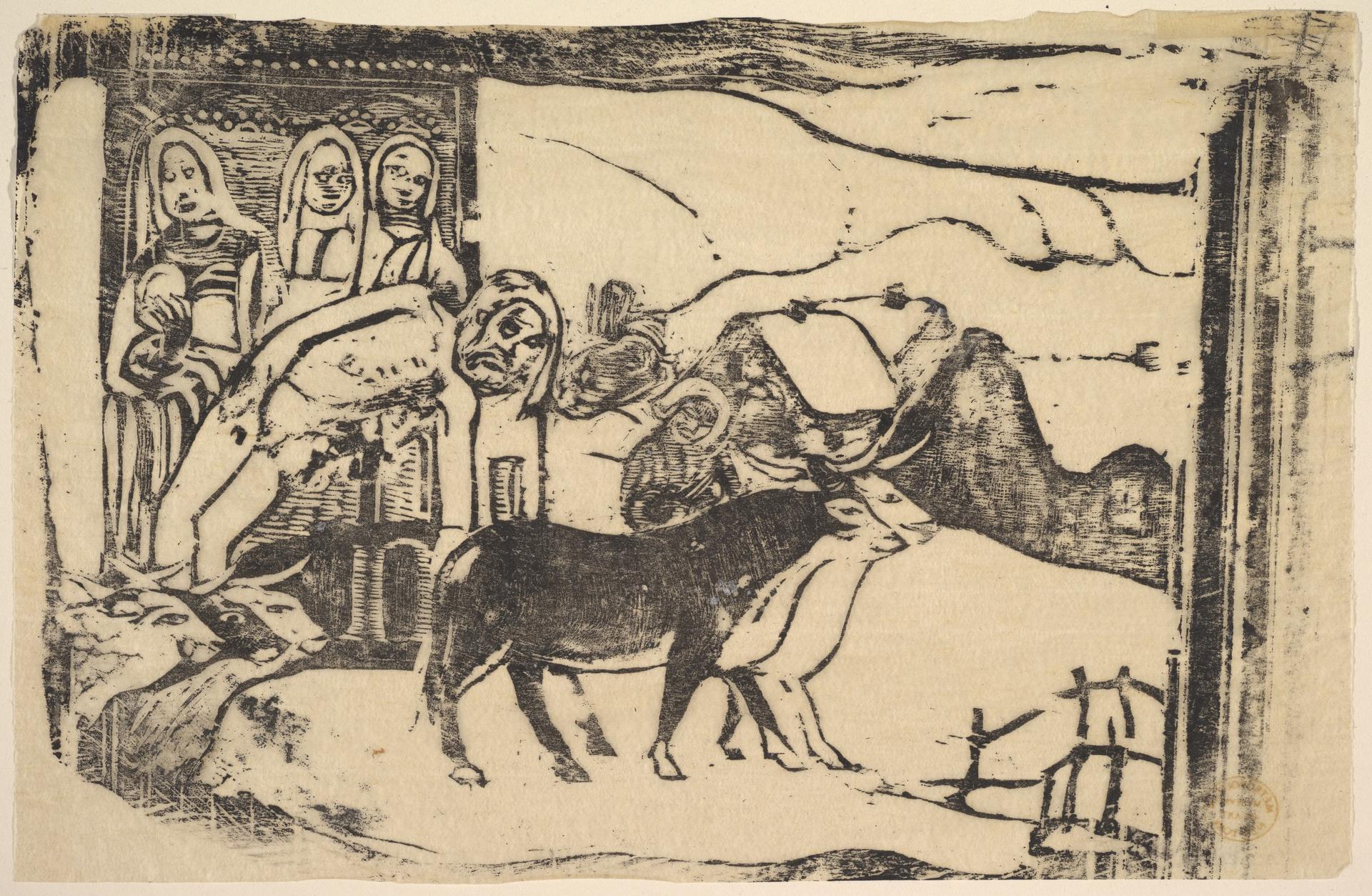
Le Calvaire Breton
Original title: Le Calvarie Breton
kurzbeschreibung
Paul Gauguin's woodcut "Le Calvarie Breton" (1898–99) stands apart from other Passion depictions by fusing Breton memory with Tahitian present. Printed on japan tissue, the sheet belongs to a group of woodcuts made during Gauguin's second stay in Tahiti.
Description
Unlike many Crucifixion images, this print places a suffering figure directly beneath the cross at its heart, surrounded by several companions. On the right, a figure with an arrow or lance alludes to the Passion. Further back, more people and possibly animals are sketched. Bold, clear lines define the image; the colouring stays monochrome in shades of grey and white, and the light appears even, with no visible shadows.
Context
During his second Tahitian period, Gauguin turned increasingly to the woodcut as a means of expression. The motif of the Breton calvary points back to his earlier years in Brittany, where he worked in Pont-Aven in 1889–90. In this phase he sought to realise his artistic ideals through a primitivist aesthetic.
Impact
The restrained palette and weighty lines give the sheet something archaic, almost expressive. The unusual arrangement, with the suffering figure at its centre, creates a strong emotional tension that grips the viewer directly.
Technique
For this work Gauguin used the woodcut on japan tissue: the motif is cut into a block of wood and then printed. The striking linear quality and monochrome colouring are characteristic of his woodcuts from those years, which often employ rough cutting and reduced printing inks.
AI-generated description text
Source: Metropolitan Museum of Art · Public Domain (CC0 1.0)