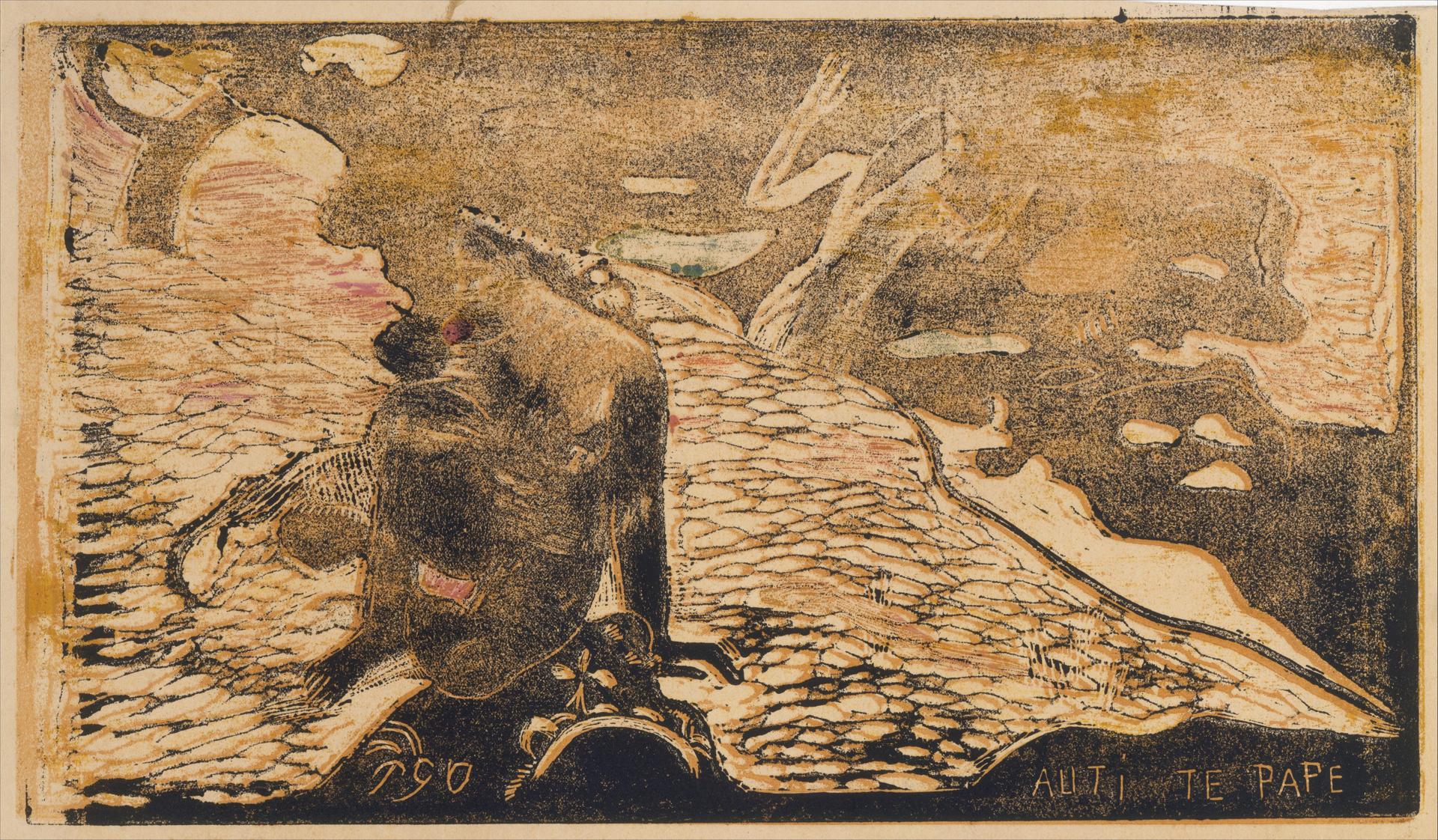
Auti Te Pape (1893–94, Met-Objekt 734)
Original title: Auti Te Pape
kurzbeschreibung
Paul Gauguin's woodcut Auti Te Pape dates from 1893–94. It depicts a figure seated on a rock, surrounded by abstracted forms. The print belongs to Gauguin's South Seas period and was printed on china paper.
Description
In the foreground, a figure sits on a rock, holding something in one hand. The figure wears a head covering and appears deeply absorbed. Behind, lines and shapes suggest clouds or landscape elements. The colors remain subdued: brown tones dominate, with occasional red and green accents. Light falling from above highlights the figure's contours and shadows.
Context
This woodcut emerged during Gauguin's first Tahiti stay from 1891 to 1893. The Tahitian title points to his engagement with local culture. After returning to France, he made the print as he translated his South Seas experiences into art.
Impact
A calm, contemplative mood emanates from the print, carried by the muted colors and the figure's quiet posture. The abstract elements in the background create a mysterious atmosphere and invite close looking.
Technique
Gauguin worked in woodcut: the motif is cut into a wooden block and then pulled on china paper. The thin paper allows the structure of the printing block to stand out clearly. Several layers of color and fine lines give the work its detailed texture.
AI-generated description text
Source: Metropolitan Museum of Art · Public Domain (CC0 1.0)