Auti Te Pape (1893–94, Met-Objekt 733)
Original title: Auti Te Pape
kurzbeschreibung
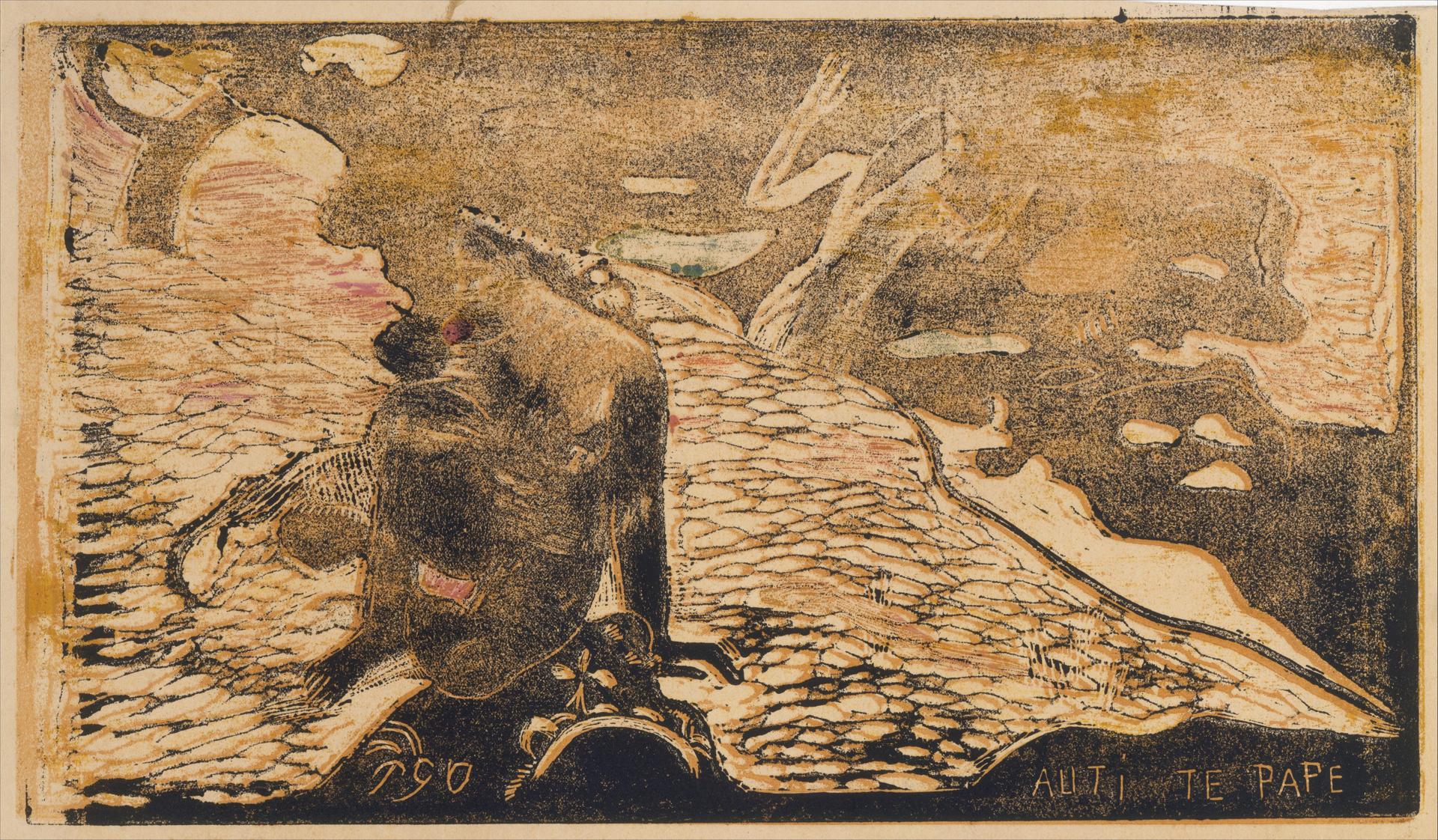
Paul Gauguin made Auti Te Pape in 1893–94 as a color woodcut. A seated figure on a rock appears, surrounded by sign-like objects; the sheet was printed on Japan paper.
Description
A dark figure wearing a headpiece sits on a rock and looks to the right. Beside it lie a shield- or armor-like form and a skull-like object. Abstract shapes and areas of color fill the background, suggesting sky or landscape. The layout feels asymmetrical, and muted browns are broken by light and dark accents.
Context
The woodcut originated during Gauguin's first Tahiti trip (1891–1893) and was finished after his return to France. Gauguin used the woodcut technique as a means of expression for his Polynesian motifs and experimented with it. The title Auti Te Pape comes from the Tahitian language and attests to his interest in local culture. The sheet belongs to a series of prints he created in Paris in 1893–94.
Impact
The expressive linework and restrained browns evoke a calm, archaic mood. Through the asymmetrical arrangement and the sign-like objects, the scene gains an enigmatic, almost mystical aura.
Technique
The colors were applied in several printing passes. Fine Japan paper served as the support, allowing the structure of the printing blocks to emerge clearly. Rough lines and flat areas demonstrate the handcrafted directness of the process.
AI-generated description text
Source: Metropolitan Museum of Art · Public Domain (CC0 1.0)