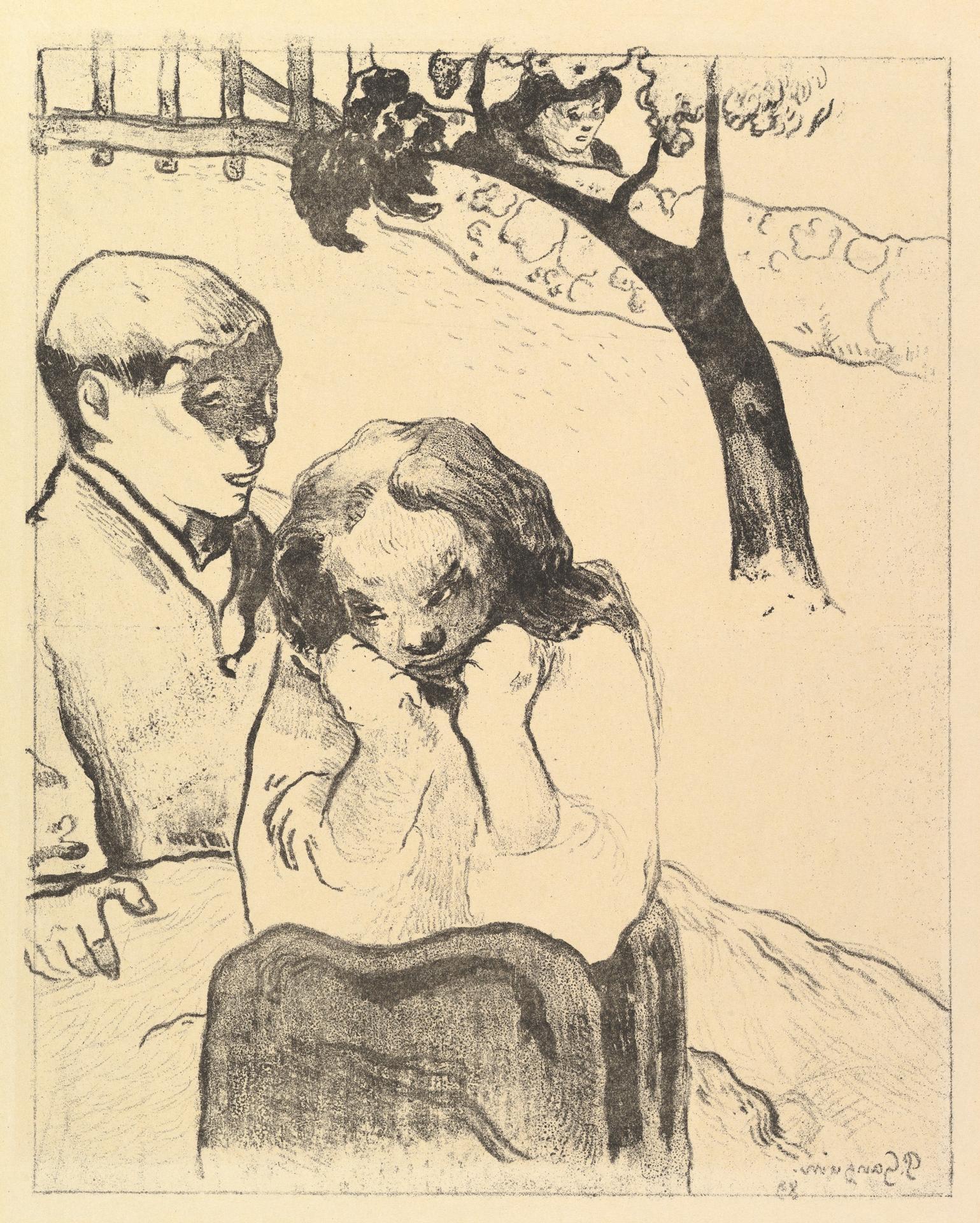
Human Misery, from the "Volpini Suite: Dessins lithographiques"
Original title: Human Misery, from the "Volpini Suite: Dessins lithographiques"
kurzbeschreibung
A woman collapses in despair in the foreground of Paul Gauguin's 1889 zincograph 'Menschliches Elend', her face buried in her hands, while a man tries to comfort her. Behind the pair, another woman crouches in a tree holding a piece of fruit. The print belongs to the 'Volpini Suite: Dessins lithographiques' and was printed in brown ink on chrome yellow wove paper.
Description
The arrangement is lopsided, pulling the eye straight to the seated woman up front, her head dug into her hands and her posture heavy with sadness. A bald man stands at her side, his hand resting gently on her shoulder. Further back, a woman sits in a tree, holding a plant or fruit, looking over toward the seated figure. The drawing stays sketchy, built from clear lines with no shading or deep shadows.
Context
Gauguin made this sheet in 1889 in Brittany, at a point when he was turning away from academic art. It belongs to the 'Volpini Suite', a set of zincographs he had printed at a café for that year's Paris World's Fair. The series reflects his interest in plain, existential subjects and his break with Impressionism.
Impact
From the first glance, the mood feels quiet but weighted down, produced by the spare lines and the yellow ground. Despair and consolation are presented directly and forcefully, without sentimental embellishment.
Technique
For this sheet Gauguin used zincography, a lithographic method in which a zinc plate replaces the usual limestone. It was printed in brown ink on chrome yellow wove paper; the first edition appeared in 1889.
AI-generated description text
Source: Metropolitan Museum of Art · Public Domain (CC0 1.0)