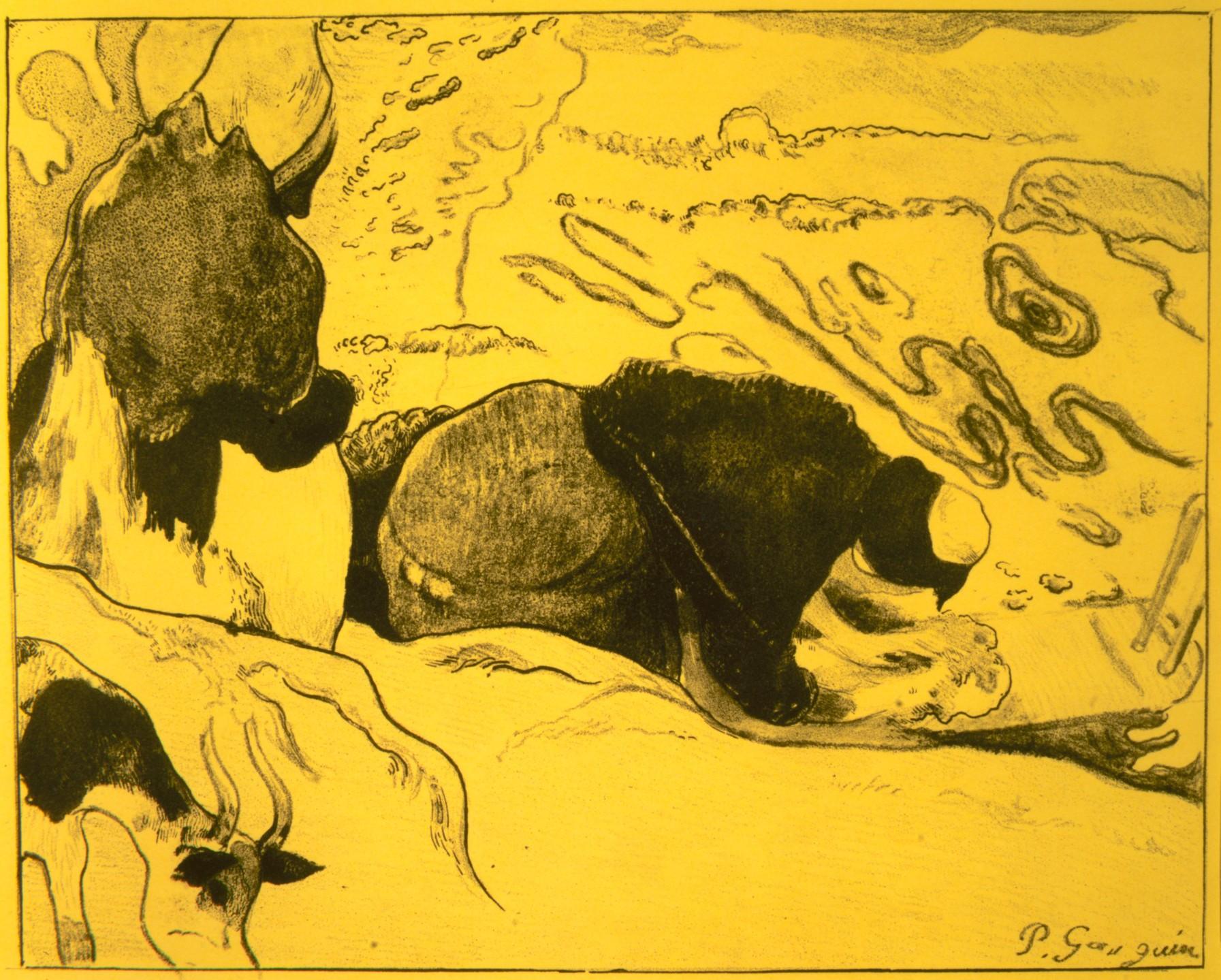
Washerwomen, from the "Volpini Suite: Dessins lithographiques"
Original title: Washerwomen, from the "Volpini Suite: Dessins lithographiques"
kurzbeschreibung
Unlike many sheets in the Volpini Suite, Paul Gauguin's 1889 zincograph 'Wäscherinnen' presents two women on sand whose faces remain hidden. The first edition was printed on chrome yellow wove paper.
Description
Two female figures occupy a sandy ground, but their faces cannot be made out, leaving identity and feeling concealed. They engage in an everyday or ritual activity, perhaps washing or cleaning. Flowing lines suggest sand and sky. Yellow and brown tones dominate the palette, creating a warm, almost surreal mood. The linear flow feels fluid and expressive, as is typical of Gauguin.
Context
Gauguin made this print in 1889 while living in Brittany and drawing inspiration from rural scenes. The Volpini Suite was created for the exhibition at the Café Volpini during the 1889 Paris World's Fair. With zincography, an inexpensive printing method, Gauguin could produce a large edition. The series often brings together rural life and visions of Tahiti.
Impact
The subdued color and hidden faces give the image a mysterious, quiet atmosphere. Expressive lines and warm tones produce an almost dreamlike effect that draws the viewer into the scene.
Technique
This sheet is a zincograph, a lithographic process using a zinc plate as the printing support. It was printed on chrome yellow wove paper, which enhances the warm color effect. The first edition appeared in 1889; further editions followed later.
AI-generated description text
Source: Metropolitan Museum of Art · Public Domain (CC0 1.0)