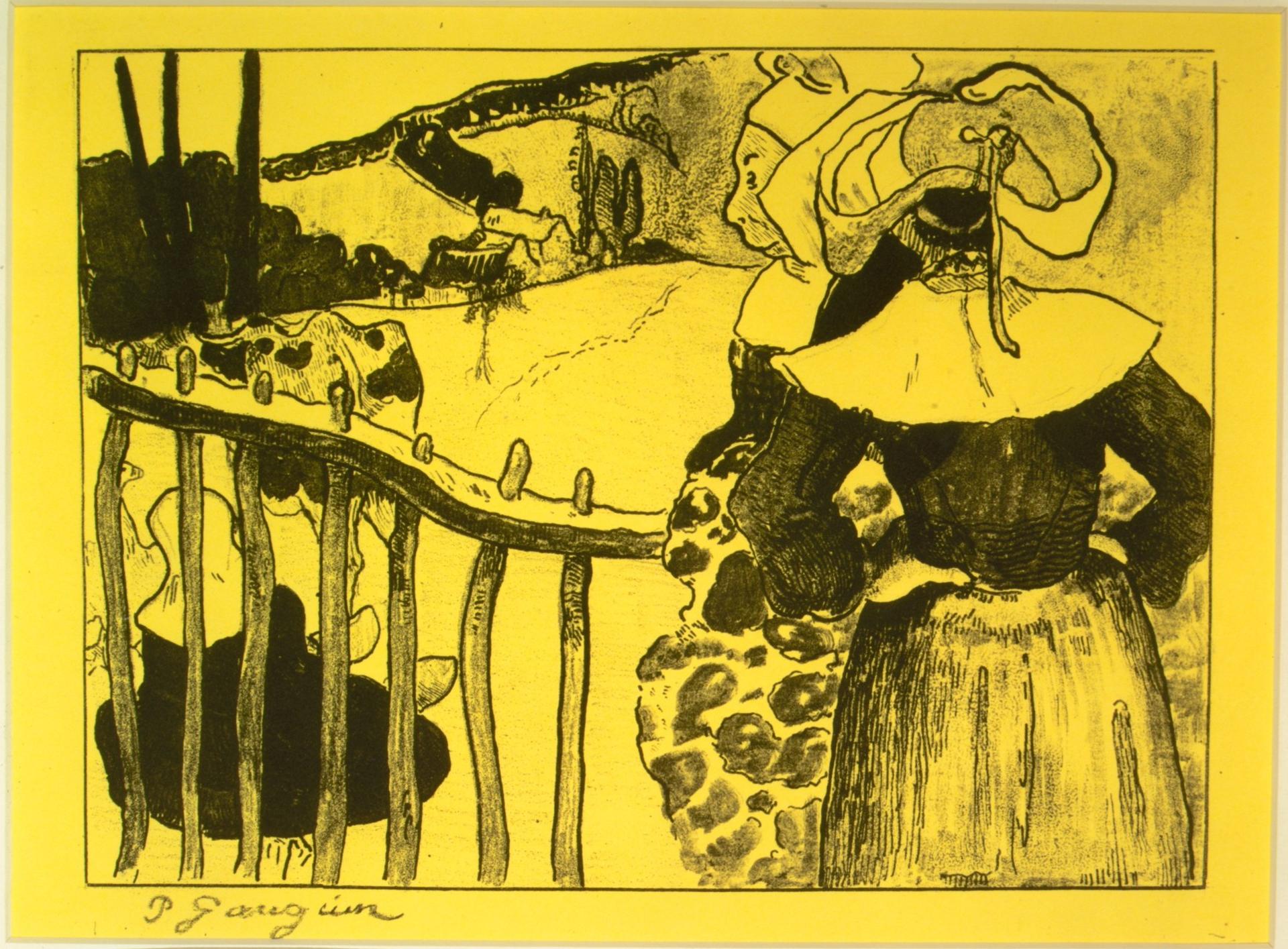
Bretonnes à la Barrière, from the "Volpini Suite: Dessins lithographiques"
Original title: Bretonnes à la Barrière, from the "Volpini Suite: Dessins lithographiques"
kurzbeschreibung
Paul Gauguin's zincograph 'Breton Women at the Gate' was made in 1889 and shows a peasant woman in Breton dress leaning against a barrier. The print belongs to the 'Volpini Suite: Dessins lithographiques' and was printed on yellow paper.
Description
A woman in traditional Breton clothing bends over a gate or platform. She wears a wide, flat cap, a dark bodice, and a long, ribbed skirt; her hands suggest she is leaning or pausing. Behind her lies a landscape with trees and a dark, almost black area that could be water or a deep hollow. The layout is asymmetrical: the figure dominates the right side, the landscape the left. The palette is limited to yellows and blacks, with the yellow paper providing the highlights and dark contours defining the drawing.
Context
Gauguin created the 'Volpini Suite' in 1889 during his stay in Pont-Aven, an artists' colony in Brittany. The suite was intended for the exhibition at the Café Volpini on the occasion of the 1889 Paris World's Fair. The zincographs were printed in an edition of about 50 copies on yellow paper, which Gauguin chose for its high-contrast effect. Breton peasant women were a central motif in Gauguin's work of this period, in which he captured the rural life and religious tradition of the region.
Impact
The coarse black lines and the luminous yellow of the paper immediately strike the viewer as graphic tension. The reduced palette and simplified forms give the print a monumental, almost symbolist presence that goes beyond mere documentation of everyday life.
Technique
For this print, a zinc plate served as the printing block, a lithographic process. Gauguin used the technique to achieve bold, high-contrast lines, which he printed on yellow paper. The rough, expressive stroke is typical of his style and emphasizes the flatness and ornamental effect of the arrangement.
AI-generated description text
Source: Metropolitan Museum of Art · Public Domain (CC0 1.0)