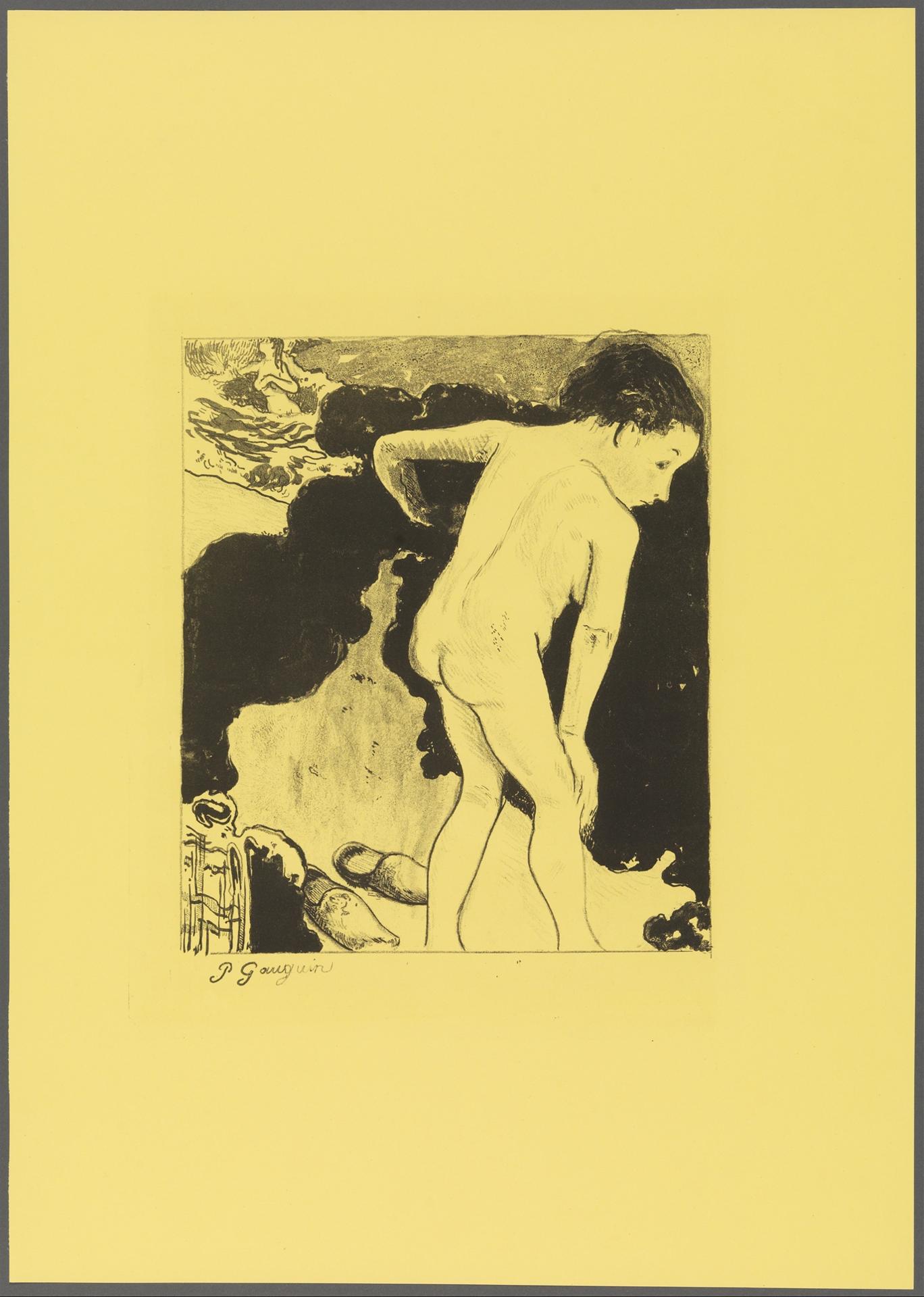
Bathers in Brittany, from the "Volpini Suite: Dessins lithographiques"
Original title: Bathers in Brittany, from the "Volpini Suite: Dessins lithographiques"
kurzbeschreibung
In 1889 Paul Gauguin made the zincograph 'Bathers in Brittany' as part of the 'Volpini Suite: Lithographic Drawings'. It shows a nude man leaning to the left, holding something in the water, surrounded by dark, flowing shapes.
Description
A nude man bends to the left and reaches one arm into the water. Dark, flowing forms that suggest water or clouds fill the background. Grays dominate the image, with the background darker and the foreground lighter. Light from the front emphasizes the man's contours. The style is expressive and belongs to Post-Impressionism.
Context
The 'Volpini Suite' was created in 1889 during Gauguin's stay in Pont-Aven in Brittany, where he began experimenting with zincography. The prints were first shown in 1889 at the exhibition of the Impressionist and Synthetist Group at the Café Volpini in Paris. Gauguin used zincography as a cheaper alternative to lithography to bring his work to a wider audience.
Impact
The expressive lines and strong contrast between light and dark give the sheet a lively, almost dramatic presence. The restriction to grays and the flowing forms create a calm, meditative mood that draws the viewer into the scene.
Technique
This sheet is a zincograph, a printing process that uses a zinc plate instead of a lithographic stone. It was printed on chrome yellow wove paper; the work belongs to the first edition of the 'Volpini Suite'. Zincography allowed fine lines and a quick transfer of the drawing, which suited Gauguin's spontaneous style.
AI-generated description text
Source: Metropolitan Museum of Art · Public Domain (CC0 1.0)