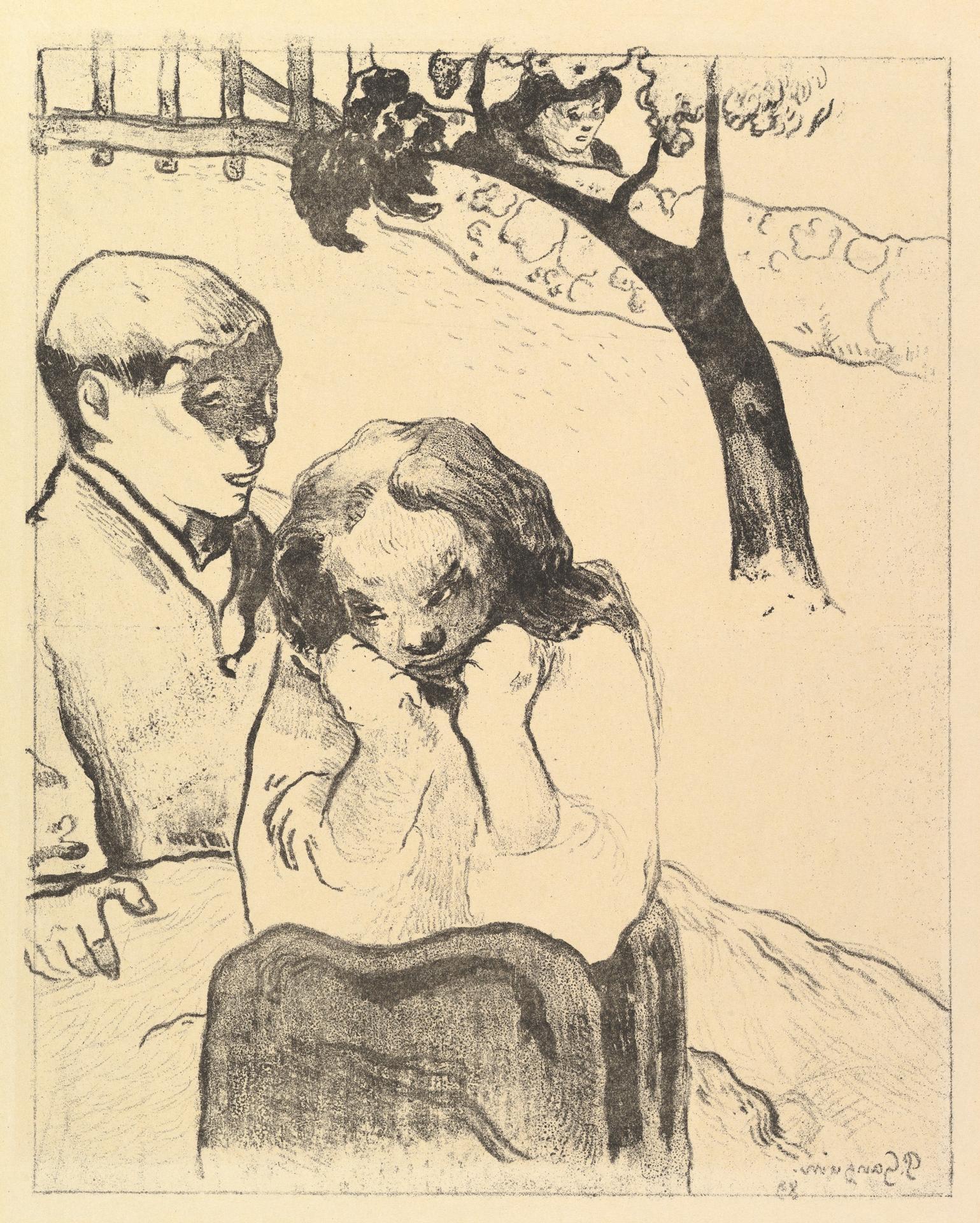
Human Misery, from the Volpini Suite: Dessins lithographiques
Original title: Human Misery, from the Volpini Suite: Dessins lithographiques
kurzbeschreibung
Unlike many sheets in the Volpini suite, which often appear purely decorative or exotic, Paul Gauguin's zincograph "Human Misery" from 1889 centers on a rural scene with two figures in the foreground and another person in the background. Printed on simili-Japan paper, this work belongs to the second edition and combines social observation with a reduced, almost graphic visual language.
Description
In front, a woman sits with her upper body bent forward, holding her forehead with both hands—a gesture that expresses despair. Behind her stands a man with a serious expression, watching her. Further back, a person sits on a tree branch, smoking. A wooden bridge and more trees anchor the view in a rural setting. The layout remains monochromatic and thrives on strong contrasts between dark and light areas.
Context
Gauguin made this print in 1889 in Brittany, ahead of the exhibition at the Café Volpini during the Paris World's Fair. The Volpini suite brought together several zincographs intended as an affordable edition. The theme of human misery runs through Gauguin's work of those years and is shaped by social observation and existential gloom.
Impact
The woman's hunched posture and the man's grave gaze intensify the somber mood. Monochromatic tonality and harsh light-dark contrasts give the sheet something dramatic, almost graphic. Clear lines and flat areas also create a calm, contemplative atmosphere.
Technique
This sheet is a zincograph, a cheap variant of lithography in which the drawing is transferred to a zinc plate. It was printed on simili-Japan paper, whose fine, slightly textured surface supports the effect. The technique manifests in sharp contours and a fine dot pattern that generates the tonal values.
AI-generated description text
Source: Metropolitan Museum of Art · Public Domain (CC0 1.0)