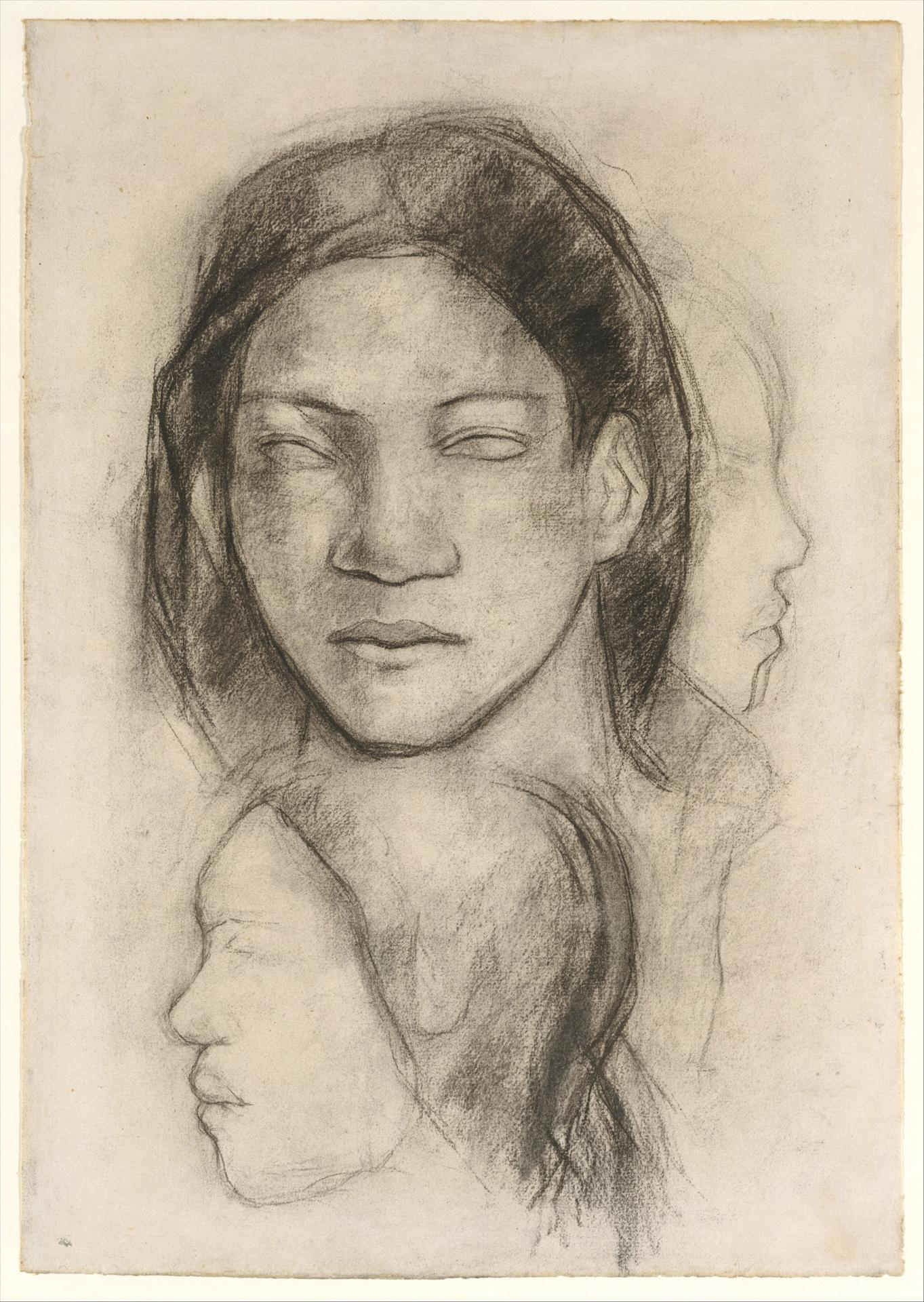
Tahitian Faces (Frontal View and Profiles)
Original title: Tahitian Faces (Frontal View and Profiles)
kurzbeschreibung
Paul Gauguin's drawing "Tahitian Faces (Frontal View and Profiles)" dates from around 1899 and gathers several charcoal studies of Tahitian faces on a single sheet of laid paper. It includes a frontal view with closed eyes and two profile studies. The sheet documents Gauguin's enduring interest in the facial features of South Sea islanders.
Description
A frontal face with closed eyes and hair wrapped in a headcloth dominates the foreground. To its right appear two profile views of the same or similar models. The drawing remains monochrome in shades of gray; the light feels even and avoids harsh shadows. It renders the structure of the headcloth and the facial features with realistic detail.
Context
During his second stay in Tahiti (1895–1901), Gauguin made this study, in which he engaged closely with the local people and their culture. It likely served as preparatory work for paintings or prints from those years. It belongs to a series of head studies that attest to Gauguin's engagement with Tahitian facial types. Later the sheet entered the collection of the Metropolitan Museum of Art, where it is shown as part of the holdings.
Impact
The drawing feels focused and calm because it places the faces and their expressions at the center. The juxtaposition of frontal and profile views creates a rhythmic layout that invites comparative looking. The closed eyes of the frontal figure give the work a meditative, inward-turned mood.
Technique
For this work Gauguin used charcoal on laid paper, a handmade paper with a pronounced surface texture. Charcoal allows both fine lines and soft shading, which enables the detailed rendering of facial features and fabric structures. The drawing is monochrome; the various gray tones arise from varying pressure and changing stroke direction.
AI-generated description text
Source: Metropolitan Museum of Art · Public Domain (CC0 1.0)