Hail Mary (Ia Orana Maria)
Original title: Hail Mary (Ia Orana Maria)
kurzbeschreibung
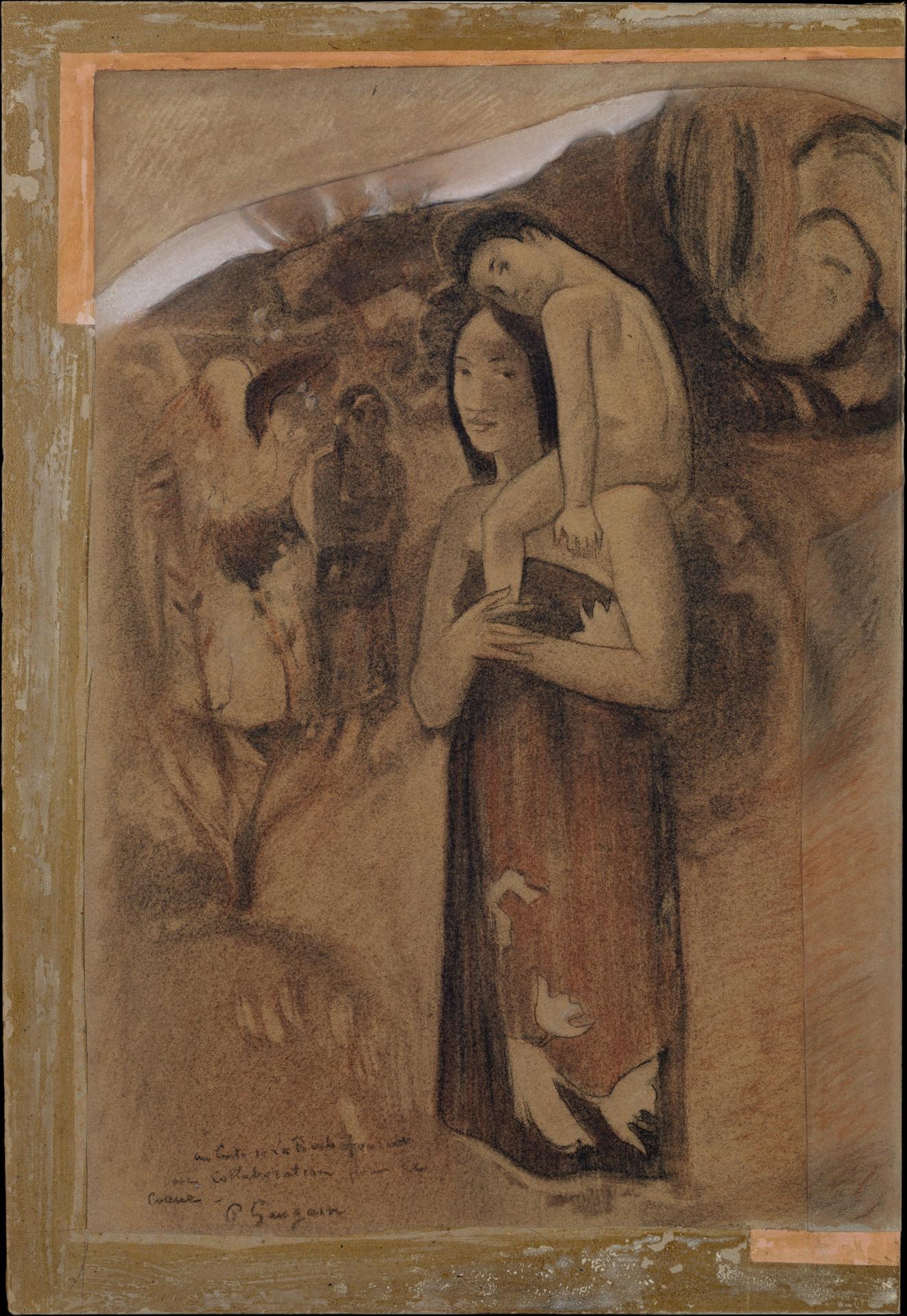
Paul Gauguin made this drawing, Ave Maria (Ia Orana Maria), around 1893–95. It presents an Annunciation-like scene: a woman carrying a child on her back is surrounded by angels. Gauguin worked in charcoal, red chalk, and white pastel on what was once blue laid paper.
Description
A woman in a long dark garment bears a child on her back, and the child holds a book. Several angels stand behind her in a semicircle, one raising a crown above her head. Brown tones dominate the muted coloring, while light enters from above and lifts the figures out. The arrangement is symmetrical, with the woman and child at its heart, ringed by the angels. An expressive style joins traditional religious iconography to a modern, forceful way of seeing.
Context
Gauguin began the work during his first stay in Tahiti (1891–1893) and likely finished it after returning to France. It belongs to a group of works that carry Christian themes into Polynesian culture. The Tahitian inscription Ia Orana Maria translates the greeting Ave Maria. Later accounts placed the sheet within Gauguin's broader engagement with spirituality and indigenous culture.
Impact
The dark, earthy palette and the symmetrical layout produce a calm, devotional mood. Familiar religious symbols meet unfamiliar elements, giving the image an enigmatic, cross-cultural presence.
Technique
Gauguin used fabricated charcoal, red chalk, and white pastel on formerly blue laid paper mounted on millboard. Along two edges, strips of rose-colored laid paper have been added. The different drawing media allow fine shifts between light and shadow and give the surface a tactile variety.
AI-generated description text
Source: Metropolitan Museum of Art · Public Domain (CC0 1.0)