Vessel with Women and Goats
Original title: Vessel with Women and Goats
kurzbeschreibung
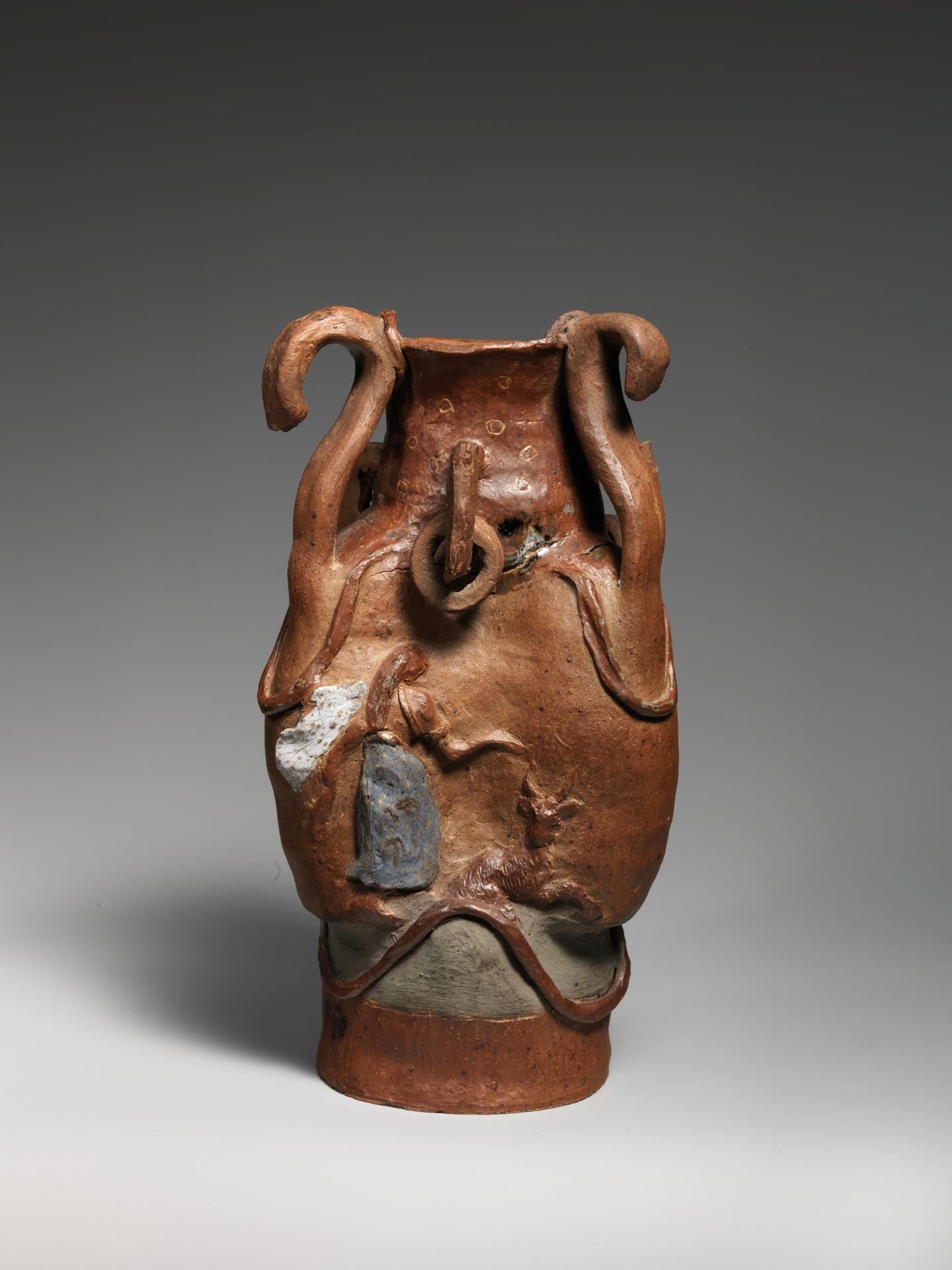
Two stylised women with children and, below them, two goats decorate the surface of this stoneware vase by Paul Gauguin, made around 1887–89. The irregularly shaped body, with its glazed, textured skin, makes the vessel a sculptural one-off.
Description
At the upper rim sit two large, crescent-shaped projections that recall horns or tentacles. The bulbous body rests on a flat, round base and is of irregular, organic form. Its surface appears rough and shows nuances of brown, reddish-brown and grey, likely from a glaze. On the side, two small, stylised female figures with children stand out, and below them two further figures that have been interpreted as goats. Lighter than the dark clay of the vase, they clearly contrast with the ground. The pictorial arrangement feels asymmetrical and lively.
Context
During his years in Brittany and on Martinique (1887–89), Gauguin engaged with indigenous cultures and simple ways of life. It was during this period that the vessel was made in the Paris ceramic workshop of Ernest Chaplet, with whom the artist had collaborated since 1886. The stylised female and animal forms testify to Gauguin's departure from realism and his turn towards symbolist and primitivist ideas.
Impact
The irregular, organic swelling and the contrasting tones give the vessel a dynamic, almost archaic presence. Through the crescent-shaped outgrowths it gains a sculptural force that sets it apart from ordinary vases.
Technique
Made of stoneware, the vessel carries a glazed surface with various brown tones and grey gradations. The irregular shape and the structured skin suggest a hand-formed work that was treated in a firing process with salt glaze or a similar technique.
AI-generated description text
Source: Metropolitan Museum of Art · Public Domain (CC0 1.0)