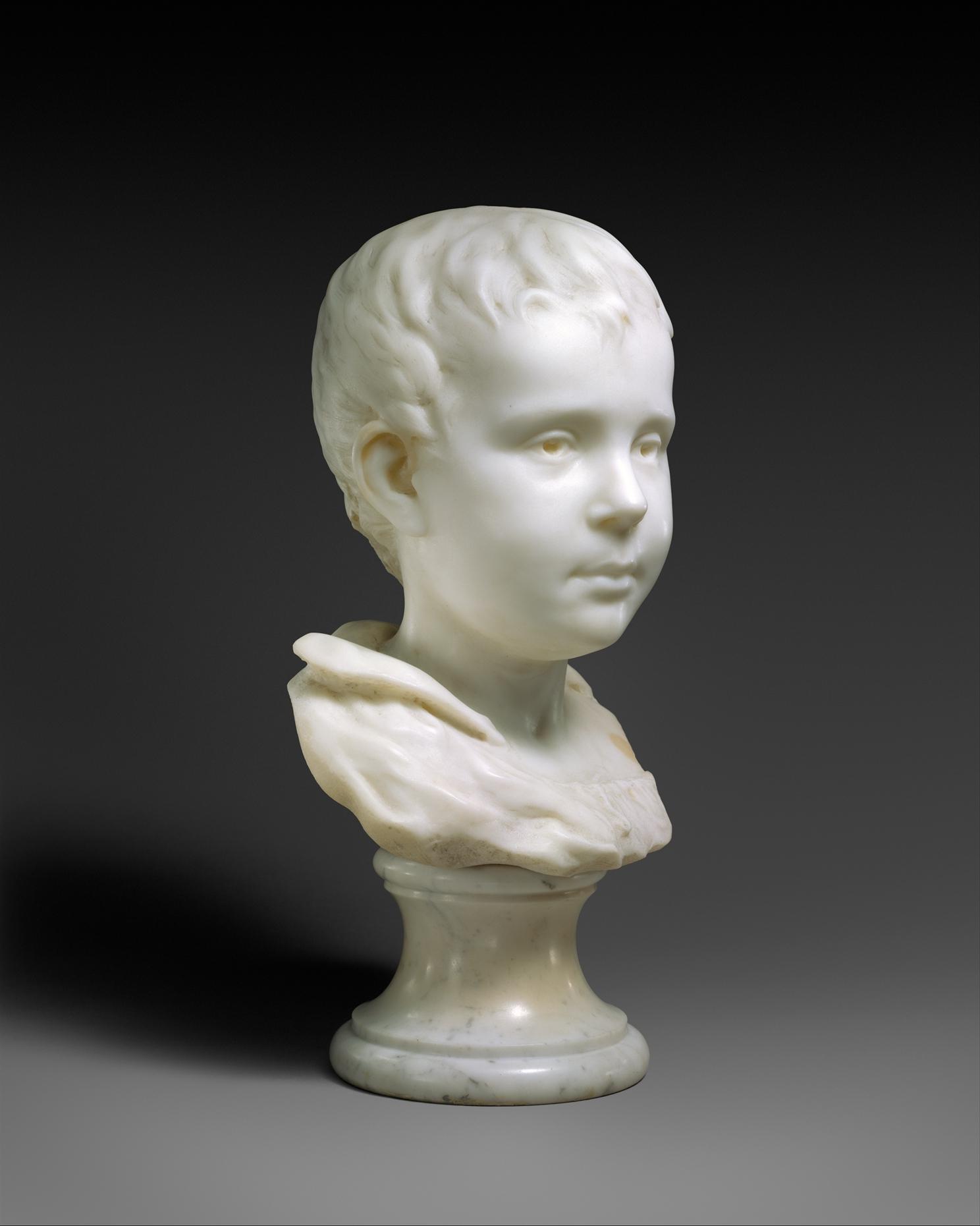
Emile Gauguin (1874–1955), the artist's son
Original title: Emile Gauguin (1874–1955), the artist's son
kurzbeschreibung
This marble bust of Paul Gauguin's son Emile was made around 1877–78, when the boy was still a child. It is one of the artist's early sculptural works. The boy appears with a serious, thoughtful expression and wears a collared shirt.
Description
The boy's head and upper torso are shown in profile. Short, slightly wavy hair frames his face, and the shirt has a collar. The features are carefully worked, conveying a serious, pensive look. Against the dark background, the uniformly white marble stands out clearly. The arrangement is clear and centered, with the face and shoulders drawing most of the attention.
Context
Gauguin made this bust during his early phase as a sculptor, before he devoted himself entirely to painting. The portrait of his firstborn son Emile dates from a time when the artist was living in Paris and experimenting with various techniques. The work reveals the influence of Impressionism and contemporary portrait sculpture on the young Gauguin.
Impact
The serious expression and precise modeling create a calm, intimate mood. The white marble surface gives the work a timeless, classical grace, while the lively rendering of the child lends it a modern touch.
Technique
Marble served as the material, valued for its hardness and fine workability. The high level of detail, especially in the hair and facial expression, points to careful craftsmanship. The uniform white color of the stone suggests a polished surface that reflects light.
AI-generated description text
Source: Metropolitan Museum of Art · Public Domain (CC0 1.0)