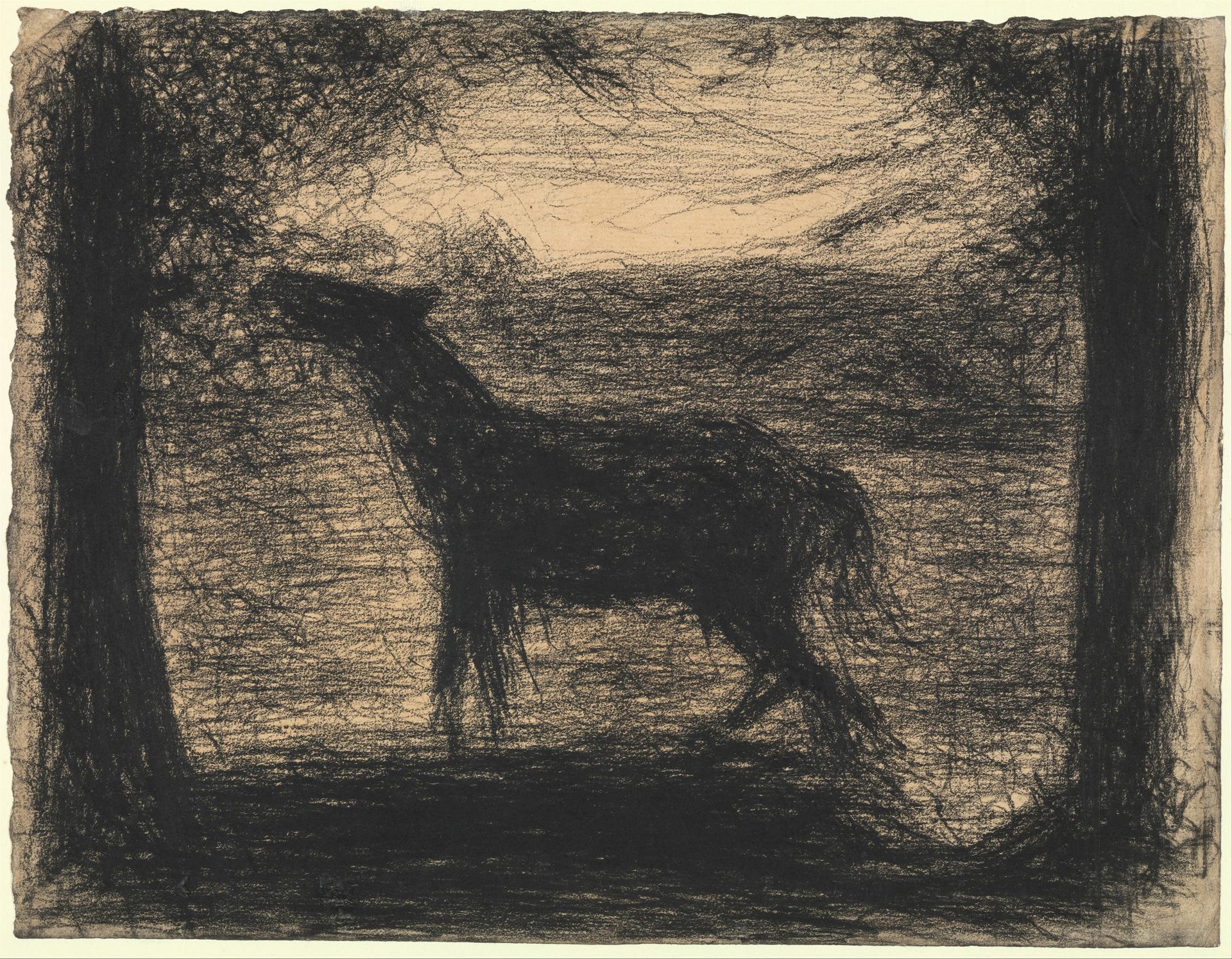
Foal (Le Poulain)
Original title: Foal (Le Poulain) [also called "The Colt"]
kurzbeschreibung
Georges Seurat drew a young horse in profile in 1882–83. This study in black Conté crayon on textured laid paper belongs to his works exploring light and form.
Description
The foal takes up nearly the entire sheet, positioned slightly off-center and facing left. Seurat uses dark, almost black strokes that stand out sharply against the lighter gray and beige ground. The lines are loose and fluid, giving the paper a natural texture. The predominantly dark, neutral tones evoke a serious, contemplative mood.
Context
In the early 1880s, Seurat devoted himself increasingly to the interplay of light and shadow, stimulated by contemporary discussions of Impressionism. This sheet was made in France, where horses were ubiquitous as work and leisure animals. It belongs to a group of Conté drawings from that decade, some intended as preparatory studies, others as independent exercises.
Impact
A calm, almost meditative quality emanates from the strong contrast between light and dark. The flowing lines lend the foal a quiet liveliness despite its static pose. The reduced, concentrated arrangement draws the eye to form and mood.
Technique
Black Conté crayon was applied to laid paper, a handmade support with visible texture. The crayon is laid down in loose, sometimes parallel strokes, with the paper's surface helping to shape the gray tones. Instead of flat hatching, Seurat uses fine tonal gradations, revealing his interest in nuanced values of lightness.
AI-generated description text
Source: Metropolitan Museum of Art · Public Domain (CC0 1.0)