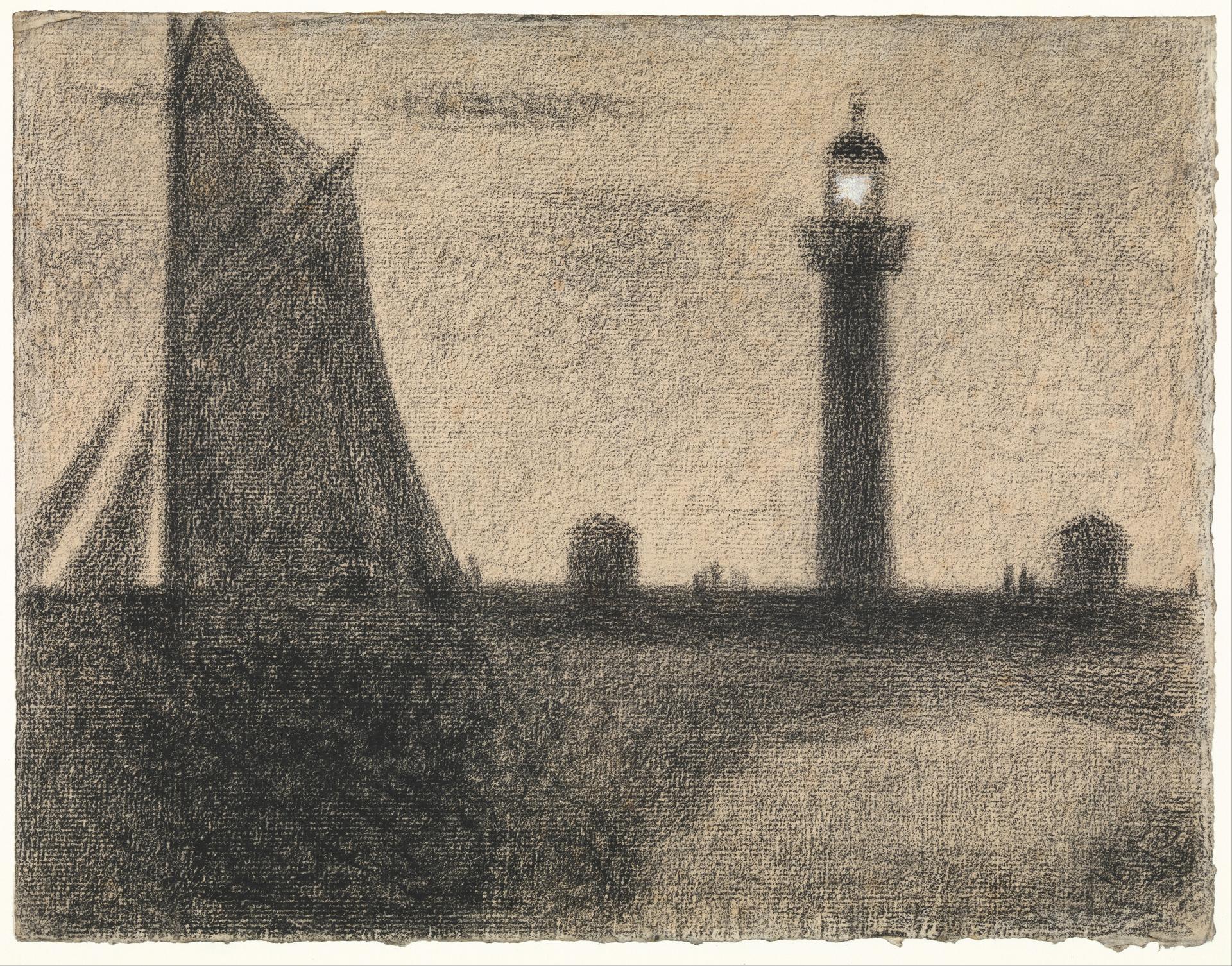
The Lighthouse at Honfleur
Original title: The Lighthouse at Honfleur
kurzbeschreibung
Georges Seurat's 1886 drawing "Der Leuchtturm von Honfleur" presents a harbour scene that stands apart from his other maritime studies by focusing on a single, striking lighthouse and a large sailing ship. The sheet is executed in Conté crayon with white gouache heightening on laid paper.
Description
A large sailing ship dominates the foreground, its sail area tilting slightly to the right. Behind it rises a cylindrical lighthouse with a brightly shining lantern, accompanied by two smaller buildings. Grey tones define the palette, with the light lighthouse creating a strong contrast to the darker ship. The rough texture of the paper remains visible through the crayon; sparingly applied white gouache accents emphasise the forms.
Context
This drawing was made during Seurat's stay in the summer of 1886 in Honfleur, a port town in Normandy. At the time, he was experimenting with Conté crayon on rough paper to explore tonal values and light effects, much as he did in his pointillist paintings. Honfleur was a popular destination for artists, and Seurat studied maritime and rural motifs there.
Impact
The strong light-dark contrast between the illuminated lighthouse and the dark ship gives the sheet a calm, atmospheric presence. The reduced colouration and clear layout make the view appear timeless and almost graphic. The texture of the paper and the fine crayon strokes create a lively surface that subtly reflects light.
Technique
For this work, Seurat used Conté crayon — a hard, greasy drawing medium — on laid paper with a rough surface to achieve rich tonal gradations. He applied gouache sparingly for bright accents, such as on the lighthouse lantern. The combination of crayon and gouache allowed him precise control over light and shadow without relying on lines.
AI-generated description text
Source: Metropolitan Museum of Art · Public Domain (CC0 1.0)