Landscape at Saint-Ouen
Original title: Landscape at Saint-Ouen
kurzbeschreibung
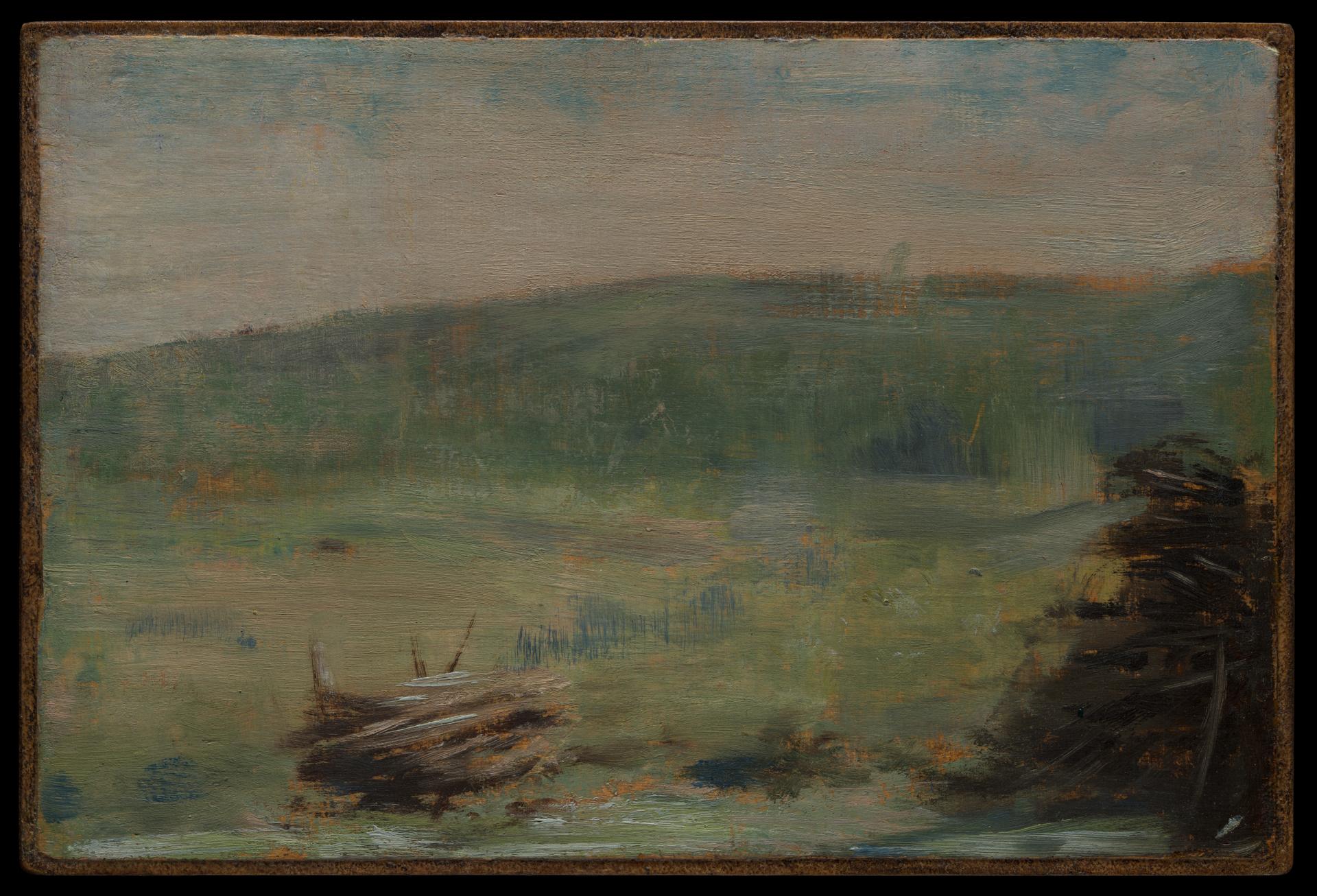
Georges Seurat painted Landschaft bei Saint-Ouen in 1878 or 1879. This quiet landscape, rendered in oil on wood, features a flat foreground scattered with wood debris, a wooded hill rising behind it, and a sky in shades of blue.
Description
Green and brown tones dominate the foreground, broken by dark brown shapes that recall fallen branches or wood remnants, some bearing light patches. Behind them, a densely vegetated hill ascends and blends softly into the sky. The sky shimmers in various blues, suggesting early morning or late afternoon. The light feels soft and diffuse, and the colors remain muted and natural. The layout is broad and emphasizes the expanse of the terrain.
Context
Seurat made this painting early in his career, before he developed Pointillism. Saint-Ouen, northwest of Paris, was a popular destination in the 1870s for artists seeking rural surroundings. The work dates from the time when Seurat was studying at the École des Beaux-Arts and engaging with traditional painting methods. It ranks among his earliest surviving landscapes.
Impact
The calm arrangement and soft light evoke a peaceful, contemplative mood. Horizontal lines and restrained colors create a silent breadth that draws the viewer into the landscape.
Technique
The artist used oil on wood, with the wood panel mounted on another wood support. Visible brushstrokes and a textured surface reveal a thick application typical of oil painting, giving the landscape a physical presence.
AI-generated description text
Source: Metropolitan Museum of Art · Public Domain (CC0 1.0)